


Chunghwa Telecom Co (中華電信) said yesterday it was in talks with Vodafone about joining its handset procurement program and extending cooperation in international roaming services.
Starting next month, the nation’s top telecom operator will provide a discount of about 30 percent to international roaming services for its mobile subscribers and those of Vodafone when they travel to 17 countries in Europe as well as Australia and New Zealand, the two firms announced in Taipei.
The pact makes Chunghwa Telecom Vodafone’s eighth partner in Asia. Vodafone is the world’s biggest mobile operator by revenue.
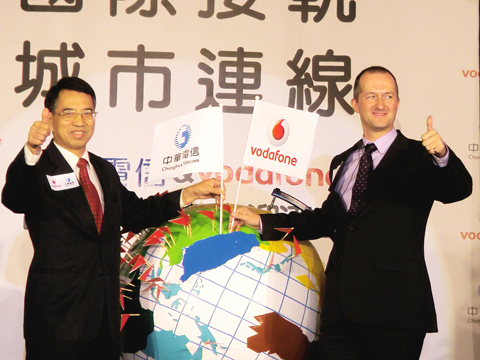
PHOTO: WANG YI-HUNG, TAIPEI TIMES
“International roaming is only a beginning of our cooperation with Vodaofne. We are looking for the opportunity of purchasing end user products [handsets], or network equipment to reduce cost,” Chunghwa Telecom chairman Lu Shyue-ching (呂學錦) told a media briefing.
“We hope this to be done as soon as possible,” Lu said.
Chunghwa Telecom has 9.2 million mobile users, a 35 percent share of the nation’s mobile market.
“There are a lot of good suppliers in Taiwan and perhaps we can introduce them to our partners,” Lu said in response to a Taipei Times’ question on whether HTC Corp (宏達電) would be on the short list because it is the world’s biggest maker of cellular phones running on Microsoft Corp’s system.
HTC has long been a major mobile phone supplier for both Chunghwa Telecom and Vodafone.
Chunghwa Telecom has set up a special task force, with members from both companies, to review the feasibility of it joining Vodafone’s global procurement program.
Richard Daly, Vodafone’s chief executive for global market cooperation, said that his company was able to bring its partners both buying power and the advantages of its buying operations, which would result in improving pricing and improving profitability.
Vodafone, which has 300 million subscribers, has strong bargaining power because of its huge scale and huge geographic footprint, he said.
He declined, however, to reveal the volume of its annual handset purchases and said there was no timetable for the two firms to deepen their cooperation.
Vodafone has no plan to invest in Chunghwa Telecom, as the company has changed its strategies of aggressive expansion overseas via equity investment, he said.
With the improving economy in Taiwan, Chunghwa Telecom said it planned to increase by about 11 percent its purchase of handsets from 1.8 million this year to 2 million next year.

SETBACK: Apple’s India iPhone push has been disrupted after Foxconn recalled hundreds of Chinese engineers, amid Beijing’s attempts to curb tech transfers Apple Inc assembly partner Hon Hai Precision Industry Co (鴻海精密), also known internationally as Foxconn Technology Group (富士康科技集團), has recalled about 300 Chinese engineers from a factory in India, the latest setback for the iPhone maker’s push to rapidly expand in the country. The extraction of Chinese workers from the factory of Yuzhan Technology (India) Private Ltd, a Hon Hai component unit, in southern Tamil Nadu state, is the second such move in a few months. The company has started flying in Taiwanese engineers to replace staff leaving, people familiar with the matter said, asking not to be named, as the
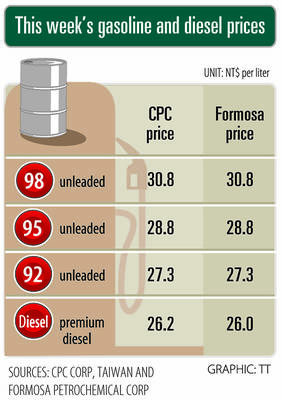
The prices of gasoline and diesel at domestic fuel stations are to rise NT$0.1 and NT$0.4 per liter this week respectively, after international crude oil prices rose last week, CPC Corp, Taiwan (台灣中油) and Formosa Petrochemical Corp (台塑石化) announced yesterday. Effective today, gasoline prices at CPC and Formosa stations are to rise to NT$27.3, NT$28.8 and NT$30.8 per liter for 92, 95 and 98-octane unleaded gasoline respectively, the companies said in separate statements. The price of premium diesel is to rise to NT$26.2 per liter at CPC stations and NT$26 at Formosa pumps, they said. The announcements came after international crude oil prices
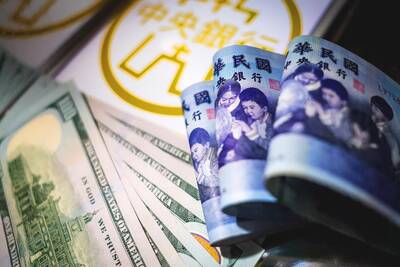
DOLLAR SIGNS: The central bank rejected claims that the NT dollar had appreciated 10 percentage points more than the yen or the won against the greenback The New Taiwan dollar yesterday fell for a sixth day to its weakest level in three months, driven by equity-related outflows and reactions to an economics official’s exchange rate remarks. The NT dollar slid NT$0.197, or 0.65 percent, to close at NT$30.505 per US dollar, central bank data showed. The local currency has depreciated 1.97 percent so far this month, ranking as the weakest performer among Asian currencies. Dealers attributed the retreat to foreign investors wiring capital gains and dividends abroad after taking profit in local shares. They also pointed to reports that Washington might consider taking equity stakes in chipmakers, including Taiwan Semiconductor
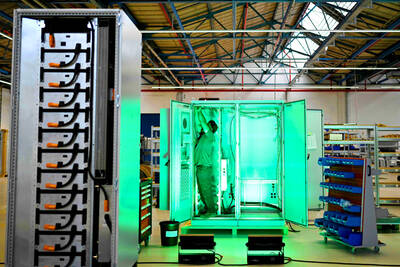
A German company is putting used electric vehicle batteries to new use by stacking them into fridge-size units that homes and businesses can use to store their excess solar and wind energy. This week, the company Voltfang — which means “catching volts” — opened its first industrial site in Aachen, Germany, near the Belgian and Dutch borders. With about 100 staff, Voltfang says it is the biggest facility of its kind in Europe in the budding sector of refurbishing lithium-ion batteries. Its CEO David Oudsandji hopes it would help Europe’s biggest economy ween itself off fossil fuels and increasingly rely on climate-friendly renewables. While


 RSS
RSS