


Amid rounds of applause, more than 300 representatives from Nan Shan Life Insurance Co’s (南山人壽) labor union yesterday left the negotiating table with smiles on their faces, confident that US parent American International Group (AIG) is committed to pension repayments and NT$14 billion (US$424 million) in provident funds before the unit’s sale at the end of this month — but an official avoided firm promises.
The repayment of pensions for Nan Shan’s 36,000 employees and sales agents is expected to cost financially troubled AIG between NT$10 billion and NT$15 billion.
However, Rick Bender, AIG’s executive vice president and chief operating officer for the Greater China and India region, looked confused and failed to give concrete promises after yesterday’s two-hour meeting, organized by Chinese Nationalist Party (KMT) Legislator Lo Shu-lei (羅淑蕾) and conducted mostly in Mandarin.
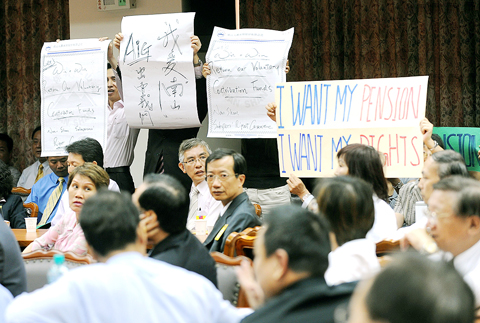
PHOTO: LIU HSIN-DE, TAIPEI TIMES
Reluctant to discuss details, Bender said repeatedly that “there is no certainty that a sale [of Nan Shan] will take place. And AIG is committed to the responsible treatment of all agents and employees.”
Bender also vowed to “protect the [local life insurer’s] provident fund” in the event of any change of ownership, concluding his address at yesterday’s meeting by saying: “I assure you … that you should expect no less.” He did not elaborate.
Also present at yesterday’s meeting was Huang Tien-mu (黃天牧), director-general of the Insurance Bureau under the Financial Supervisory Commission, who boosted the labor union’s position by affirming regulatory guidance.
He said that “no transfer of ownership will be finalized with [his bureau’s] regulatory approval unless all labor issues have been well addressed [by the seller] to allow [AIG] to exit the local market.”
Coaxed by Lo during the meeting, Nan Shan president and chief executive officer Frank Chan (陳潤霖) yesterday promised to fully relinquish the company’s management committee’s rights to operate the provident fund to representatives elected by the union within three days.
After taking over, the labor union will work toward redistributing the provident fund to employees and agents after seeking legal and accounting advice, union representative Chang Li-chiao (張麗皎) told yesterday’s meeting.
Chan, nevertheless, told reporters afterwards that based on due process he “has to seek final consent from AIG’s New York-based headquarters” on the fund’s management, even though he had given his word.
Another union representative, Chiu Fu-yung (邱富勇), yesterday presented a formula the union would use to settle the repayment of pensions. The calculation is based on the employee’s average monthly salary over the past three years and the number of years he or she has worked for the life insurer.
For example, if an agent has worked for 10 years with an average monthly salary of NT$50,000 over the past three years, he or she could receive a pension of NT$1.1 million.
Bender didn’t address the pension formula, but said: “There could be unforeseen circumstances or consequences to our action. We have to be careful.”
BIG BUCKS: Chairman Wei is expected to receive NT$34.12 million on a proposed NT$5 cash dividend plan, while the National Development Fund would get NT$8.27 billion Taiwan Semiconductor Manufacturing Co (TSMC, 台積電), the world’s largest contract chipmaker, yesterday announced that its board of directors approved US$15.25 billion in capital appropriations for long-term expansion to meet growing demand. The funds are to be used for installing advanced technology and packaging capacity, expanding mature and specialty technology, and constructing fabs with facility systems, TSMC said in a statement. The board also approved a proposal to distribute a NT$5 cash dividend per share, based on first-quarter earnings per share of NT$13.94, it said. That surpasses the NT$4.50 dividend for the fourth quarter of last year. TSMC has said that while it is eager
‘IMMENSE SWAY’: The top 50 companies, based on market cap, shape everything from technology to consumer trends, advisory firm Visual Capitalist said Taiwan Semiconductor Manufacturing Co (TSMC, 台積電) was ranked the 10th-most valuable company globally this year, market information advisory firm Visual Capitalist said. TSMC sat on a market cap of about US$915 billion as of Monday last week, making it the 10th-most valuable company in the world and No. 1 in Asia, the publisher said in its “50 Most Valuable Companies in the World” list. Visual Capitalist described TSMC as the world’s largest dedicated semiconductor foundry operator that rolls out chips for major tech names such as US consumer electronics brand Apple Inc, and artificial intelligence (AI) chip designers Nvidia Corp and Advanced
Saudi Arabian Oil Co (Aramco), the Saudi state-owned oil giant, yesterday posted first-quarter profits of US$26 billion, down 4.6 percent from the prior year as falling global oil prices undermine the kingdom’s multitrillion-dollar development plans. Aramco had revenues of US$108.1 billion over the quarter, the company reported in a filing on Riyadh’s Tadawul stock exchange. The company saw US$107.2 billion in revenues and profits of US$27.2 billion for the same period last year. Saudi Arabia has promised to invest US$600 billion in the US over the course of US President Donald Trump’s second term. Trump, who is set to touch
SKEPTICAL: An economist said it is possible US and Chinese officials would walk away from the meeting saying talks were productive, without reducing tariffs at all US President Donald Trump hailed a “total reset” in US-China trade relations, ahead of a second day of talks yesterday between top officials from Washington and Beijing aimed at de-escalating trade tensions sparked by his aggressive tariff rollout. In a Truth Social post early yesterday, Trump praised the “very good” discussions and deemed them “a total reset negotiated in a friendly, but constructive, manner.” The second day of closed-door meetings between US Secretary of the Treasury Scott Bessent, US Trade Representative Jamieson Greer and Chinese Vice Premier He Lifeng (何立峰) were due to restart yesterday morning, said a person familiar


 RSS
RSS