


Hong Kong billionaire Li Ka-shing (李嘉誠), who predicted China’s stock market bubble would burst in 2007, said the global economy would not recover this year and told investors to be “cautious” about buying shares, especially with borrowed money.
“The worst is over for the global economy,” Li, Asia’s second-richest man, said yesterday after his companies, Cheung Kong (Holdings) Ltd (長江實業) and Hutchison Whampoa Ltd (和記黃埔), posted better-than-estimated first-half earnings.
“Yet it’s too optimistic to say the global economy has reached a turning point. The degree of decline has shrunk but that doesn’t mean it has stopped shrinking,” he said.
Predictions from 81-year-old Li are closely watched in Hong Kong, where the media has dubbed him “Superman” for his investing acumen.
Home prices in the territory have risen 15 percent since March, when he told investors to buy real estate.
Li said investors should avoid margin trading or borrowing to buy stocks when prices are too high.
“I won’t buy stocks today,” Li said. “It’s not that I wouldn’t buy at all, but if the prices are too high, I will be very careful. For example, if the PE [price-earnings ratio] is low and the dividend yield is okay, and the stock isn’t overbought, I will buy.”
SHANGHAI LISTING
Li said he was considering listing his companies in Shanghai.
“Possible. Possible. But I will be more careful in this matter because I am representing a lot of shareholders,” Li said. “I will be more careful about the details, rules and requirements. But yes, if you ask me about listing in Shanghai, I am considering it.”
The benchmark Shanghai Composite Index has jumped 72 percent this year, compared with a 45 percent gain in the Hang Seng Index.
Hutchison, the world’s largest container port operator, has risen 50 percent in Hong Kong trading this year, even as China’s exports dropped 22 percent in the first seven months. Cheung Kong stock has fallen 33 percent in Hong Kong this year.
Cheung Kong, Hutchison’s largest shareholder and the world’s second-largest real estate developer by market value, said yesteday net income gained 4.7 percent to HK$11.5 billion (US$1.5 billion), almost double analysts’ estimates. Hutchison posted a 33 percent decline in first-half profit as the global recession curbed sales at mobile-phone and retail units and cut port traffic.
Global trade has shrunk and interest rates will not rise in the short term, Li said at a press conference after the results were announced. He said the worst was over for containerized shipping and the pace of the decline in Asia would slow.
“Globally, ports are steadier compared with 2008,” Li said. “They fell, but the degree of decline from now onwards won’t be as severe as in the past few months.”
That global scope hurt earnings at Hutchison, operator of container terminals in 49 ports, including Hong Kong; Felixstowe, U.K.; Buenos Aires; Freeport, Bahamas; Sohar, Oman; and Amsterdam. Falling oil prices eroded Hutchison’s energy earnings.
INCOME DROP
Hutchison’s net income dropped to HK$5.76 billion, or HK$1.35 a share, from a restated HK$8.6 billion, or HK$2.01, a year earlier, the company said in a statement to the Hong Kong stock exchange.
Continued losses at Hutchison’s 3 Group, its high-speed mobile-phone companies in markets including the UK and Italy, come in a year that Li plans for the unit to become profitable.
Cheung Kong benefited from a 22 percent increase in Hong Kong home prices and a tripling in the fair-value gain from its investment properties.
Canning Fok (霍建寧), managing director of Hutchison Whampoa, said 3G losses would narrow this year, declining to reiterate Li’s March forecast of breaking even.
“Given the economic situation, we are being more conservative,” Fok said.
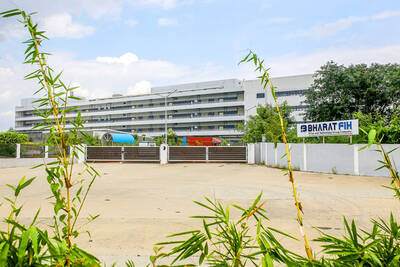
SETBACK: Apple’s India iPhone push has been disrupted after Foxconn recalled hundreds of Chinese engineers, amid Beijing’s attempts to curb tech transfers Apple Inc assembly partner Hon Hai Precision Industry Co (鴻海精密), also known internationally as Foxconn Technology Group (富士康科技集團), has recalled about 300 Chinese engineers from a factory in India, the latest setback for the iPhone maker’s push to rapidly expand in the country. The extraction of Chinese workers from the factory of Yuzhan Technology (India) Private Ltd, a Hon Hai component unit, in southern Tamil Nadu state, is the second such move in a few months. The company has started flying in Taiwanese engineers to replace staff leaving, people familiar with the matter said, asking not to be named, as the
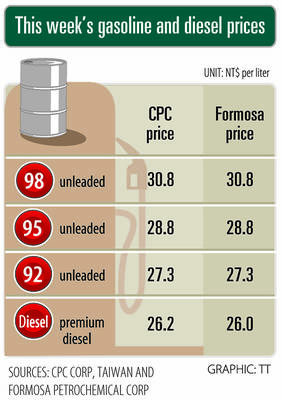
The prices of gasoline and diesel at domestic fuel stations are to rise NT$0.1 and NT$0.4 per liter this week respectively, after international crude oil prices rose last week, CPC Corp, Taiwan (台灣中油) and Formosa Petrochemical Corp (台塑石化) announced yesterday. Effective today, gasoline prices at CPC and Formosa stations are to rise to NT$27.3, NT$28.8 and NT$30.8 per liter for 92, 95 and 98-octane unleaded gasoline respectively, the companies said in separate statements. The price of premium diesel is to rise to NT$26.2 per liter at CPC stations and NT$26 at Formosa pumps, they said. The announcements came after international crude oil prices
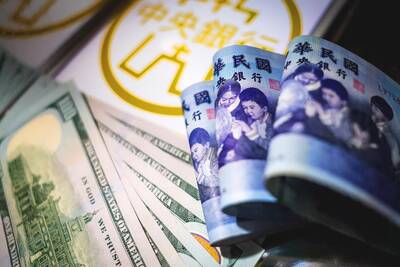
DOLLAR SIGNS: The central bank rejected claims that the NT dollar had appreciated 10 percentage points more than the yen or the won against the greenback The New Taiwan dollar yesterday fell for a sixth day to its weakest level in three months, driven by equity-related outflows and reactions to an economics official’s exchange rate remarks. The NT dollar slid NT$0.197, or 0.65 percent, to close at NT$30.505 per US dollar, central bank data showed. The local currency has depreciated 1.97 percent so far this month, ranking as the weakest performer among Asian currencies. Dealers attributed the retreat to foreign investors wiring capital gains and dividends abroad after taking profit in local shares. They also pointed to reports that Washington might consider taking equity stakes in chipmakers, including Taiwan Semiconductor
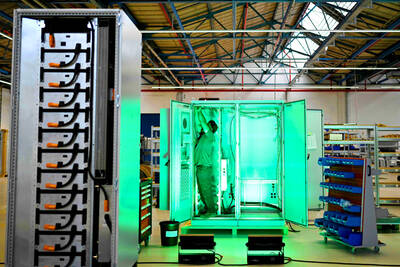
A German company is putting used electric vehicle batteries to new use by stacking them into fridge-size units that homes and businesses can use to store their excess solar and wind energy. This week, the company Voltfang — which means “catching volts” — opened its first industrial site in Aachen, Germany, near the Belgian and Dutch borders. With about 100 staff, Voltfang says it is the biggest facility of its kind in Europe in the budding sector of refurbishing lithium-ion batteries. Its CEO David Oudsandji hopes it would help Europe’s biggest economy ween itself off fossil fuels and increasingly rely on climate-friendly renewables. While


 RSS
RSS