


Since early this month, stock prices for the nation’s major electronics manufacturers have jumped significantly as a growing number of local companies received rush orders from vendors amid a prolonged economic slump, with investors seeing the unusual demand as a possible precursor of recovery.
Rises in shares of component makers can shed some light on the rush order effect after the Lunar New Year, because companies that produce semiconductors and flat panels, for instance, are more sensitive to the industry’s ups and downs than downstream PC makers or mobile handset manufacturers in the downstream electronics supply chain.
Shares of the nation’s biggest liquid-crystal-display (LCD) panel maker AU Optronics Corp (友達光電) and Taiwan Semiconductor Manufacturing Co (TSMC, 台積電), the world’s top contract chipmaker, have leaped 16.73 percent and 10 percent to NT$27.2 and NT$45.95, respectively, since Feb. 2 when the stock market resumed trading after Lunar New Year holiday.
The increases were bigger than a rise of 7.8 percent on the benchmark TAIEX index over the same period, data from the Taiwan Stock Exchange showed.
“I will take rush orders as a positive message to the LCD panel industry, which is the first positive sign over the past six to nine months,” said Jeff Pu (蒲得宇), who tracks the flat-panel industry for Yuanta Securities (元大證券).
New demand in the form of rush orders — ad hoc orders that were not forecast — meant that panel makers have successfully eased oversupply through drastic cuts in production in the past quarter and have stimulated inventory buildup in the slow first quarter, Pu said.
Companies traditionally see declines in shipments during the first quarter following the Lunar New Year holiday shopping season. But AU Optronics vice president Paul Peng (彭雙浪) told an investors conference on Jan. 22 that rush demand primarily from its Chinese customers could help partially cushion the falling shipments this quarter.
AU Optronics expects its TV and PC panel shipment to fall by 15 percent to 20 percent quarter-on-quarter in the first quarter, better than the 27 percent quarterly decline last quarter, Peng said.
Last week, the nation’s second-largest flat-panel maker, Chi Mei Optoelectronics Corp (奇美電子), posted record losses of NT$31.41 billion (US$922.6 million) in the fourth quarter after booking large impairment losses, or inventory revaluation losses, after prices collapsed.
Still, Chi Mei president Ho Jau-yang (何昭陽) described the recent rebound in orders as “a ray of hope glimmering in deep darkness.”
The company expects the orders to boost shipments of PC and TV LCD panels by between 5 percent and 10 percent this quarter from 11 million last quarter, Ho told investors on Thursday.
Starting late last month, TSMC reportedly received more handset chip orders from MediaTek Inc (聯發科) and Qualcomm Inc, which prompted the company to call back some of its employees from unpaid leave, the Chinese-language Commercial Times reported on Jan. 11, without specifying its sources.
For TSMC and rival United Microelectronics Corp (UMC, 聯電) the current economic environment makes it difficult to make long-term forecasts.
The two companies therefore hope the recent rush in orders could herald a solid recovery later, making the first quarter the worst period for the chip industry.
TSMC’s fourth-quarter profit plunged 64 percent to NT$12.45 billion from NT$34.48 billion a year earlier, while UMC posted record quarterly losses of NT$23.51 billion in the fourth quarter.
But, there were warning signs that a slight recovery in stock replenishment demand may not be strong enough to support the companies’ expectations of a near-term revival, while such unconventional booking seen recently could turn out to be a burden to inventory management if end demand fails to pick up later this year.
“The rate of the recovery and the sustainability of some spot upticks we have seen in the supply chain are still in question, and end-demand dependent, which is suspect at best,” said Randy Abrams, a semiconductor analyst with Credit Suisse, said in a report dated Tuesday.
Local notebook computer maker Pegatron Corp (和碩), a spinoff PC manufacturing unit of EeePC maker Asustek Computer Inc (華碩), said it could be a challenge for most electronics assemblers to cope with rush orders as they must have great flexibility in component stock and labor force management, the Commercial Times reported on Friday, citing the company’s spokesperson Denese Yao (姚德慈).
Being realistic this time, Taiwanese electronic companies remain focused on cost-saving measures as they become more cautious about the recent order pickup. Chi Mei, for instance, plans to launch a structural adjustment to enhance operation efficiency and profitability, rather than capacity expansion and market share gain. The new plan is set to take effect on March 1.
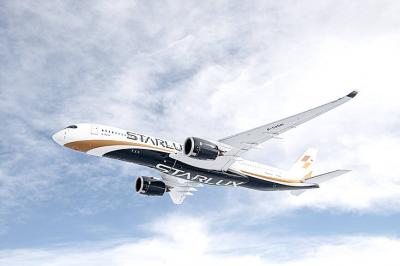
Starlux Airlines Co (星宇航空) today unveiled a long-haul network expansion plan at a shareholders’ meeting in Taipei, including direct flights to Barcelona, Spain, and Zurich, Switzerland, as well as a service connecting Taipei, Sydney and New Zealand. Starlux is to become the first Taiwanese carrier to offer non-stop services to the two European cities, while the inaugural oceanic route is expected to expand transit opportunities within the Australia-New Zealand market, Starlux said. Flight services to Chicago, Dallas, Washington and New York are under evaluation, the airline added. Prior to the shareholders’ meeting, the airline earlier this year announced that it would be

Cairo’s new monorail slices across the city skyline, running above the familiar chaos of blaring horns and aging buses’ exhaust fumes that mark rush hour below. The US$4.5 billion monorail, opened this month, is among Egypt’s most prominent new transport projects, part of a debt-funded infrastructure drive criticized for sapping state finances while bringing limited benefits to most of the country’s 109 million people. “It feels like you’re in a different country,” said Ramy Sayed, a restaurant manager, aboard a driverless Innovia 300 train. “No noise, no traffic, we’re not used to this.” The eastern line runs 56km from the bustling middle-class

Netherlands-based semiconductor equipment supplier ASML Holding NV yesterday said that it is planning to hire an additional 1,000 people in Taiwan this year in response to growing demand from clients. ASML had previously planned to recruit 600 people this year, but that the plan has been adjusted upward, ASML vice president and ASML Taiwan general manager Grace Wang (汪佳慧) told reporters. ASML has a workforce of more than 4,500 in Taiwan, accounting for about 10 percent of its global total, Wang said. This year’s recruitment campaign would focus on adding people in the customer support, manufacturing and supply chain domains to assist ASML

Nvidia Corp yesterday announced that CEO Jensen Huang (黃仁勳) would attend an employee meeting in Taipei tomorrow to celebrate the launch of the company’s Taiwan headquarters project. Huang would attend a gathering at the site of Nvidia’s planned headquarters in Beitou Shilin Technology Park (北投士林科技園區), the company said in a statement. After arriving in Taiwan on Saturday last week, Huang told reporters that he plans to meet with Quanta Computer Inc (廣達) chairman Barry Lam (林百里) and Taiwan Semiconductor Manufacturing Co (TSMC, 台積電) chairman C.C. Wei (魏哲家), and would attend the groundbreaking ceremony for Nvidia’s Taiwan headquarters tomorrow. Nvidia has not yet applied


 RSS
RSS