

Companies interested in moving their offices into the world's tallest building, the Taipei 101 Tower, will pay over NT$2,000 per ping in rent, and risk paying more if they do not act quickly, according to the skyscraper's owner, Taipei Financial Center Corp (
"[Tenants] will need to pay a rent of no less than ... NT$2,000 [per ping]," the company's president, Lin Hong-ming (
Lin made the remarks while dismissing speculation that the company had dropped rents to around NT$1,600 per ping from the set premium rate of NT$3,200 when it signed a 15-year lease with the Taiwan Stock Exchange Corp last month.
The Taiwan Stock Exchange, which is one of the Taipei Financial Center's shareholders, will pay more than NT$2,000 per ping, and will be the only company to enjoy such low rates as the Taipei Financial Center plans to charge more in the future, Lin said.
"Early birds can enjoy preferential treatment, as rates will gradually increase by 10 percent to 15 percent this year," he said.
The Taipei Financial Center said it will rent out over 30 percent of the building's 54,000 ping office space and expects to see the occupancy rate reach between 60 percent and 70 percent by the year's end, and 95 percent before the end of next year.
The skyscraper's lobby will be opened to the public on April 1 and its first tenant, Bayer Taiwan, will move into the 53rd and 54th floors in the middle of next month, Taipei Financial Center said.
Lin shied away from commenting on lower-than-expected interest in moving into the building expressed by other shareholders, such as the China Development Industrial Bank (
Taipei 101 plans to start leasing office space above the 60th floor in the second half of this year.
The company expects rents to be 20 percent higher than the average rate of NT$2,306 per ping for the Xinyi District in the fourth quarter of last year, the company's assistant vice president Cathy Yang (楊文琪) said.
Looking ahead, "Taipei's office building market looks promising," said Calvin Wang (王治平), managing director of Jones Lang LaSalle International Property Consultants, which is also Taipei 101's leading leasing agent.
Rents are expected to rise by 10 percent on average this year, driven by higher occupancy rates, Wang said.
The industry veteran predicted that the vacancy rate will slide to 7.5 percent in the first quarter from 7.9 percent last quarter, with rents to rise to between NT$2,300 and NT$2,400 per ping from NT$2,172.

Taiwan Semiconductor Manufacturing Co (TSMC, 台積電) yesterday dismissed concerns about a deeper correction of the artificial intelligence (AI) market, saying that soaring global demand AI applications continues to outstrip its supply of advanced chips. The world’s largest contract chipmaker said in a statement that it continues to observe challenges facing the consumer and price-sensitive end-market segments posed by rising component prices and economic uncertainties, TSMC chairman and chief executive officer C.C. Wei’s (魏哲家) remarks during an earnings conference on Oct. 15. “Global demand for AI continues to grow, with its long-term outlook remaining upbeat,” TSMC said in the statement. “Demand
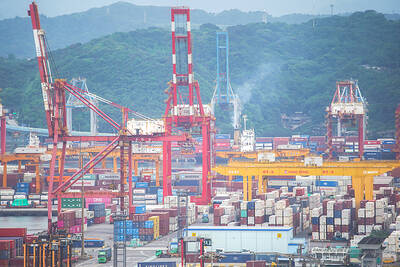
BOOM DRIVEN: The third-quarter current account surplus was the second-highest on record, well up from last year, and lagging only behind last year’s fourth quarter Taiwan’s current account surplus in the third quarter of this year reached its second-highest level on record, as exports hit new highs on the back of robust global demand for artificial intelligence (AI)-related applications, the central bank said on Friday. The surplus rose by US$22.04 billion from a year earlier to US$68.79 billion in the third quarter, second only to the US$69.69 billion recorded in the fourth quarter of last year, the bank said. The current account mainly measures a country’s transactions in goods and services, as well as primary and secondary income flows with the rest of the world. Taiwan’s merchandise trade
CHINA LEANING? The US has greenlit the sale of less-than-cutting-edge Nvidia chips to China, amidst national security and technology control concerns US Secretary of the Treasury Scott Bessent said on Friday that no more restrictions on the sale of older Nvidia Corp chips to China were needed following US President Donald Trump administration’s move earlier last week to block China’s remote access to the latest semiconductors. The ability of Chinese tech firms to access Nvidia’s technology came under scrutiny after CEO Jensen Huang (黃仁勳) stepped down amid allegations of his affair with an executive at Megaspeed International Pte Ltd, a Singapore-based company that uses advanced chips to generate computing power that Chinese firms access remotely. “The proper chip restrictions are in place,” Bessent

China’s Z.AI Co (智譜) has fallen behind schedule on its next flagship artificial intelligence (AI) model, while rival Moonshot AI Technology Co (月之暗面) expects the interval between major releases could double from six months to a year or longer if it loses access to overseas computing power, people familiar with the matter said. The previously unreported details show how efforts by US AI companies OpenAI and Anthropic PBC to prevent distillation, a technique in which developers train models using answers generated by more capable ones, have slowed Chinese AI development. Washington’s latest chip restrictions threaten further delays. The measures jeopardize a key


 RSS