


A consumer advocacy group yesterday urged the public to be wary of unsolicited short messages on cellphones, as returning these calls may result in high phone charges.
"Over last few months an increasing number of consumers complained that they have received fraudulent ads or sexually explicit messages on their cellphones," said Cheng Jen-hung (

PHOTO: REUTERS
Chen said that the messages were an invasion of privacy.
According to Chen, a popular message says, "Hi, I am your old friend, long time no see ... you can reach me via the phone number."
Another scam specifically targets males.
"Ever since my boyfriend and I broke up, I've lost the happy feeling of making love with someone. A one-night stand won't cost you anything ... please call me."
But a return call to the attached phone number will transfer the caller to an overseas line, costing up to several thousand NT dollars.
"Mobile phones are very convenient communications devices, but they can also be very dangerous when criminal groups make use of them," he said.
Short-messaging services (SMS) are major gateways that allow companies and individuals to send messages from a computer or cellphone to other cellphones.
According to the Directorate General of Telecommunications, Taiwan's mobile-penetration rate is over 100 percent, surpassing Luxembourg to rank as the world's highest.
A National Police Administration official said the spread of unwanted messages is "rampant."
"It's overwhelming ... over the last two months we received over a thousand complaints regarding spam messages," the administration's section chief, Huang Wan-fa (
Police have disconnected nearly 900 suspect phone lines between December and January in an effort to stem the flow of unwanted calls, he said. Huang said not to dial unrecognized "missed calls," and specifically advised against calling numbers with the 0941 or 0951 prefix. Calls to these numbers will result in an NT$500 charge per call.
The Consumers' Foundation also urged the public to protect personal-contact information and to be alert when receiving short messages from unfamiliar sources.
"Consumers should notify mobile-service operators or the police to investigate when their's a problem," Chen said.
But Huang said that keeping one's cellphone number secure is no assurance against unwanted calls or messages.
"Crime organizations send out messages randomly to a large amount of numbers," Huang said.
Mobile-service operators should also make better efforts to block spam, he said.
"A party trying to send out short messages has to go through an operators' mobile network," Huang said. "Mobile-service operators should actively block these kinds of transmissions."
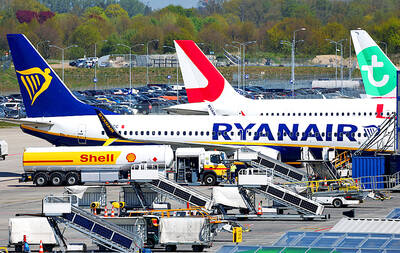
Ryanair, Transavia, Volotea and other low-cost airlines are feeling the financial pain from high jet fuel prices as a result of the Middle East war and are cutting flights. The closure of the Strait of Hormuz has taken a huge chunk of oil supplies off the market, sending the price of jet fuel soaring and triggering fears of shortages that could force airlines to cancel flights. Airlines are not waiting for a lack of supplies to react. “Travel alert: Airlines are cutting thousands of flights right now,” Travel Therapy host Karen Schaler said in an Instagram reel this past weekend.

MANAGING RISKS: Taiwan has secured LNG sufficient to cover 95 percent of electricity demand for next month, UBS said, describing the government’s approach as proactive UBS Group AG has raised its forecast for Taiwan’s economic growth this year to 8 percent, up from 6.9 percent previously, and said expansion could reach as high as 8.6 percent if external energy shocks are avoided. The upgrade reflects a stronger-than-expected first-quarter performance and sustained momentum in artificial intelligence (AI)-driven exports, which UBS said are providing a firm foundation for growth despite geopolitical and energy risks. Taiwan’s GDP expanded 13.69 percent year-on-year in the first quarter, the fastest growth since the second quarter of 1987, the Directorate-General of Budget, Accounting and Statistics (DGBAS) reported on Thursday. On a seasonally
The Fair Trade Commission’s (FTC) ongoing review of Grab Holdings Ltd’s US$600 million acquisition of Foodpanda Taiwan’s operations, announced on March 23, has taken on fresh urgency as industry experts warn that the transaction could embed significant Chinese cybersecurity vulnerabilities into Taiwan’s digital infrastructure through Grab’s deep ties to autonomous-driving firm WeRide (文遠知行). Less than 16 months after the FTC blocked Uber Eats’ direct attempt to acquire Foodpanda Taiwan — citing potential combined market shares of 80 to 90 percent — the emergence of Grab as the buyer has prompted questions about whether the same competitive harm is simply being rerouted

The list of Asian stocks that benefit from business partnership with Nvidia Corp is getting longer, as the region further integrates into the artificial intelligence (AI) chip giant’s business ecosystem. Just in the past week, South Korea’s LG Electronics Inc, Taiwan’s Nanya Technology Corp (南亞科技), as well as China’s Huizhou Desay SV Automotive Co (德賽西威) and Pateo Connect Technology Shanghai Corp (博泰車聯) have become the latest to rally on news of tie-ups, supply-chain participation or product collaboration with the US chip designer. Asian suppliers account for about 90 percent of Nvidia’s production costs, up from about 65 percent last year, data compiled


 RSS
RSS