


Thousands of Chinese prostitutes line the streets of Tibet's capital, mostly catering to a non-stop influx of Chinese construction crews, soldiers, drivers and service workers.
These bubble-gum blowing ladies who spit in the street through too much makeup, and their sometimes suited mates, are apt to be from neighboring, overcrowded Szechuan province.
They arrange trysts in tiny barber shops, dim cafes, sing-along Karaoke bars, upstairs massage parlors and concrete rooms which offer little more than curtained-off beds.
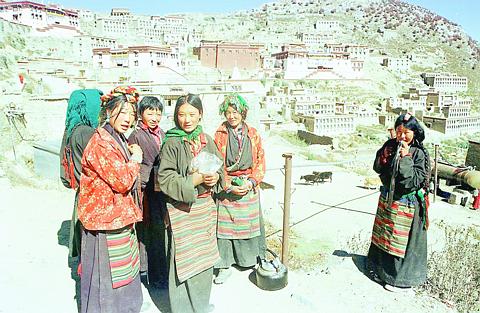
PHOTO: NY TIMES NEWS SERVICE
Though illegal, virtually every main street in Lhasa offers Chinese women for rent. Mini-skirted Chinese females with mischievous lipsticked grins also compete for men in the bleak, dusty streets of Tibet's second-largest city, Xigatse -- also known as Shigatse -- and in smaller Gyantse town.
They are just some of the millions of Chinese who have already migrated to Tibet looking for a fast buck and a new place to call home.
The racial competition between mostly impoverished, indigenous Tibetans and business-savvy migrant Chinese is now sharper than ever. Tibetan culture is also struggling against these odds, merely to survive.
As a result, many Tibetans are openly anti-Chinese, and eagerly cheered the US missile attack against China's embassy last May, which killed three Chinese in Yugoslavia.
A Tibetan Buddhist maroon-robed monk with shaven head -- eating "tsampa" barley powder mixed with water alongside other monks in Drepung monastery -- reacted to the bombardment with a chuckle and said, "Bombing Chinese Embassy good, good. Sometimes you have to stop China."
And a Tibetan travel agent explained, "We were happy, very happy, when we heard the news. Why? Because the way Chinese treat us. It is like Tibet is Kosovo, in Yugoslavia.
"When those Chinese journalists were killed, then Chinese news is full of that story over and over again. But the Chinese don't care when Chinese kill Tibetans. So many Tibetans died "during the past 40 years.
"I don't hate the Chinese here," he said, pointing at a Lhasa street where pedestrian traffic was a mixture of Tibetans and Chinese. "I hate the Chinese government."
Across town, a cluster of Tibetan Buddhist nuns grinned when one sister responded to news of the bombardment by exclaiming, "America good. Dalai Lama good. China no good."
Another nun held up her fist and said, "We are not afraid of the Chinese. We will fight them if we need to."
But today, 40 years after a bloody, failed, anti-Chinese uprising and decades of communism which reportedly left more than one million Tibetans dead, the suppressed Tibetans are heavily outclassed and outgunned by Chinese.
Amid the racial rivalry, money has become one of the biggest obsessions in Tibet, with people on all sides trying to cash in on whatever icons or markets are available.
So far, the Chinese are scarfing up most of the profits, but some Tibetans are making up for lost time.
Coveted Chinese currency notes are visible everywhere: stuck to glass shrines in Tibetan Buddhist temples, waved in the fists of aggressive panhandling monks, and piled up in front of destitute men, women and children who squat near open sewers in Lhasa's Tibetan ghetto.
Money is also fueling Tibet's tourist boom. Tibetans hoping to upgrade, or cash in, are busily rebuilding monasteries wrecked by Chinese, hammering out religious souvenirs, or staffing hotels, restaurants and trekking services.
The rush for cash has created a cultural renaissance, albeit modest, in Lhasa's maze-like neighborhoods, and to a lesser extent also amid the reconstruction at Tibetan monasteries and historic places in Gyantse and Xigatse.
Drepung Monastery on Lhasa's outskirts, meanwhile, has been extensively rebuilt in the past 15 years, wired with electricity, and now claims 600 monks -- still far less than the 7,000 monks who lived in the monastery's fortress-village before China's disastrous Cultural Revolution of 1965 to 1975. But 15 years ago, only a trickle of surviving monks lived in Drepung.
Singing volunteers, and construction workers who said they receive about US$1 a day, now sledgehammer rocks and repair roofs at various monasteries and other old buildings. Mindful of the money to be made, big monasteries have erected signs pointing busloads of tourists to entrance ticket windows. Another indication of the small cultural renaissance is the swelling numbers of monks.
Thousands of Tibetan monks now dwell in monasteries scattered throughout the region. Hundreds more monks plod or sit on Lhasa's filthy, rough-hewn, gray stone streets -- chanting ancient scripture or blatantly demanding cash.
"Money, money, money," robed monks and other beggars insist, while holding up fists of currency notes. "Koochie, koochie, koochie," others ask in Tibetan, describing a little charitable gift. Other monks prefer to attract cash by camping in the street and blowing a human thigh bone horn, twirling a two-sided drum, or performing other spiritual rituals. "Some of the monks you see begging are not real monks, because real monks will never beg like that, and there are some people who just put on robes and pretend, but at night they have a girl or gamble," one Tibetan said.
He said he stopped being a monk after five years because his monastery's senior lama beat novices with a stick during scripture examinations. Tibetan Buddhist monasteries often mete out such child abuse. During the Dalai Lama's time before he fled Tibet in 1959, head lamas in his Potala Palace beat errant monks for gambling or other naughty behavior. Today, many young monks display half-inch-sized, scabbed bruises on their foreheads.
When asked about a few vertical scabs on a Drepung Monastery monk's forehead, the robed young man nervously touched the gashes and replied sadly, "My teacher."
In some ways, Tibet's monasteries have traditionally been boarding schools where sons are sent whether or not they want to be clergymen. These days, many drop out because of the beatings, austere existence or harassment by Chinese police.
"I quit the monastery also because the Chinese were coming around asking the monks to say bad things about the Dalai Lama," the former monk said.
"Most monks would rather go to jail than say bad things about the Dalai Lama. Now there are many monks because Tibetans are very religious people, and when Tibetans pray, they offer food or money. When I was a monk, we had everything we needed.
"But now the Chinese don't let young children to be monks. The Chinese say the children must go to school first and learn things. Only later can they be a monk. That is a good idea, but the Chinese actually just say that, so the Chinese can teach the children about Chinese politics and other things. So it is like a trick."
The Dalai Lama insists Chinese are intentionally engaged in "cultural genocide" by overpopulating Tibet's capital and plateau towns. Census figures are impossible to find, but Lhasa is estimated to now house 200,000 people, 70 percent of them Chinese. Tibetans still form a majority of people living in the inhospitable countryside.
But in April, the Washington DC-based International Campaign for Tibet issued "an emergency alert" about "Tibetans attempting to escape to freedom."
"Survivors tell chilling stories of terrifying interrogations, beatings, starvation, threats at gunpoint, gang rape, and other torture," allegedly committed by Chinese security forces, which prompt the escape of 3,000 Tibetans a year, mostly south across the border to Nepal and then to India.
As a sign of Tibet's slow trickle-down economics, however, many monks who belong to big monasteries in and around Lhasa now sport new woollen robes and leather shoes. They also frequently display a carefree casualness, whether joking among themselves or with an occasional foreign visitor. For example, a pair of young monks played with squirt guns on the flat roof of Lhasa's central, fabled Jokhang Temple. Three at the Drepung Monastery teased each other, sometimes painfully, with a battery-powered shaver.
But virtually all begging street urchins, maimed men, mothers suckling infants and other ragged destitutes are Tibetan, not Chinese.
The clawing economic desperation reflects the financial nightmare of countless people eking out an existence in the dual harsh environment of Tibet's rock-pile desert landscape, and one-party political regime. But Lhasa's essentially segregated Tibetan ghetto has actually expanded to become a few square miles of heavy stone-walled homes, shops and businesses, zig-zagged by stone streets.
One Tibetan woman, who tried to ignore a few Tibetan men urinating on a nearby wall, said, "There are more Tibetans now in Lhasa, and the Tibetan area is bigger, but there are more problems now.
"Difficult to find jobs. If there are any good jobs, and a Tibetan applies, the Chinese will say, `No. It's filled.' But when the Chinese apply, the Chinese employers will say, `Yes, come on.' And now there is more crime, more stealing and cheating, both by Tibetans and Chinese.
"I think it is because the economic situation is difficult, especially for Tibetans. But the Chinese like it here, because they can earn a lot of money doing business and other things.
"Many Chinese arrive by bus with only a sleeping bag and a cup, but after some years, they leave by airplane with many things and much money."
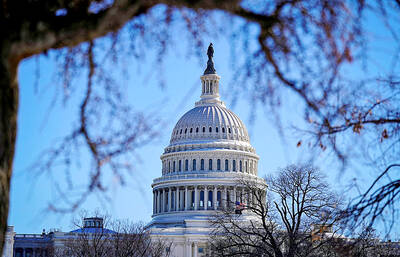
RESTRAINTS: Should China’s actions pose any threat to Taiwan’s security, economic or social systems, China would be excluded from major financial institutions, the bill says The US House of Representatives on Monday passed the PROTECT Taiwan Act, which states that Washington would exclude China from participating in major global financial organizations if its actions directly threaten Taiwan’s security. The bill, proposed by Republican Representative Frank Lucas, passed with 395 votes in favor and two against. It stipulates that if China’s actions pose any threat to Taiwan’s security, economic or social systems, the US would, “to the maximum extent practicable,” exclude Beijing from international financial institutions, including the G20, the Bank for International Settlements and the Financial Stability Board. The bill makes it clear that China must be prepared

PEACE AT LAST? UN experts had warned of threats and attacks ahead of the voting, but after a turbulent period, Bangladesh has seemingly reacted to the result with calm The Bangladesh Nationalist Party (BNP) yesterday celebrated a landslide victory in the first elections held since a deadly 2024 uprising, with party leader Tarique Rahman to become prime minister. Bangladesh Election Commission figures showed that the BNP alliance had won 212 seats, compared with 77 for the Islamist-led Jamaat-e-Islami alliance. The US embassy congratulated Rahman and the BNP for a “historic victory,” while India praised Rahman’s “decisive win” in a significant step after recent rocky relations with Bangladesh. China and Pakistan, which grew closer to Bangladesh since the uprising and the souring of ties with India, where ousted Bangladeshi prime minister Sheikh Hasina

Taiwanese trade negotiators told Washington that Taipei would not relocate 40 percent of its semiconductor production to the US, and that its most advanced technologies would remain in the nation, Vice Premier Cheng Li-chiun (鄭麗君) said on Sunday. “I told the US side very clearly — that’s impossible,” Cheng, who led the negotiation team, said in an interview that aired on Sunday night on Chinese Television System. Cheng was referring to remarks last month by US Secretary of Commerce Howard Lutnick, in which he said his goal was to bring 40 percent of Taiwan’s chip supply chain to the US Taiwan’s almost
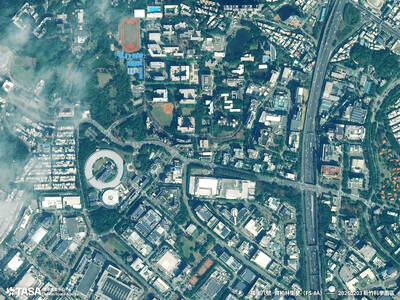
The Taiwan Space Agency (TASA) yesterday released the first images from its Formosat-8A satellite, featuring high-resolution views of Hsinchu Science Park (新竹科學園區), Tainan’s Anping District (安平), Kaohsiung’s Singda Harbor (興達港), Japan’s National Stadium in Tokyo and Barcelona airport. Formosat-8A, named the “Chi Po-lin Satellite” after the late Taiwanese documentary filmmaker Chi Po-lin (齊柏林), was launched on Nov. 29 last year. It is designed to capture images at a 1m resolution, which can be sharpened to 0.7m after processing, surpassing the capabilities of its predecessor, Formosat-5, the agency said. It is the first of TASA’s eight-satellite Formosat-8 constellation to be sent into orbit and


 RSS
RSS