


A rise in the yuan would be a disaster for labor-intensive Chinese exporters, a semi-official trade group said yesterday, as frictions grow with the US and other Western powers over Beijing’s stable currency policy.
The China Council for the Promotion of International Trade was checking with more than 1,000 exporters in 12 industries on whether they could cope with a stronger exchange rate, Zhang Wei (張偉), vice-chairman of the association, said.
Exporters in labor-intensive sectors such as garments and furniture worked on margins as small as 3 percent, he said.
“If the yuan rises, these companies will face the immediate risk of going bust as their profit margin is already very narrow,” Zhang told a news conference. “So for these companies, the consequences would be disastrous.”
China is under growing pressure from Washington to let the yuan appreciate. US lawmakers are threatening to slap duties on Chinese goods unless Beijing abandons its effective peg of 6.83 yuan per dollar instituted in mid-2008 to help its exporters ride out the global financial crisis.
While external pressure on China to push up the yuan is intense, domestic pressure to hold the currency down is even greater, said Zhang, whose members include the country’s biggest exporters.
China’s shipbuilders alone had US$150 billion of orders on hand, so a stronger yuan would result in immediate losses, he said. Only a minority of Chinese firms hedge exchange rate risk.
Exporters of telecommunications equipment and mechanical products would also be particularly vulnerable, he said.
Several branches of government, including the ministries of commerce and industry, conducted similar currency stress tests last month.
A government source familiar with one of the missions to China’s coastal exporting hubs said it came back unconvinced that the advantages of a stronger yuan would outweigh the drawbacks because of the razor-thin margins that Zhang mentioned.
“But having said that, we found that these companies are quite flexible in adapting to new market conditions,” he said.

Nvidia Corp yesterday unveiled its new high-speed interconnect technology, NVLink Fusion, with Taiwanese application-specific IC (ASIC) designers Alchip Technologies Ltd (世芯) and MediaTek Inc (聯發科) among the first to adopt the technology to help build semi-custom artificial intelligence (AI) infrastructure for hyperscalers. Nvidia has opened its technology to outside users, as hyperscalers and cloud service providers are building their own cost-effective AI chips, or accelerators, used in AI servers by leveraging ASIC firms’ designing capabilities to reduce their dependence on Nvidia. Previously, NVLink technology was only available for Nvidia’s own AI platform. “NVLink Fusion opens Nvidia’s AI platform and rich ecosystem for
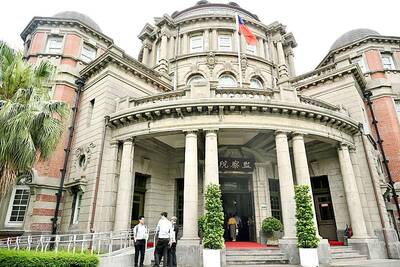
WARNING: From Jan. 1 last year to the end of last month, 89 Taiwanese have gone missing or been detained in China, the MAC said, urging people to carefully consider travel to China Lax enforcement had made virtually moot regulations banning civil servants from making unauthorized visits to China, the Control Yuan said yesterday. Several agencies allowed personnel to travel to China after they submitted explanations for the trip written using artificial intelligence or provided no reason at all, the Control Yuan said in a statement, following an investigation headed by Control Yuan member Lin Wen-cheng (林文程). The probe identified 318 civil servants who traveled to China without permission in the past 10 years, but the true number could be close to 1,000, the Control Yuan said. The public employees investigated were not engaged in national
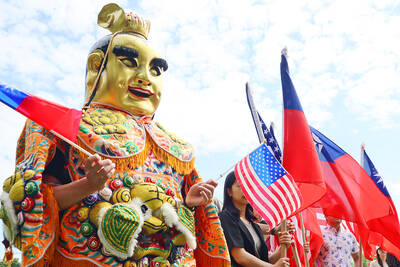
ALL TOGETHER: Only by including Taiwan can the WHA fully exemplify its commitment to ‘One World for Health,’ the representative offices of eight nations in Taiwan said The representative offices in Taiwan of eight nations yesterday issued a joint statement reiterating their support for Taiwan’s meaningful engagement with the WHO and for Taipei’s participation as an observer at the World Health Assembly (WHA). The joint statement came as Taiwan has not received an invitation to this year’s WHA, which started yesterday and runs until Tuesday next week. This year’s meeting of the decisionmaking body of the WHO in Geneva, Switzerland, would be the ninth consecutive year Taiwan has been excluded. The eight offices, which reaffirmed their support for Taiwan, are the British Office Taipei, the Australian Office Taipei, the
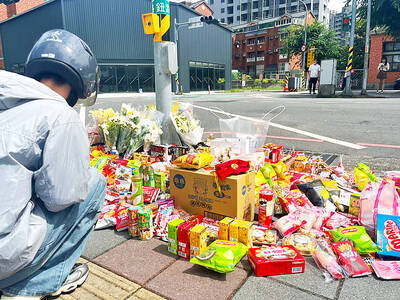
DANGEROUS DRIVERS: The proposal follows a fatal incident on Monday involving a 78-year-old driver, which killed three people and injured 12 The Ministry of Transportation and Communications yesterday said it would lower the age for elderly drivers to renew their license from 75 to 70 as part of efforts to address safety issues caused by senior motorists. The new policy was proposed in light of a deadly incident on Monday in New Taipei City’s Sansia District (三峽), in which a 78-year-old motorist surnamed Yu (余) sped through a school zone, killing three people and injuring 12. Last night, another driver sped down a street in Tainan’s Yuching District (玉井), killing one pedestrian and injuring two. The incidents have sparked public discussion over whether seniors


 RSS
RSS