


Foie gras makers in Bulgaria and Hungary say they have been able to cushion themselves from the worst of the global economic crisis thanks to low wages and competitive feed prices.
Indeed, the two countries, which are now the largest producers of the delicacy after France, were able to book a rise in output this year, unlike France, which is experiencing a sharp drop in both output and demand.
France remains the biggest producer and consumer of fattened duck or goose liver — a dish that is part of the national protected cultural and gastronomical heritage — with annual output of more than 20,000 tonnes.
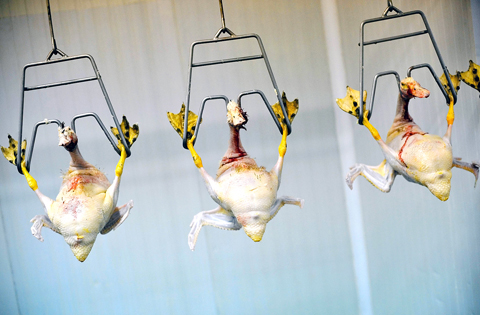
PHOTO: AFP
Production in Bulgaria and Hungary is still only around one10 percent of that, but is rising fast.
This year, Bulgaria, which specializes in duck foie gras, is expected to lift total output by 5 percent to10 percent to 2,100-2,200 tonnes. Hungary expects to produce 1,800 tonnes of goose foie gras and 800 tonnes of duck foie gras.
Hungary has a quasi monopoly on goose foie gras after France phased it out in favor of duck foie gras, which is easier and cheaper to make.
“We were hit much harder by the drought and the subsequent grain shortage in 2007-2008 than by the current financial crisis,” said Boris Stoimenov, chairman of the Bulgarian Poultry Producers Association. “After declining in 2008, production has picked up in 2009.”
“We can survive thanks to the unbeatable price of the labor here, which is four times cheaper than in France,” Plamen Chelebiev, owner of Volex, a Bulgarian company that produces the whole range of duck products, from eggs to several varieties of foie gras.
Willy de Neef is a Belgian whose Bulgaria-based company supplies 800 supermarkets in France and Belgium with four to five tonnes of fattened duck livers per week.
“The crisis hasn’t touched us,” said de Neef, who believes he has found a new market for mass produced foie gras where customers are ready to accept a lower-grade product for a reasonable price.
He said his production costs in Bulgaria are 20 percent to 25 percent lower than in France or Belgium. Jozsef Magyar, chief executive of Hungarian firm Hungerit, said the sector “isn’t performing all that badly — following a somewhat slow first quarter, Western buyers have started coming back.”
Experts argue that cheap labor and feed and less investment in farms, force-feeding equipment and slaughterhouses, give Bulgaria and Hungary a distinct price advantage over France. Volex owner Chelebiev said his company had adjusted production to the slump in demand in France and kept its prices 3 euros (US$4.40) to 4 euros per kilogram lower than in France.
Michel Colle, a French partner of Volex, admitted that “there has always been some prejudice” in France about the quality of imported foie gras.
But such nationalist sentiments were fading as “food chains see that the quality is the same and appreciate the competitive prices of the imported products.”
Bulgaria and Hungary also have another advantage: The birds are fed in collective cages, which are cheaper than the single-bird cages used in France.
The European Convention for the Protection of Animals Kept for Farming will oblige all producers to use collective cages from 2011.
The crisis has encouraged producers in both Bulgaria and Hungary to seek markets in Russia, Ukraine, Southeast Asia and the Middle East and increase their sales of duck meat and eggs and even feathers.

NO HUMAN ERROR: After the incident, the Coast Guard Administration said it would obtain uncrewed aerial vehicles and vessels to boost its detection capacity Authorities would improve border control to prevent unlawful entry into Taiwan’s waters and safeguard national security, the Mainland Affairs Council (MAC) said yesterday after a Chinese man reached the nation’s coast on an inflatable boat, saying he “defected to freedom.” The man was found on a rubber boat when he was about to set foot on Taiwan at the estuary of Houkeng River (後坑溪) near Taiping Borough (太平) in New Taipei City’s Linkou District (林口), authorities said. The Coast Guard Administration’s (CGA) northern branch said it received a report at 6:30am yesterday morning from the New Taipei City Fire Department about a

IN BEIJING’S FAVOR: A China Coast Guard spokesperson said that the Chinese maritime police would continue to carry out law enforcement activities in waters it claims The Philippines withdrew its coast guard vessel from a South China Sea shoal that has recently been at the center of tensions with Beijing. BRP Teresa Magbanua “was compelled to return to port” from Sabina Shoal (Xianbin Shoal, 仙濱暗沙) due to bad weather, depleted supplies and the need to evacuate personnel requiring medical care, the Philippine Coast Guard (PCG) spokesman Jay Tarriela said yesterday in a post on X. The Philippine vessel “will be in tiptop shape to resume her mission” after it has been resupplied and repaired, Philippine Executive Secretary Lucas Bersamin, who heads the nation’s maritime council, said

CHINA POLICY: At the seventh US-EU Dialogue on China, the two sides issued strong support for Taiwan and condemned China’s actions in the South China Sea The US and EU issued a joint statement on Wednesday supporting Taiwan’s international participation, notably omitting the “one China” policy in a departure from previous similar statements, following high-level talks on China and the Indo-Pacific region. The statement also urged China to show restraint in the Taiwan Strait. US Deputy Secretary of State Kurt Campbell and European External Action Service Secretary-General Stefano Sannino cochaired the seventh US-EU Dialogue on China and the sixth US-EU Indo-Pacific Consultations from Monday to Tuesday. Since the Indo-Pacific consultations were launched in 2021, references to the “one China” policy have appeared in every statement apart from the

More than 500 people on Saturday marched in New York in support of Taiwan’s entry to the UN, significantly more people than previous years. The march, coinciding with the ongoing 79th session of the UN General Assembly, comes close on the heels of growing international discourse regarding the meaning of UN Resolution 2758. Resolution 2758, adopted by the UN General Assembly in 1971, recognizes the People’s Republic of China (PRC) as the “only lawful representative of China.” It resulted in the Republic of China (ROC) losing its seat at the UN to the PRC. Taiwan has since been excluded from


 RSS
RSS