


European stocks fell for the first week in more than a month as investors speculated share prices have outpaced the outlook for economic growth and companies from Aegon NV to Nestle SA posted lower earnings.
Aegon, the Dutch owner of US insurer Transamerica Corp, slumped 12 percent, while Nestle, the world’s biggest food company, sank 4.4 percent. Volkswagen AG plummeted 24 percent after saying it will pay about 3.3 billion euros (US$4.7 billion) for a stake in Porsche SE’s automotive unit.
Europe’s Dow Jones STOXX 600 Index lost 0.8 percent to 228.77 in the past week, snapping four weeks of gains. A 45 percent rebound since March 9 has left the regional measure valued at 39.9 times the profits of its companies, the most expensive since September 2003, weekly data compiled by Bloomberg show.
“In the short term you have to be cautious, equities are no longer very cheap,” said Manfred Hofer, head of equity analysis at LGT Capital Management in Pfaeffikon, Switzerland, which oversees about US$73 billion. “Companies have been able to post profits because of cost cutting. We now need to see economic data confirm an upturn, then it’s possible that profits and revenues will increase.”
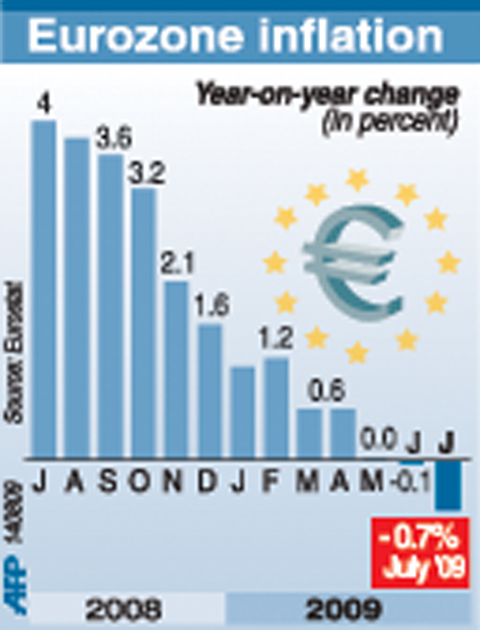
The euro region’s economy contracted 0.1 percent in the second quarter as Germany and France unexpectedly returned to growth, suggesting Europe’s worst recession since World War II is coming to an end. Economists had estimated gross domestic product declined 0.5 percent in the three months through June, the median of 32 forecasts in a Bloomberg survey showed.
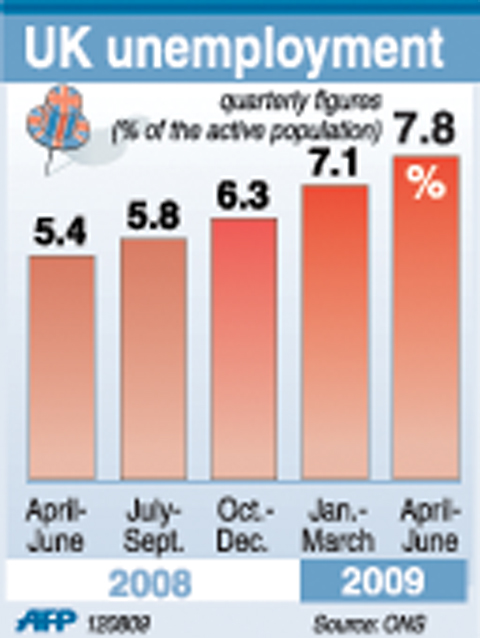
Bank of England Governor Mervyn King said that while recent economic reports are “encouraging,” growth won’t resume on an annual basis until 2010 while banks restrict access to credit.
National benchmark indexes declined in 10 of the 18 western European markets. The UK’s FTSE 100 lost 0.4 percent, and France’s CAC 40 decreased 0.7 percent. Germany’s DAX dropped 2.8 percent as Daimler AG slid.
Aegon tumbled 12 percent. The Dutch insurer posted a fourth straight quarterly loss on writedowns and the sale of a unit and said it will sell 1 billion euros of shares to help repay state aid. The second-quarter net loss was 161 million euros, wider than analysts’ estimates, and compared with a profit of 276 million euros a year earlier.

NEXT GENERATION: The four plants in the Central Taiwan Science Park, designated Fab 25, would consist of four 1.4-nanometer wafer manufacturing plants, TSMC said Taiwan Semiconductor Manufacturing Co (TSMC, 台積電) plans to begin construction of four new plants later this year, with the aim to officially launch production of 2-nanometer semiconductor wafers by late 2028, Central Taiwan Science Park Bureau director-general Hsu Maw-shin (許茂新) said. Hsu made the announcement at an event on Friday evening celebrating the Central Taiwan Science Park’s 22nd anniversary. The second phase of the park’s expansion would commence with the initial construction of water detention ponds and other structures aimed at soil and water conservation, Hsu said. TSMC has officially leased the land, with the Central Taiwan Science Park having handed over the
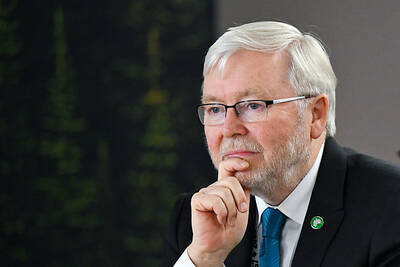
AUKUS: The Australian Ambassador to the US said his country is working with the Pentagon and he is confident that submarine issues will be resolved Australian Ambassador to the US Kevin Rudd on Friday said that if Taiwan were to fall to China’s occupation, it would unleash China’s military capacities and capabilities more broadly. He also said his country is working with the Pentagon on the US Department of Defense’s review of the AUKUS submarine project and is confident that all issues raised will be resolved. Rudd, who served as Australian prime minister from 2007 to 2010 and for three months in 2013, made the remarks at the Aspen Security Forum in Colorado and stressed the longstanding US-Australia alliance and his close relationship with the US Undersecretary
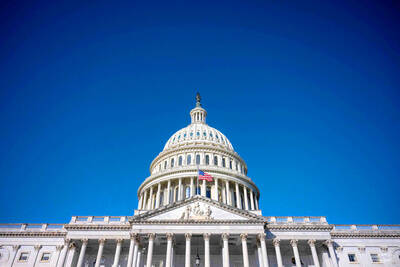
‘WORLD WAR III’: Republican Representative Marjorie Taylor Greene said the aid would inflame tensions, but her amendment was rejected 421 votes against six The US House of Representatives on Friday passed the Department of Defense Appropriations Act for fiscal 2026, which includes US$500 million for Taiwan. The bill, which totals US$831.5 billion in discretionary spending, passed in a 221-209 vote. According to the bill, the funds for Taiwan would be administered by the US Defense Security Cooperation Agency and would remain available through Sept. 30, 2027, for the Taiwan Security Cooperation Initiative. The legislation authorizes the US Secretary of Defense, with the agreement of the US Secretary of State, to use the funds to assist Taiwan in procuring defense articles and services, and military training. Republican Representative

TAIWAN IS TAIWAN: US Representative Tom Tiffany said the amendment was not controversial, as ‘Taiwan is not — nor has it ever been — part of Communist China’ The US House of Representatives on Friday passed an amendment banning the US Department of Defense from creating, buying or displaying any map that shows Taiwan as part of the People’s Republic of China (PRC). The “Honest Maps” amendment was approved in a voice vote on Friday as part of the Department of Defense Appropriations Act for the 2026 fiscal year. The amendment prohibits using any funds from the act to create, buy or display maps that show Taiwan, Kinmen, Matsu, Penghu, Wuciou (烏坵), Green Island (綠島) or Orchid Island (Lanyu, 蘭嶼) as part of the PRC. The act includes US$831.5 billion in


 RSS
RSS