


India’s airlines are caught in a “perfect storm” of big losses, high debt and falling demand, and need urgent help from the new government to make them high-flyers again, an industry report said.
The struggling sector was once a vibrant symbol of India’s economic progress but it has seen its fortunes nosedive because of over-expansion, costly fuel and cut-throat competition.
“The industry now is at a very critical stage,” said Kapil Kaul, India head of the Sydney-based Center for Asia Pacific Aviation, the consultancy that authored the report entitled Aviation Agenda for The Next Indian Government.
Sector losses for the fiscal year that ended in March are expected to nearly double from last year to US$1.75 billion, Kaul said.
That’s a fifth of the losses of airlines globally of US$8.5 billion estimated by the International Air Transport Association.
“India’s contribution to this [loss] is significantly higher than the 2 percent of world air traffic for which it accounts,” the report said.
The Indian industry’s woes are highlighted by a slump in passengers. Last month, the number of domestic passengers fell by 591,000 or 15.2 percent year-on-year, the fourth straight month of declines.
The figures are a far cry from earlier heady government forecasts that passenger growth would run at 25 percent annually until the end of the decade.
Passenger numbers were expanding by double digits when India’s economy was booming. Cheap fares and increasing affluence among India’s middle classes drove a migration from the country’s antiquated train network to planes.
After the government opened India’s skies to more competition in 2004, a clutch of new airlines took flight, revolutionizing domestic travel in the country of 1.1 billion.
But then costlier oil pushed up air fares last year, sending many passengers back to trains.
Now the sector has also been hit by a slowing economy triggered by the global financial crisis, reducing business and leisure journeys.
“It needs to quickly restructure and the new government has to help them reduce high structural costs,” Kaul said, citing hefty jet fuel taxes.
There is also a need to allow more domestic airlines to fly internationally to boost revenues, Kaul said.
The Congress-led government should allow foreign airlines to take equity stakes in domestic airlines to give them access to fresh capital, he said, but to draw investment the carriers must clean up their balance sheets.
“Over-aggressive expansion” to grab market share was “partly responsible for the fiscal demise of the sector,” the report said.
Flagship state airline Air India is hurting the most. It’s estimated to have racked up US$800 million in losses for the past year and debt of US$4 billion, the report said.
Air India, which flies internationally, merged with government-run domestic carrier Indian last year to become more efficient, but its planes are flying emptier and passenger revenues are still declining.

National Taiwan University (NTU) yesterday said it disqualified a person from an entrance examination for using AI smart glasses to cheat, along with two others for making untruthful statements in their curriculum vitae. The three applicants were given null scores, Taiwan’s highest-ranked university said, calling on prospective students to be honest in the admissions process. NTU registrar Lee Hung-sen (李宏森) said that the cheating applicant wore a hat and thick-rimmed glasses to the second written exam for medical school, claiming that they felt cold. Suspicions were aroused when the applicant stared oddly at the test for long stretches while steadily bringing the paper
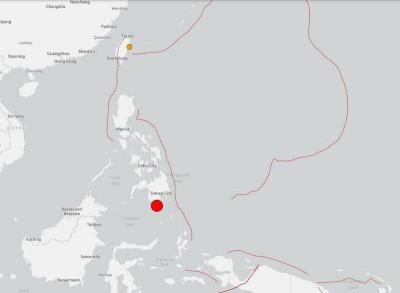
A magnitude 7.8 earthquake struck off the southern coast of Mindanao in the Philippines at 7:38am today, prompting the US Tsunami Warning System to issue an alert for neighboring countries, including Taiwan. The system issued a purple alert indicating a "tsunami threat." The potential threat zone includes Taiwan, the Philippines, Papua New Guinea, Yap and Palau. Philippine authorities were assessing the damage from the quake, with the office of civil defense seeking to verifying initial reports that 15 people had been killed and 129 injured in the region, mostly from falling debris. Arlene Hollero, disaster chief of Maasim town in the Philippines' Sarangani Province,

‘GRAY ZONE’ PRESSURE: Beijing’s activities are intended to create the deceitful impression that China has jurisdiction over the area around Taiwan, the CGA said Taiwan’s rights over its territorial waters and exclusive economic zone must not be violated by any country, the Mainland Affairs Council said yesterday, adding that it will not accept any unprovoked actions. The council issued the remarks in response to the China Coast Guard conducting maritime enforcement drills near eastern Taiwan and claiming to fully exercise China’s maritime administrative law enforcement authority. The Coast Guard Administration (CGA) has been closely monitoring the situation and is taking concrete steps to defend the nation’s sovereignty and secure its waters, the council said. China has no sovereign rights over the waters off eastern
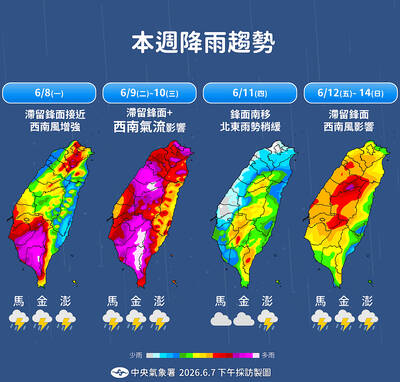
Heavy rain is expected to affect parts of Taiwan this week, the Central Weather Administration (CWA) said yesterday as a meteorologist said the active part of the annual plum rain season has started. A stationary plum rain front and southwesterly winds would bring unstable weather and abundant moisture to Taiwan from today for about a week, with the heaviest rainfall forecast for tomorrow and Wednesday, the CWA said. The agency said western and northeastern Taiwan, and mountainous areas in the east and southeast, could expect showers or thunderstorms on those two days, with localized heavy rain possible. Other parts of


 RSS
RSS