


Steep discounts on clothes, toys and electronics enticed shoppers to stores this weekend but they are still making fewer purchases leading into the final stretch of the holiday shopping season.
Based on early reports from analysts and malls, sales results were generally mixed to moderately down this past weekend, the second-to-last of the season that can make or break many retailers.
Stores offered big discounts to shoppers who have been pulling back their spending, concerned about the recession and job stability. Shoppers came to stores for these discounts but largely stuck to their shopping lists and basic items like clothing, analysts say.
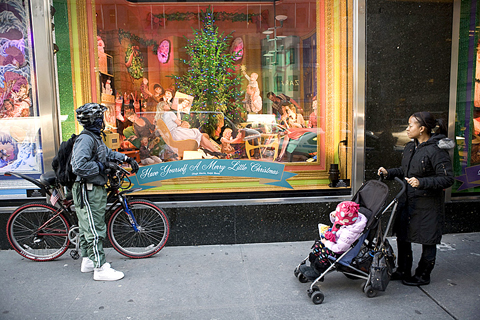
PHOTO: BLOOMBERG
Traffic levels at stores were comparable to last year, said Marshal Cohen, chief industry analyst at market research group NPD Group. People were looking for deals but not as willing to spend their money as last year.
“The number of consumers actually making purchases were down and when they did purchase they purchased less,” Cohen said.
Results were mixed across the country, with electronics still doing well and stores like warehouse-club operator Costco Wholesale Corp were mobbed, he said.
“It wasn’t as good as last year but it wasn’t as doom and gloom as everyone was expecting,” he said.
This Saturday was the strongest yet this season, said Karen MacDonald, a spokeswoman at mall operator Taubman Centers Inc.
Traffic was up at stores throughout the country, but in terms of sales, business overall ranged from slightly above, to flat, to slightly below last year’s levels, she said. Apparel was a top seller while high-end jewelry and home furnishings were weak.
Figures released on Sunday by SpendingPulse pointed to more signs that shoppers are continuing their frugal ways, despite a decent Black Friday spending surge. SpendingPluse is a data service provided by MasterCard Advisors that estimates US retail sales across all payment forms, including cash and checks.
From Nov. 28, the day after Thanksgiving known through Dec. 6, luxury sales dropped 34.5 percent compared to the same period last year, while overall apparel sales fell 22.9 percent. Electronic sales fell 22.3 percent.
Michael McNamara, vice president at SpendingPulse, said consumers are resisting big-ticket items priced US$1,000 or more.
“Spending has obviously contracted, but the key question is will it contract even further,” he said.
Online sales last week fell 1 percent to US$3.81 billion from the same week last year, according to research company comScore Inc., which called the drop “marginal.”
From Dec. 1, which marked the kickoff to the online holiday shopping season, through Friday, sales were up 3 percent to US$8.26 billion from last year, the firm said on Sunday.
Tuesday last week marked the heaviest online spending day on record with US$887 million in sales, the firm said, adding that it expects online retailers to continue offering discounts on products and expedited shipping to spur sales.
It noted apparel and accessories sales were up 21 percent in the first 12 days of December, while books and magazine sales rose 18 percent.
This season could shape up to be the worst in decades as the economy spins into recession and consumers worry about their slumping investments, rising prices and job stability.
Same-store sales are expected to be down as much as 1 percent last month and this month, according to Michael Niemira, chief economist at the International Council of Shopping Centers.
If that holds true it would mark the weakest season since at least 1969 when the index began. The only holiday period that was almost as weak was 2002, when same-store sales rose by only 0.5 percent, Niemira said. Same-store sales are sales at stores opened at least a year and are considered a key indicator of a retailer’s health.
Slumping sales are weighing on retailers. Last week they forced retailer KB Toys to file for bankruptcy protection for the second time in four years. The 86-year-old company plans to begin going-out-of business sales at its stores immediately.
With spending expected down, stores have been stepping up their discounts to try to capture whatever money consumers decide to part with.
Consumers had said all along they were going to cut their spending, stick to basics and look for deals, and they’ve kept their word, said C. Britt Beemer, chairman of America’s Research Group.

NO-LIMITS PARTNERSHIP: ‘The bottom line’ is that if the US were to have a conflict with China or Russia it would likely open up a second front with the other, a US senator said Beijing and Moscow could cooperate in a conflict over Taiwan, the top US intelligence chief told the US Senate this week. “We see China and Russia, for the first time, exercising together in relation to Taiwan and recognizing that this is a place where China definitely wants Russia to be working with them, and we see no reason why they wouldn’t,” US Director of National Intelligence Avril Haines told a US Senate Committee on Armed Services hearing on Thursday. US Senator Mike Rounds asked Haines about such a potential scenario. He also asked US Defense Intelligence Agency Director Lieutenant General Jeffrey Kruse

STUMPED: KMT and TPP lawmakers approved a resolution to suspend the rate hike, which the government said was unavoidable in view of rising global energy costs The Ministry of Economic Affairs yesterday said it has a mandate to raise electricity prices as planned after the legislature passed a non-binding resolution along partisan lines to freeze rates. Chinese Nationalist Party (KMT) lawmakers proposed the resolution to suspend the price hike, which passed by a 59-50 vote. The Taiwan People’s Party (TPP) voted with the KMT. Legislative Speaker Han Kuo-yu (韓國瑜) of the KMT said the resolution is a mandate for the “immediate suspension of electricity price hikes” and for the Executive Yuan to review its energy policy and propose supplementary measures. A government-organized electricity price evaluation board in March

NOVEL METHODS: The PLA has adopted new approaches and recently conducted three combat readiness drills at night which included aircraft and ships, an official said Taiwan is monitoring China’s People’s Liberation Army (PLA) exercises for changes in their size or pattern as the nation prepares for president-elect William Lai’s (賴清德) inauguration on May 20, National Security Bureau (NSB) Director-General Tsai Ming-yen (蔡明彥) said yesterday. Tsai made the comment at a meeting of the Legislative Yuan’s Foreign Affairs and National Defense Committee, in response to Democratic Progressive Party (DPP) Legislator Wang Ting-yu’s (王定宇) questions. China continues to employ a carrot-and-stick approach, in which it applies pressure with “gray zone” tactics, while attempting to entice Taiwanese with perks, Tsai said. These actions aim to help Beijing look like it has

China is mischaracterizing UN Resolution 2758 for its own interests by conflating it with its “one China” principle, US Deputy Assistant Secretary for China and Taiwan Mark Lambert said on Monday. Speaking at a seminar held by the German Marshall Fund, Lambert called for support for Taiwan’s meaningful participation in the international community at a time when China is increasingly misusing Resolution 2758. The resolution had a clear impact when it changed who occupied the China seat at the UN, Lambert said. “Today, however, the PRC [People’s Republic of China] increasingly mischaracterizes and misuses Resolution 2758 to serve its own interests,” Lambert said. “Beijing


 RSS
RSS