


China’s cash-rich financial institutions want to extend their influence overseas, but experts say the risks of investing in Wall Street giants have left them deeply wary of coming to the rescue.
Morgan Stanley, desperate for a white knight, is reportedly in talks to sell a 49 percent stake to China Investment Corp (CIC, 中國投資公司), a sovereign wealth fund.
At the same time, separate reports say the US investment bank is also in discussions with Beijing-controlled conglomerate CITIC (中國國際信託投資).
“Crisis is a good opportunity for buying cheap assets,” said Mei Xinyu (梅新育), a leading researcher at a Ministry of Commerce-backed think tank.
Morgan Stanley’s market value shrank to US$24.1 billion this week, he said, adding: “It’s cheap indeed.”
But he also cautioned China has much to consider before plunging in, from the real value of US institutions and the risk that Washington will restrict management and voting rights.
China has already been burned by investing in Wall Street. The US’ finance center was the CIC’s first shopping stop after it was established last year to invest part of China’s US$1.8 trillion in foreign reserves.
The stake they bought in private equity group Blackstone and a 9.9 percent holding in Morgan Stanley are now worth less than half what they paid — US$ 3 billion and US$5 billion respectively.
“The collapse of Lehman Brothers doesn’t mean the bottom of the market,” said Shen Hongpu, an analyst for Cinda Asset Management Corp (信達資產管理公司). “There’s still a couple of months to go and more trouble ahead.”
Sovereign funds, including CIC, justified their early Wall Street purchases as long-term investments, but after this week the argument may no longer hold.
“That view has now been overridden by fears that many companies may not last until the wider market rebounds — there is the perception that companies of any size may fail anytime in coming months,” Sherman Chan (陳穎嘉), a Sydney-based analyst for Moody’s, wrote in a research note.
The risk of investing in emerging Asian markets may now be no greater than the US or Europe, Chan wrote.
Analysts say Chinese institutions are being cautious and not hinting at how they will respond to the latest escalation in the crisis, which began more than a year ago with the US subprime housing crisis and resulting credit crunch.
Transactions by China’s emerging financial titans made public this week sent mixed signals.
The Bank of China (中國銀行) bought a one-fifth share in the Edmond de Rothschild Finance Company of France for 236 million euros (US$342 million), a spokesman for the French bank said late on Thursday.
The country’s largest insurer by premiums, China Life Insurance Co (中國人壽), said on Tuesday in a notice to the Hong Kong exchange that as of June it had reduced its holding in Visa Inc to 3 million shares, down from 6.8 million in March.
The latest turmoil has also highlighted one of China’s unique challenges: how to protect itself from being left with a growing mountain of foreign reserves — and investments — mostly denominated in depreciating dollars, said Shi Jianxun (石建勛), a professor at Shanghai’s Tongji University.
Another major hurdle in keeping Beijing from bailing out Wall Street, he said, is the government would face hard questions at home if it failed to first address China’s sagging markets and own struggling national champions.
This week Beijing took major steps to dismantle that obstacle by removing taxes on buying shares, increasing its stakes in three leading banks and introducing its first interest rate cut in six years.
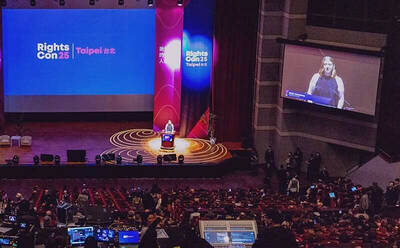
SILENCING CRITICS: In addition to blocking Taiwan, China aimed to prevent rights activists from speaking out against authoritarian states, a Cabinet department said The Ministry of Foreign Affairs (MOFA) yesterday condemned transnational repression by Beijing after RightsCon, a major digital human rights conference scheduled to be held in Zambia this week, was abruptly canceled due to Chinese pressure over Taiwanese participation. This year’s RightsCon, the world’s largest conference discussing issues “at the intersection of human rights and technology,” was scheduled to take place from tomorrow to Friday in Lusaka, and expected to draw 2,600 in-person attendees from 150 countries, along with 1,100 online participants. However, organizers were forced to cancel the event due to behind-the-scenes pressure from China, the ministry said, expressing its “strongest condemnation”
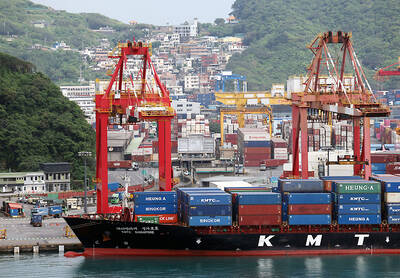
Taiwan’s economy grew far faster than expected in the first quarter, as booming demand for artificial intelligence (AI) applications drove a surge in exports, spilling over into investment and consumption, the Directorate-General of Budget, Accounting and Statistics (DGBAS) said yesterday. GDP growth was 13.69 percent year-on-year during the January-to-March period, beating the DGBAS’ February forecast by 2.23 percentage points and marking the most robust growth in nearly four decades, DGBAS senior official Chiang Hsin-yi (江心怡) told a news conference in Taipei. The result was powered by exports, which remain the backbone of Taiwan’s economy, Chiang said. Outbound shipments jumped 51.12 percent year-on-year to
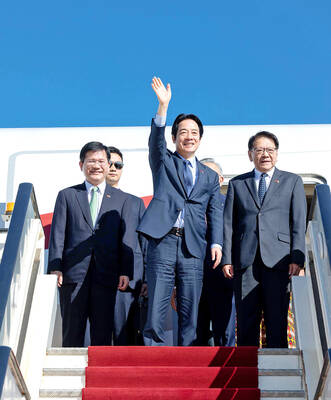
DELAYED BUT DETERMINED: The president’s visit highlights Taiwan’s right to international engagement amid regional pressure from China President Willaim Lai (賴清德) yesterday arrived in Eswatini, more than a week after his planned visit to Taiwan’s sole African ally was suspended because of revoked overflight permits. “The visit, originally scheduled for April 22, was postponed due to unforeseen external factors,” Lai wrote on social media. “After several days of careful arrangements by our diplomatic and national security teams, we successfully arrived today.” Lai said he looked forward to further deepening Taiwan-Eswatini relations through closer cooperation in the economy, agriculture, culture and education, as well as advancing the nation’s international partnerships. The president was initially scheduled to arrive in time to celebrate
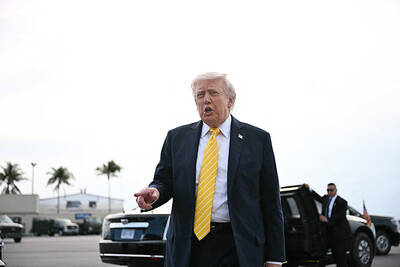
Iran’s Islamic Revolutionary Guard Corp (IRGC) yesterday said the US faced a choice between an “impossible” military operation or a “bad deal” with Tehran, after US President Donald Trump disparaged Iran’s latest peace proposal. Negotiations between the two countries have been deadlocked since a ceasefire came into effect on April 8, with only one round of direct peace talks held so far. Iran’s Tasnim and Fars news agencies reported that Tehran had submitted a 14-point proposal to mediator Pakistan, but Trump was quick to cast doubt on it. “I will soon be reviewing the plan that Iran has just sent to us, but


 RSS
RSS