


The California auto worker who is suing Toyota and others in a whistleblower lawsuit said yesterday she was merely carrying out the quality-conscious "Toyota way" in spotting defects when managers cracked down on her efforts and demoted her.
Katy Cameron, 54, employed for 23 years at New United Motor Manufacturing Inc (NUMMI), a joint venture between Toyota Motor Corp and General Motors Corp in Fremont, California, is suing the companies in a lawsuit filed on Nov. 6 in Alameda County Superior Court.
The lawsuit accuses management at NUMMI of routinely deleting or downgrading defects that Cameron found as a certified auditor -- including broken seatbelts, faulty headlights, inadequate braking and steering wheel alignment problems -- and demands US$45 million in damages for retaliation against a whistleblower and intentional infliction of emotional distress.
"I believed in the Toyota way. I really did. I just wanted to know why they turned their head on me," Cameron said from California during a telephone interview. "Why did they look the other way when I cried out for help?"
Cameron said she was trained in Toyota's corporate philosophy, which emphasizes the importance of the workers on the assembly line not only in making manufacturing more efficient but also pointing out defects and other problems. She was so good she trained other auditors, she says.
But about five years ago, the management at NUMMI seemed to shift its emphasis to quantity over quality, eager to reduce defect numbers, which determined their bonus pay, said Cameron.
And Toyota's vaunted quality-check system seemed to get neglected, she said.
Cameron said she went to court only after she tried to alert higher-ups to what she saw as serious wrongdoing, including her bosses, as well as the top executive at NUMMI, handing him a letter and other reports in writing last year.
She also sent reports in writing to Toyota executives, including one to president Katsuaki Watanabe, but has received no response so far, she said.
The companies are declining comment on the lawsuit, saying the case is pending. But NUMMI spokesman Lance Tomasu said in a statement last week that quality is a priority and said the claims will be investigated thoroughly.
Toyota executive vice president Kazuo Okamoto, who oversees technology, said he was aware of the lawsuit, but that he did not know the details.
Toyota has built its global empire riding on its reputation for reliable vehicles. Toyota executives have repeatedly said they are worried about quality standards slipping as the automaker steps up worldwide expansion.
Toyota's products, such as the Camry and Corolla, are so popular some analysts say the company is on track to beat GM as the world's biggest automaker by sales this year. But the number of recalls has ballooned with the surge in vehicle sales.
"It was Katy's passion to be the eye of the consumer," Cameron's attorney Kelly Armstrong said. "This is a US$45 million message to NUMMI, Toyota and General Motors that they can no longer emphasize quantity over quality at the expense of hardworking Americans and consumers."
Cameron, who has been on medical leave from stress the lawsuit says is caused by persistent on-the-job harassment, returned to work yesterday. But she has been assigned to putting auto parts in boxes, and is no longer allowed to inspect vehicles. Her bosses have repeatedly threatened to fire her.
Cameron said NUMMI management blocked her attempts to relay quality problems to Toyota in Japan by preventing her from using the company phone and fax and taking away her in-company Internet privileges.
She expressed admiration for the Toyota work ethic, praising the corporate culture as "awesome." There is nothing Cameron wants more than to have her job back checking for defects, she says.
"I was trying to do my job. It was my job. And now here I am: I am punished for doing my job," she said. "I felt really betrayed. And I felt used because I worked hard. I worked very hard."

LEVERAGE: China did not ‘need to fire a shot’ to deny Taiwan airspace over Africa when it owns ‘half the continent’s debt,’ a US official said, calling it economic warfare The EU has raised concerns about overflight rights following the delay of President William Lai’s (賴清德) planned state visit to the Kingdom of Eswatini after three African nations denied overflight clearance for his charter at the last minute. Taiwanese allies Paraguay and Saint Kitts and Nevis, as well as several US lawmakers and the Inter-Parliamentary Alliance on China (IPAC) condemned China for allegedly pressuring the countries. Lai was scheduled to fly directly to Taiwan’s only African ally from yesterday to Sunday to celebrate the 40th anniversary of King Mswati III’s accession and his 58th birthday, but Seychelles, Mauritius and Madagascar suddenly revoked
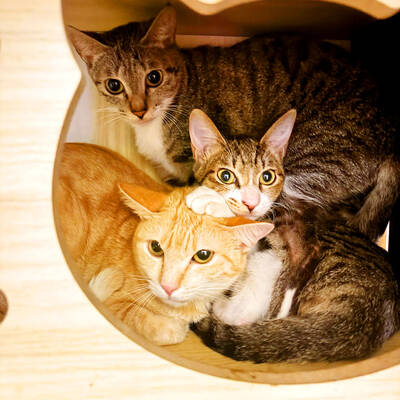
The number of pet cats in Taiwan surpassed that of pet dogs for the first time last year, reaching 1,742,033, a 32.8 percent increase from 2023, the Ministry of Agriculture said yesterday, citing a survey. By contrast, the number of pet dogs declined slightly by 1.2 percent over the same period to 1,462,528, the ministry said. Despite the shift, households with dogs still slightly outnumber those with cats by 1.2 percent. However, while the number of households with multiple dogs has remained relatively stable, households keeping more than two cats have increased, contributing to the overall rise in the feline population. The trend
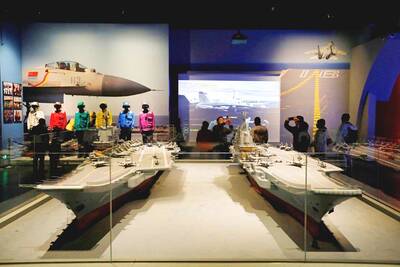
China on Wednesday teased in a video an aircraft carrier that could be its fourth, and the first using nuclear power, while making an allusion to Taiwan and vowing to further build up its islands, as it looks to boost maritime power, secure resources and bolster territorial claims. The video, issued on the eve of the 77th founding anniversary of the Chinese People’s Liberation Army Navy, featured fictional officers with names that are homophones of three commissioned aircraft carriers, the Liaoning (遼寧), Shandong (山東) and Fujian (福建). Titled Into the Deep, it showed a 19-year-old named “Hejian” (何劍) joining the group, sparking
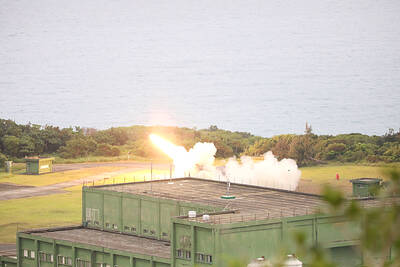
Taiwan has signed six arms procurement offers from the US totaling more than NT$208 billion (US$6.59 billion) covering long-range precision strike systems, missile stockpile replenishment and joint production of large-caliber ammunition, the Ministry of National Defense said yesterday. The government’s proposed NT$1.25 trillion special defense budget has been stalled in the Legislative Yuan as opposition lawmakers question the amount and procurement items, while the Presidential Office and defense ministry say that the full amount is necessary to safeguard Taiwan. Minister of National Defense Wellington Koo (顧立雄) on Monday briefed the legislature’s Foreign Affairs and National Defense Committee on the defense budget for


 RSS
RSS