


China's government has ordered some prices frozen and told officials to closely monitor others in its most drastic step yet to contain a surge in inflation.
The order, issued by six government agencies on Wednesday, came after inflation rose to 6.5 percent last month -- its highest monthly rate in 11 years -- propelled by a double-digit rise in politically sensitive food prices, including pork, the country's staple meat.
The statement stressed the importance of maintaining "market stability" ahead of a key Chinese Communist Party meeting next month. It said controlling inflation would affect China's development, reform and stability.
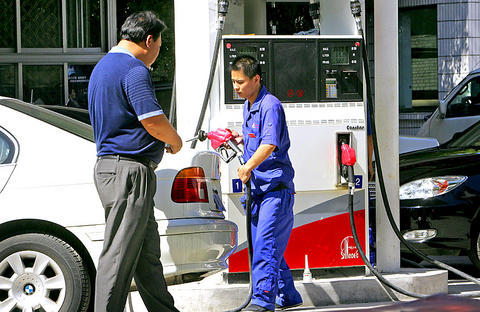
PHOTO: AP
The order said government-set prices would be frozen through the end of the year, though it did not specify which items were covered. A man who answered the phone at the Cabinet's planning agency, the National Development and Reform Commission, and refused to give his name said he was unclear what goods would be affected.
A list on the Web site of the Beijing city government planning agency said products for which the state still controls prices include cooking oil, sugar, gasoline, tobacco, salt, coal and fertilizer.
The government's latest move could help to contain inflation in free-market prices by reassuring producers of stable costs for energy and raw materials, said Shen Minggao (沈明高), a Citigroup economist in Beijing.
"I think it will help change expectations a bit," he said. "Some companies might have wanted to raise prices because of expected higher energy or resource prices. Now they can postpone that," he said.
About one-third of prices in China are government-set, with the rest left to the market, Shen said.
The inflation spike came amid a boom that saw the economy expand by 11.9 percent last quarter, while prices of stocks and real estate are soaring. The country's main stock index hit a new high of 5,460.08 points yesterday morning. The government has raised interest rates repeatedly and imposed investment curbs in an attempt to cool the boom, but its efforts so far have had little impact.
Market order has to be maintained to ensure the "smooth opening of the 17th Party Congress," said the government order.
It was issued jointly by the ministries of finance, agriculture and commerce, the Cabinet's planning body and two other agencies.
The party congress, held once every five years to appoint senior leaders, opens Oct. 15 and is expected to see Chinese President Hu Jintao (
Communist leaders are especially worried about the political impact of soaring food prices, which hit the country's vast, poor majority especially hard. Families in the countryside and the urban working class spend about one-third of their incomes on food.
Pork prices have soared due to shortages blamed on a decline in pig rearing, rising feed costs and an outbreak of a pig disease that killed more than 70,000 animals and infected 280,000 this year.
The government has tried to bring down the price of pork, the country's staple meat, by encouraging farmers to raise more pigs with promises of free vaccinations and other aid.
Wednesday's order told local authorities to closely watch market prices of pork and other meat, eggs, electricity and liquified gas but did not order controls on them.
In July, the central government barred local authorities from changing state-set prices for consumer goods in areas where they had already surpassed the official targets.

Nvidia Corp yesterday unveiled its new high-speed interconnect technology, NVLink Fusion, with Taiwanese application-specific IC (ASIC) designers Alchip Technologies Ltd (世芯) and MediaTek Inc (聯發科) among the first to adopt the technology to help build semi-custom artificial intelligence (AI) infrastructure for hyperscalers. Nvidia has opened its technology to outside users, as hyperscalers and cloud service providers are building their own cost-effective AI chips, or accelerators, used in AI servers by leveraging ASIC firms’ designing capabilities to reduce their dependence on Nvidia. Previously, NVLink technology was only available for Nvidia’s own AI platform. “NVLink Fusion opens Nvidia’s AI platform and rich ecosystem for
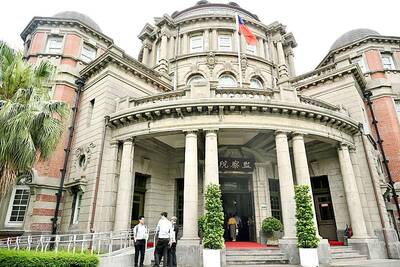
WARNING: From Jan. 1 last year to the end of last month, 89 Taiwanese have gone missing or been detained in China, the MAC said, urging people to carefully consider travel to China Lax enforcement had made virtually moot regulations banning civil servants from making unauthorized visits to China, the Control Yuan said yesterday. Several agencies allowed personnel to travel to China after they submitted explanations for the trip written using artificial intelligence or provided no reason at all, the Control Yuan said in a statement, following an investigation headed by Control Yuan member Lin Wen-cheng (林文程). The probe identified 318 civil servants who traveled to China without permission in the past 10 years, but the true number could be close to 1,000, the Control Yuan said. The public employees investigated were not engaged in national
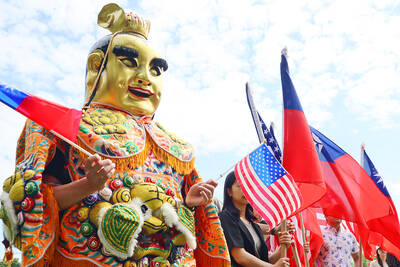
ALL TOGETHER: Only by including Taiwan can the WHA fully exemplify its commitment to ‘One World for Health,’ the representative offices of eight nations in Taiwan said The representative offices in Taiwan of eight nations yesterday issued a joint statement reiterating their support for Taiwan’s meaningful engagement with the WHO and for Taipei’s participation as an observer at the World Health Assembly (WHA). The joint statement came as Taiwan has not received an invitation to this year’s WHA, which started yesterday and runs until Tuesday next week. This year’s meeting of the decisionmaking body of the WHO in Geneva, Switzerland, would be the ninth consecutive year Taiwan has been excluded. The eight offices, which reaffirmed their support for Taiwan, are the British Office Taipei, the Australian Office Taipei, the
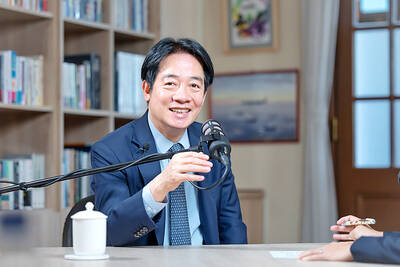
CAUSE AND EFFECT: China’s policies prompted the US to increase its presence in the Indo-Pacific, and Beijing should consider if this outcome is in its best interests, Lai said China has been escalating its military and political pressure on Taiwan for many years, but should reflect on this strategy and think about what is really in its best interest, President William Lai (賴清德) said. Lai made the remark in a YouTube interview with Mindi World News that was broadcast on Saturday, ahead of the first anniversary of his presidential inauguration tomorrow. The US has clearly stated that China is its biggest challenge and threat, with US President Donald Trump and US Secretary of Defense Pete Hegseth repeatedly saying that the US should increase its forces in the Indo-Pacific region


 RSS
RSS