


Tribune Co has accepted a buyout offer from real estate investor Sam Zell in a deal valued at about US$8.2 billion, the media company said yesterday.
Tribune said Zell plans to invest US$315 million in the deal and the company will sell the Chicago Cubs baseball team at the end of this season.
He will eventually become chairman of the Chicago-based company's board when the deal is complete.
Members of a special committee of board members had spent much of the week sifting through dueling offers for the US's second-largest newspaper publisher by circulation.
The Zell offer involved an ESOP, which resembles a profit-sharing plan, but allows the company to borrow money and repay loans using pretax dollars.
Payments of both interest and principal are tax-deductible and would create more leverage for a buyer.
Tribune also is said to be considering a "self-help" plan that would involve spinning off the company's broadcast division and borrowing money to pay a one-time cash dividend to shareholders.
Like most newspaper companies, Tribune has been struggling with declining profits, circulation and advertising revenues.
Last month, the company announced revenue had fallen 3.4 percent in February as its publishing division continued to struggle.
In addition to the Chicago Tribune, the company owns nine other daily newspapers, including the Los Angeles Times, as well as 23 TV stations and the Chicago Cubs baseball team.
Tribune's share price fell about 50 percent from early 2004 until last spring and has languished at just above US$30 for months, down from an all-time high of $60.88 in November 1999.
Its shares climbed nearly 2 percent on Friday on the NYSE as investors awaited an announcement from the company.
Zell, 65, has earned a reputation as an astute investor, making his fortune reviving moribund real estate.
After a bidding war culminated in February, he sold his company, Equity Office, to the private equity firm Blackstone Group for US$23 billion.
He is proposed using an employee stock ownership plan as a way to lower the taxes of any sale, but has said he had no plans to break up the company.
Tribune said yesterday that it was planning to sell the Chicago Cubs at the end of this year's baseball season.
This would put one of its most valuable assets on the block as it simultaneously announced Zell was acquiring the media conglomerate.
Analysts have estimated that the Cubs could fetch US$600 million or more.
Tribune bought the baseball team in 1981 for approximately US$20 million.
"The Cubs have been an important part of Tribune for more than 25 years and are one of the most storied franchises in all of sports," said Dennis FitzSimons, Tribune chairman, president and chief executive officer.
"In our last season of ownership, the team has one mission, and that is to win for our great fans," her added.
Tribune said the company's 25 percent interest in Comcast SportsNetChicago would be part of the sale package.
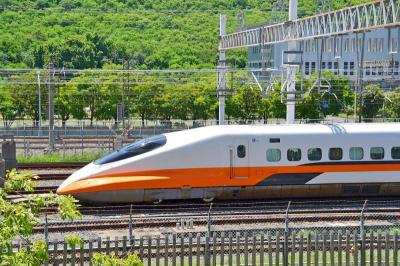
A signaling system malfunction disrupted high-speed rail (HSR) services beginning at 8am today, with trains temporarily reduced to three northbound and three southbound trains per hour as authorities conduct inspections. The malfunction occurred on a section of track in Miaoli County during pre-operation checks early this morning, forcing northbound and southbound trains to use a single track, the HSR operator said. The regular schedule has been replaced with three hourly trains offering only nonreserved seating in each direction, stopping at every station, it said, adding that business class cars would still have reserved seating. Departures from terminal stations are scheduled at the top

Taiwan is still in the process of assessing the possibility of recruiting workers from Eswatini, the Ministry of Foreign Affairs said yesterday, adding that its goal is to help Eswatini upgrade its vocational training centers. If there are plans to recruit workers from Eswatini, safeguarding national security, protecting public health and ensuring the employment rights of Taiwanese would be prerequisites, Department of West Asian and African Affairs Director-General Yen Chia-liang (顏嘉良) told a news conference. Key considerations would also include filling labor shortages in specific industries, and fostering bilateral professional and technical exchanges, he said. Yen was asked about the progress of labor

A US uncrewed surface vessel (USV) encountered multiple Chinese warships during an autonomous transit of the Taiwan Strait, US defense company Seasats said in a statement on Wednesday. Seasats announced that a Lightfish USV had completed the first autonomous transit of the Taiwan Strait. Over five days, the USV traversed the entire length of the Strait while constantly monitoring surface vessel traffic, the company said. The Lightfish encountered multiple Chinese warships, one of which was a Chinese People’s Liberation Army Navy (PLAN) Type 056 corvette, it said. The Chinese vessels were operating “well within Taiwan’s exclusive economic zone without transmitting their identity via the
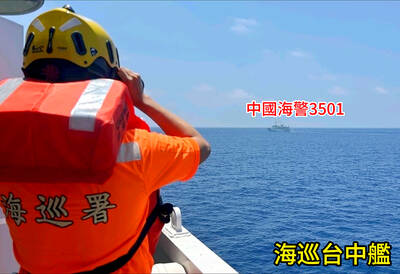
VERBOSE VESSELS: A CGA cutter and a China Coast Guard exchanged verbal barbs for more than a day in Taiwanese-controlled waters before the Chinese vessel left The Taiwanese and Chinese coast guards had a standoff near the strategically located Pratas Islands (Dongsha Islands, 東沙群島) in the north of the South China Sea, the Coast Guard Administration (CGA) said yesterday. The two sides engaged in intense radio exchanges over sovereignty claims during the 33-hour standoff. China Coast Guard vessel 3501 eventually left the restricted waters, 26.6 nautical miles (49.2km) west of the Pratas Islands, at 5pm yesterday, the CGA said. Lying approximately between southern Taiwan and Hong Kong, the Taiwan-controlled Pratas are seen by some security experts as vulnerable to Chinese attack due to their distance — more than


 RSS
RSS