


US and South Korean negotiators are wrestling with issues on automobiles and agricultural products, including opening up the market for rice and beef, during their US$29 billion free-trade talks, South Korea's chief negotiator said.
"I think we will negotiate on agriculture and automobiles until the very end," Ambassador Kim Jong-hoon told reporters yesterday during a press luncheon.
Still, Kim said he expected the two governments to be able to conclude a free-trade accord by the end of this month, as scheduled.
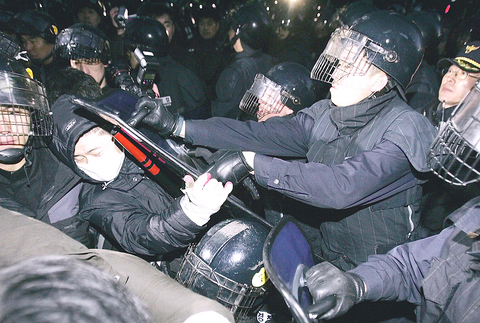
PHOTO: AP
Meanwhile, police in South Korea said yesterday they were questioning 10 protesters after violent street demonstrations against ongoing free trade talks.
Riot police late on Saturday clashed with 3,000 protesters, including farmers and students who rallied in downtown Seoul in defiance of a police ban on the demonstrations.
Some protesters kicked and punched the riot police who used water cannon, shields and batons to disperse the demonstrators, police said.
US and South Korean negotiators have been locked in talks since Thursday aimed at reaching what would be the biggest free trade agreement since 1993.
However, the protesters say it threatens their jobs and industries.
"Ten protesters are still in custody for questioning" over the violence, a Seoul police spokesman said.
Seven officers were hurt in the clashes, he added. Witnesses said civilians, including protesters and some journalists, were injured by riot police.
Negotiators of the US and South Korea, in free trade talks since last June, missed their original goal of completing the talks last year and must conclude an accord by the end of this month to get the deal to their respective legislatures by April 2 for a 90-day review before US President George W. Bush's "fast-track" trade promotion authority expires on July 1.
An agreement could boost US exports to South Korea by US$19 billion, with a US$10 billion jump in shipments the other way, according to the US International Trade Commission.
The US delegation, led by Assistant US Trade Representative Wendy Cutler, wants South Korea to lower taxes on agricultural products and allow them to send more rice to South Korea, while Seoul has said the subject of rice is off the negotiating table.
The US also wants South Korea to lower taxes on automobiles with larger engines, the types of cars that Ford Motor Co and DaimlerChrysler AG want to export to South Korea.
The two sides have agreed on three chapters of the accord during this eighth and final round of negotiations which end tomorrow; one on competition laws, another on government procurement and the remaining one on customs regulations. They have to conclude negotiations on 15 other different areas.
The final agreement will be unveiled "six to eight weeks" after the accord is handed to the US Congress and the South Korean National Assembly, Kim said.
The free-trade agreement, if ratified, would be the biggest for the US since the 1994 North American Free Trade Agreement.
South Korea has already signed free-trade agreements with Chile, Singapore and the European Free Trade Association, consisting of Switzerland, Norway, Iceland and Liechtenstein. It is in negotiations with Canada and Japan and in discussions with India, and is examining deals with China and the EU.
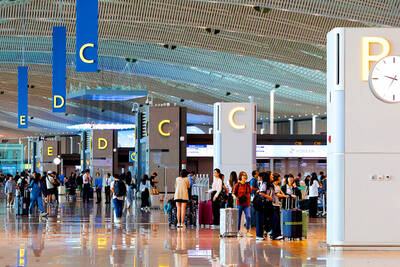
South Korea has adjusted its electronic arrival card system to no longer list Taiwan as a part of China, a move that the Ministry of Foreign Affairs said would help facilitate exchanges between the two sides. South Korea previously listed “Taiwan” as “Taiwan (China)” in the drop-down menus of its online arrival card system, where people had to fill out where they came from and their next destination. The ministry had requested South Korea make a revision and said it would change South Korea’s name on Taiwan’s online immigration system from “Republic of Korea” to “Korea (South),” should the issue not be
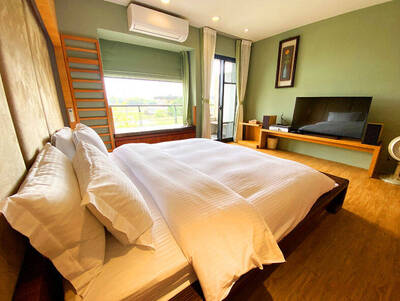
Tainan, Taipei and New Taipei City recorded the highest fines nationwide for illegal accommodations in the first quarter of this year, with fines issued in the three cities each exceeding NT$7 million (US$220,639), Tourism Administration data showed. Among them, Taipei had the highest number of illegal short-term rental units, with 410. There were 3,280 legally registered hotels nationwide in the first quarter, down by 14 properties, or 0.43 percent, from a year earlier, likely indicating operators exiting the market, the agency said. However, the number of unregistered properties rose to 1,174, including 314 illegal hotels and 860 illegal short-term rental
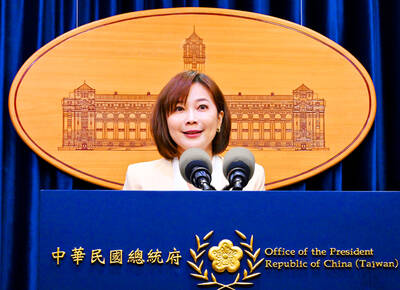
ECONOMIC COERCION: Such actions are often inconsistently applied, sometimes resumed, and sometimes just halted, the Presidential Office spokeswoman said The government backs healthy and orderly cross-strait exchanges, but such arrangements should not be made with political conditions attached and never be used as leverage for political maneuvering or partisan agendas, Presidential Office spokeswoman Karen Kuo (郭雅慧) said yesterday. Kuo made the remarks after China earlier in the day announced 10 new “incentive measures” for Taiwan, following a landmark meeting between Chinese President Xi Jinping (習近平) and Chinese Nationalist Party (KMT) Chairwoman Cheng Li-wun (鄭麗文) in Beijing on Friday. The measures, unveiled by China’s Xinhua news agency, include plans to resume individual travel by residents of Shanghai and China’s Fujian
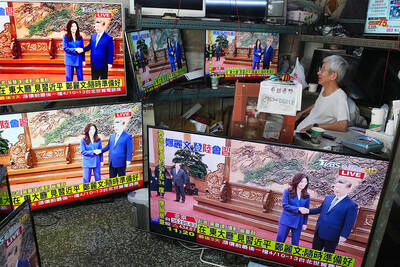
Chinese President Xi Jinping (習近平) and Chinese Nationalist Party (KMT) Chairwoman Cheng Li-wun (鄭麗文) met in Beijing yesterday, where they vowed to bring people on both sides of the Taiwan Strait closer to facilitate the “great rejuvenation of the Chinese nation.” The meeting was held in the East Hall of the Great Hall of the People, a venue typically reserved for meetings between Xi and foreign heads of state. In public remarks prior to a closed-door meeting, Xi, in his role as head of the Chinese Communist Party (CCP), said that Taiwan is historically part of China, and remains an “inalienable” and


 RSS
RSS