


NYSE Group Inc chief executive John Thain travels to China next week on a mission to lure more listings to the world's largest stock market. The trip also has another purpose, almost like house hunting in a new neighborhood.
Thain, who has been at the helm of the New York Stock Exchange for three years, has his eyes set on Asia as the next step in his plan to build a global financial marketplace. The NYSE's US$13 billion combination with the Paris-based Euronext exchange is expected to be approved soon by European regulators, setting up a shareholder vote there on Dec. 19.
The NYSE now trades shares of only 31 companies from Taiwan, China and Hong Kong. But Chinese companies have been among the NYSE's hottest initial public offerings this year, and persuading more to list could make it easier for individual investors in the US to gain access to their shares.
Investment advisors have long talked about the benefits of overseas diversification among investor holdings. Consider that Hong Kong's Hang Seng composite has soared 35 percent this year, topping the Dow Jones industrials' 15 percent gain and the Standard & Poor's 500 index's 12 percent rise.
That helps explain why Thain's ambitions go far beyond boosting listings on the Big Board.
"Over the next three to five years, we will become global and more diversified. The next logical spot is Asia," Thain said. "At some point we want a position in the Chinese market and in the Indian market."
He isn't alone. Rival Nasdaq Stock Market Inc this week announced its making another bid for the London Stock Exchange, and CEO Robert Greifeld also believes Asia remains a necessity to go global.
The Nasdaq has been a thorn in Thain's side this year, taking increasing market share in executing trades for NYSE stocks. This comes at a time when both exchanges are looking to broaden their revenue stream from listing foreign companies. But an increasing number of them are choosing to list their shares in London, Hong Kong and elsewhere because of perceived tougher US regulatory environment.
US Treasury Secretary Henry Paulson is trying to address those concerns. He said on Wednesday that US regulators must ease rules requiring public companies to test internal controls under the Sarbanes-Oxley reform law, a move that would help the NYSE keep and attract business.
Thain will spend time meeting with some of China's biggest companies in Beijing, trying to persuade them to join the NYSE. There are currently 18 companies from the People's Republic of China listed on the exchange, with a combined market value of US$458 billion.
The first international trip Thain took after becoming chief executive in 2004 was to China, where he met Chinese Premier Wen Jiabao (
Still, Thain is realistic about the challenges he faces. While the NYSE already has a memorandum of understanding with the Shanghai Exchange to share information and technology, he knows it could be years before China opens its doors for one of its financial markets to strike an alliance or be taken over by a US based exchange.
"The CEO of the Tokyo Stock Exchange, when he heard about NYSE/Euronext, himself said that it was a great combination that would make a logical partner for them," Thain said. "If you think about it, we'd have dollars, euros, and yen -- the three main currencies of the world."
But Thain knows that any kind of agreement with the Japanese financial exchange could be far off. The Tokyo market is currently in the process of demutualizing, much like the NYSE did before its own public listing in March.
The New York and Tokyo exchanges already cooperate on technology and operations on listings. A combination at some point could take the form of mutual cross-shareholdings, he said.
And like China, Thain hopes to lure Japanese companies to list on the NYSE. Mizuho Financial Group Inc, Japan's second-largest bank by assets, began trading earlier this month on the NYSE. It is the 19th listing on the NYSE from Japan, and -- with a market value of US$92 billion -- is the third-largest from that nation.

‘NO SECURITY RISK’: The Railway Bureau reassured the public that the technicians’ activities were limited to technical guidance and did not involve sensitive systems The Railway Bureau yesterday said it had invited eight Chinese technicians to assist with an airport MRT construction project. The bureau issued the confirmation after an Internet user said Chinese nationals had entered the construction zone of Taiwan Taoyuan International Airport’s Terminal 3 project. They asked why “individuals from an enemy state” were allowed access to such a major national infrastructure project, which raised serious concerns over Taiwan’s industrial safety, sensitive systems and information security. The bureau’s Northern Region Engineering Branch Office said subcontractor Taiwan Handle Industrial Co (台灣手把工業) of the Taoyuan airport MRT’s “Contract No. CU05 Project A14 Station Civil, MEP &

A US uncrewed surface vessel (USV) encountered multiple Chinese warships during an autonomous transit of the Taiwan Strait, US defense company Seasats said in a statement on Wednesday. Seasats announced that a Lightfish USV had completed the first autonomous transit of the Taiwan Strait. Over five days, the USV traversed the entire length of the Strait while constantly monitoring surface vessel traffic, the company said. The Lightfish encountered multiple Chinese warships, one of which was a Chinese People’s Liberation Army Navy (PLAN) Type 056 corvette, it said. The Chinese vessels were operating “well within Taiwan’s exclusive economic zone without transmitting their identity via the
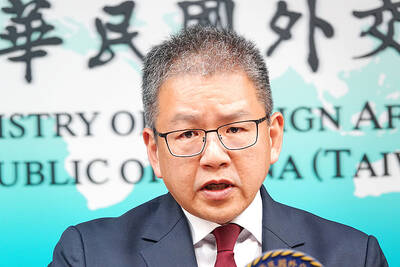
Taiwan is still in the process of assessing the possibility of recruiting workers from Eswatini, the Ministry of Foreign Affairs said yesterday, adding that its goal is to help Eswatini upgrade its vocational training centers. If there are plans to recruit workers from Eswatini, safeguarding national security, protecting public health and ensuring the employment rights of Taiwanese would be prerequisites, Department of West Asian and African Affairs Director-General Yen Chia-liang (顏嘉良) told a news conference. Key considerations would also include filling labor shortages in specific industries, and fostering bilateral professional and technical exchanges, he said. Yen was asked about the progress of labor
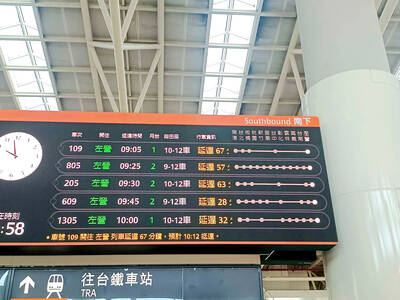
The nation’s usually punctual high-speed rail system yesterday was hit by major disruptions after all scheduled services were canceled and replaced with three hourly trains offering only non-reserved seating, affecting more than 200,000 passengers. Preliminary findings indicate the disruption was caused by a faulty power module in a track switch control cabinet, Taiwan High-Speed Rail Corp (THSRC) said, adding that as a full system inspection could only be conducted after operations end for the day, a decision on whether normal service would resume today would be announced before the first train departs. During a routine inspection early yesterday, a switch signal abnormality


 RSS
RSS