


An expected fight over the governance of the Internet looked to have been averted on Tuesday night as a tentative deal was struck which would allow the US government to retain overall control of the medium for the foreseeable future.
As delegates arrived for yesterday's opening of the UN-sponsored World Summit on the Information Society (WSIS) in the Tunisian capital, bureaucrats who had been locked in three days of pre-summit meetings reckoned they had a compromise.
The US government will retain overall control of the technology which powers the Internet -- its domain name system, root servers and the oversight of the California-based, not-for-profit Internet Corporation for Assigned Names and Numbers (ICANN) which looks after it all.
An Internet Governance Forum will be created to discuss and decide upon the over-reaching issues of the Internet, but, crucially, will not have any oversight powers.
Governments have also agreed to work within existing organizations and infrastructures to gradually transform the way the Internet is run.
EU BACKTRACKS
The agreement is a far cry from the inter-governmental oversight body that was proposed by the EU in September. That proposal, which shocked the US as much as it pleased Brazil, China and Iran, pushed the previously unnoticed issue of Internet governance on to the world stage and turned the topic into the main focus of the WSIS.
Just as surprising as the EU's proposal, however, has been its failure to push that model in Tunis this week.
In fiery opening statements, China and the US laid down their same, strong positions, but when it came to the EU to speak, delegation head David Hendon said only that it had "looked carefully at all positions, including our own" and deferred to the chair of the committee over which direction the meeting would take.
NO GRANDSTANDING
Masood Khan of Pakistan wasted no time in telling delegates that the world was expecting a decision and he would no longer accept grandstanding.
Stating that there would be no voting, only a process of consensus, Khan told delegates to find common ground and produce a list of points where they agreed. When they failed to do so after several hours of discussion, he suspended the meeting.
With such a provocative approach, the hopes that a radical solution would emerge were shot down by a series of interventions from the US and Australia. Russian attempts to push the forum into the hands of the International Telecommunications Union were neatly sidestepped.
STATUS QUO
By the end, what was left was an acceptance of the status quo with promises that they would be open to reform.
The finally wording remains to be decided but reform will have to take place in the governmental advisory committee of ICANN, which plays only an advisory role.
Internet watchers were puzzled by the EU's backtracking.
Recent speculation has centred on a letter from US Secretary of State Condoleezza Rice, to the EU in the run-up to the summit. Its contents have not been made public but Rice is said to have urged the EU to reconsider its approach.
Hendon confirmed the letter's existence but denied it had had any impact on the organization's position.
A large number of information-technology companies, including Microsoft and Google, have publicly stated their support for the existing model.
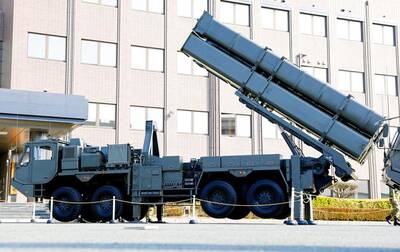
Japan has deployed long-range missiles in a southwestern region near China, the Japanese defense minister said yesterday, at a time when ties with Beijing are at their lowest in recent years. The missiles were installed in Kumamoto in the southern region of Kyushu, as Japan is attempting to shore up its military capacity as China steps up naval activity in the East China Sea. “Standoff defense capabilities enable us to counter the threat of enemy forces attempting to invade our country ... while ensuring the safety of our personnel,” Japanese Minister of Defense Shinjiro Koizumi said. “This is an extremely important initiative for

Chinese Nationalist Party (KMT) Chairwoman Cheng Li-wun (鄭麗文) today accepted an invitation from Chinese President Xi Jinping (習近平) to lead a delegation to China next month, saying she hopes to promote the peaceful development of cross-strait relations and bring stability to the Taiwan Strait. “I am grateful and happy to accept this invitation,” Cheng said in a statement from the KMT chairperson’s office. Cheng said she hopes both sides can work together to promote the peaceful development of cross-strait relations, enhance exchange and cooperation, bring stability to the Taiwan Strait and improve people’s livelihoods. At today's news conference, Cheng said any efforts to

MORE POPULAR: Taiwan Pass sales increased by 59 percent during the first quarter compared with the same period last year, the Tourism Administration said The Tourism Administration yesterday said that it has streamlined the Taiwan Pass, with two versions available for purchase beginning today. The tourism agency has made the pass available to international tourists since 2024, allowing them to access the high-speed rail, Taiwan Railway Corp services, four MRT systems and four Taiwan Tourist Shuttles. Previously, five types of Taiwan Pass were available, but some tourists have said that the offerings were too complicated. The agency said only two types of Taiwan Pass would be available, starting from a three-day pass with the high-speed rail and a three-day pass with Taiwan Railway Corp. The former costs NT$2,800

The nation’s fastest supercomputer, Nano 4 (晶創26), is scheduled to be launched in the third quarter, and would be used to train large language models in finance and national defense sectors, the National Center for High-Performance Computing (NCHC) said. The supercomputer, which would operate at about 86.05 petaflops, is being tested at a new cloud computing center in the Southern Taiwan Science Park in Tainan. The exterior of the server cabinet features chip circuitry patterns overlaid with a map of Taiwan, highlighting the nation’s central position in the semiconductor industry. The center also houses Taiwania 2, Taiwania 3, Forerunner 1 and


 RSS
RSS