


Ben Bernanke, the nominee to succeed Alan Greenspan as chairman of the US Federal Reserve, told lawmakers on Tuesday that it was a "false dichotomy" to assume that low inflation was at odds with rising wages and greater income equality.
"Middle-income living standards, and poverty for that matter, are best addressed through employment growth," Bernanke said at his confirmation hearing before the Senate Banking Committee.
"By maintaining low inflation and low expectations of inflation, you can create new employment," he said.
In his first extended public appearance since President George W. Bush nominated him to lead the Fed, Bernanke stoutly defended his proposal to base monetary policy on an explicit target for inflation and insisted that he would not weaken the central bank's "dual mandate" of promoting full employment as well as stable prices.
But he said he would proceed cautiously and seek consensus within the Fed before moving policy toward inflation targeting, one of the few areas of policy where Bernanke differs from Greenspan.
And in describing his approach he sharply distanced it from those of some central banks that focus on almost exclusively on an inflation target and not at all on promoting growth.
"I don't agree with that," Bernanke declared flatly.
Members of the committee, while making clear that Bernanke enjoys overwhelming support in the Senate and is all but certain to be confirmed soon, also warned him to maintain independence from the White House, where he served as Bush's chief economic adviser.
"I assure this committee that, if I am confirmed, I will be strictly independent of all political influences," Bernanke said in his opening statement.
Bernanke also strongly implied that the Fed did not necessarily need to raise interest rates in response to soaring energy prices, noting that long-run inflation expectations remain "well-anchored."
Lawmakers were reassured by his statements.
Senator Richard Shelby, a Republican and chairman of the banking committee, said that Bernanke "may well be the finest monetary economist of his generation."
Democrats praised his academic credentials, and spent most of their time coaxing assurances from Bernanke about his support for employment and about his political independence.
But in stressing his flexibility, Bernanke raised almost as many questions as he answered on how his proposal for a clear inflation objective would increase the Fed's credibility in financial markets.
He noted that there would be times when inflation climbed faster than the Fed's long-term goal and yet did not constitute a long-run threat, largely because investors and consumers now expected inflation to remain low in the long run.
"The contrast between the 1970s and today is very marked," Bernanke said, in response to questions from Senator Chris Dodd, a Democrat, on how he would react if natural gas prices spiked sharply this winter.
"Back then, we had high inflation expectations," Bernanke said, adding that the Fed may have waited too long and then over-reacted to higher oil prices, helping push the economy into recession.
Today, by contrast, "inflationary expectations remain well anchored" and the Fed could respond gently as long as those expectations remain low, he said.
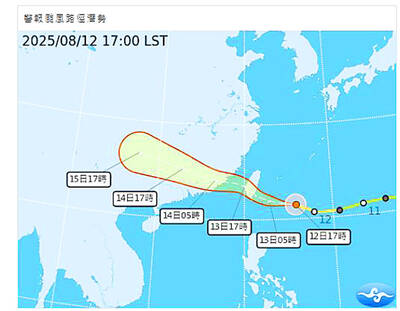
GET TO SAFETY: Authorities were scrambling to evacuate nearly 700 people in Hualien County to prepare for overflow from a natural dam formed by a previous typhoon Typhoon Podul yesterday intensified and accelerated as it neared Taiwan, with the impact expected to be felt overnight, the Central Weather Administration (CWA) said, while the Directorate-General of Personnel Administration announced that schools and government offices in most areas of southern and eastern Taiwan would be closed today. The affected regions are Tainan, Kaohsiung and Chiayi City, and Yunlin, Chiayi, Pingtung, Hualien and Taitung counties, as well as the outlying Penghu County. As of 10pm last night, the storm was about 370km east-southeast of Taitung County, moving west-northwest at 27kph, CWA data showed. With a radius of 120km, Podul is carrying maximum sustained

Tropical Storm Podul strengthened into a typhoon at 8pm yesterday, the Central Weather Administration (CWA) said, with a sea warning to be issued late last night or early this morning. As of 8pm, the typhoon was 1,020km east of Oluanpi (鵝鑾鼻), Taiwan’s southernmost tip, moving west at 23kph. The storm carried maximum sustained winds of 119kph and gusts reaching 155kph, the CWA said. Based on the tropical storm’s trajectory, a land warning could be issued any time from midday today, it added. CWA forecaster Chang Chun-yao (張竣堯) said Podul is a fast-moving storm that is forecast to bring its heaviest rainfall and strongest
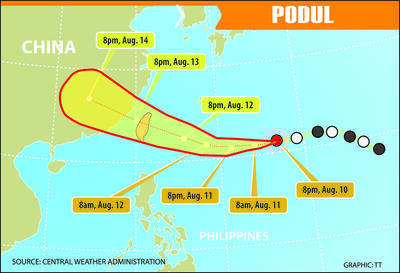
TRAJECTORY: The severe tropical storm is predicted to be closest to Taiwan on Wednesday and Thursday, and would influence the nation to varying degrees, a forecaster said The Central Weather Administration (CWA) yesterday said it would likely issue a sea warning for Tropical Storm Podul tomorrow morning and a land warning that evening at the earliest. CWA forecaster Lin Ting-yi (林定宜) said the severe tropical storm is predicted to be closest to Taiwan on Wednesday and Thursday. As of 2pm yesterday, the storm was moving west at 21kph and packing sustained winds of 108kph and gusts of up to 136.8kph, the CWA said. Lin said that the tropical storm was about 1,710km east of Oluanpi (鵝鑾鼻), Taiwan’s southernmost tip, with two possible trajectories over the next one

TALKS CONTINUE: Although an agreement has not been reached with Washington, lowering the tariff from 32 percent to 20 percent is still progress, the vice premier said Taiwan would strive for a better US tariff rate in negotiations, with the goal being not just lowering the current 20-percent tariff rate, but also securing an exemption from tariff stacking, Vice Premier Cheng Li-chiun (鄭麗君) said yesterday. Cheng made the remarks at a news conference at the Executive Yuan explaining the new US tariffs and the government’s plans for supporting affected industries. US President Donald Trump on July 31 announced a new tariff rate of 20 percent on Taiwan’s exports to the US starting on Thursday last week, and the Office of Trade Negotiations on Friday confirmed that it


 RSS
RSS