


The double-decker Airbus A380 made its first landing in Asia yesterday, and Airbus officials assured Asian airlines there will be no further delays in the delivery of the superjumbo, promising to compensate for losses.
The European jet maker, which has secured 159 firm orders for the plane so far, also said it is in talks to sell the jet to more carriers in China and India and is confident of maintaining its lead against US archrival Boeing Co.
In its first long-haul test flight outside of Europe, the giant airliner touched down shortly after 10am at Singapore's Changi Airport after completing a 13-hour flight covering 13,500km from Airbus' headquarters in Toulouse, southwest France.
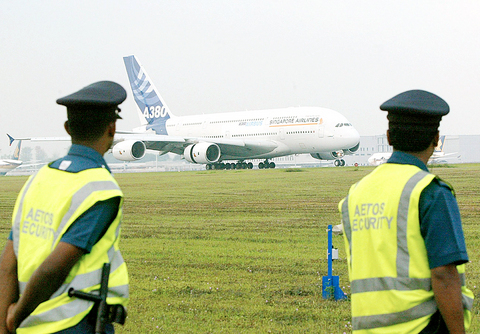
PHOTO: AFP
The great white jet, as tall as a seven-story building and stretching about three-quarters of the length of a soccer field, taxied down the runway amid tight security as hundreds of excited travelers and airport staff looked on.
The A380 prototype was originally due to arrive Tuesday in Singapore -- the first stop of an Asian-Pacific tour that includes Australia and Malaysia -- but Airbus postponed the trip three days to replace two of the plane's four engines.
Airbus chief operating officer Charles Champion, who is head of the A380 program, said there was no problem with the Rolls-Royce engine and the replacement was just a precautionary measure.
Seven airlines in the Asia-Pacific region have ordered a total of 49 A380s, accounting for 31 percent of 159 firm orders so far for the world's largest passenger aircraft.
But deliveries have been pushed back due to production delays, irking buyers.
Champion said the rollout of the plane was now on track and Airbus was "committed to deliver the first aircraft by the end of 2006" to Singapore Airlines, the first airline to operate the jet.
Singapore Airlines, which has ordered 10 A380s, has complained about an eight-month delay in delivery to next November. Australian Qantas, which has ordered 12 of the jets, and Malaysia Airlines, which has ordered six planes, are also unhappy with the postponement.
Airbus will compensate airlines for the delays according to contract terms, officials said.
"It is standard practice ... payments will be made for each day of delay in delivery. It is not an enormous amount of money considering how much the aircraft is worth," said John Leahy, chief operating officers for customers.
Other A380 customers in the region are Thai Airways, Korean Air, China Southern Airlines and India's Kingfisher Airlines.
Production will be ramped up, but new A380 customers will have to wait at least six years to take delivery, Champion said.
Singapore Airlines plans to start operating the jet by Christmas next year, said Bey Soo Khiang, a senior executive vice president. He also said the company was finalizing talks over compensation for the delays.
Singapore Transport Minister Yeo Cheow Tong toured the jet yesterday at Changi Airport, which has upgraded both its terminals to accommodate the A380, which has a list price of US$292 million.
With air travel expected to boom in the next 20 years, Leahy said the A380 -- which is designed to carry 555 passengers but can be stretched to accommodate 800 -- will help to ease airport congestion.

NO HUMAN ERROR: After the incident, the Coast Guard Administration said it would obtain uncrewed aerial vehicles and vessels to boost its detection capacity Authorities would improve border control to prevent unlawful entry into Taiwan’s waters and safeguard national security, the Mainland Affairs Council (MAC) said yesterday after a Chinese man reached the nation’s coast on an inflatable boat, saying he “defected to freedom.” The man was found on a rubber boat when he was about to set foot on Taiwan at the estuary of Houkeng River (後坑溪) near Taiping Borough (太平) in New Taipei City’s Linkou District (林口), authorities said. The Coast Guard Administration’s (CGA) northern branch said it received a report at 6:30am yesterday morning from the New Taipei City Fire Department about a

IN BEIJING’S FAVOR: A China Coast Guard spokesperson said that the Chinese maritime police would continue to carry out law enforcement activities in waters it claims The Philippines withdrew its coast guard vessel from a South China Sea shoal that has recently been at the center of tensions with Beijing. BRP Teresa Magbanua “was compelled to return to port” from Sabina Shoal (Xianbin Shoal, 仙濱暗沙) due to bad weather, depleted supplies and the need to evacuate personnel requiring medical care, the Philippine Coast Guard (PCG) spokesman Jay Tarriela said yesterday in a post on X. The Philippine vessel “will be in tiptop shape to resume her mission” after it has been resupplied and repaired, Philippine Executive Secretary Lucas Bersamin, who heads the nation’s maritime council, said

CHINA POLICY: At the seventh US-EU Dialogue on China, the two sides issued strong support for Taiwan and condemned China’s actions in the South China Sea The US and EU issued a joint statement on Wednesday supporting Taiwan’s international participation, notably omitting the “one China” policy in a departure from previous similar statements, following high-level talks on China and the Indo-Pacific region. The statement also urged China to show restraint in the Taiwan Strait. US Deputy Secretary of State Kurt Campbell and European External Action Service Secretary-General Stefano Sannino cochaired the seventh US-EU Dialogue on China and the sixth US-EU Indo-Pacific Consultations from Monday to Tuesday. Since the Indo-Pacific consultations were launched in 2021, references to the “one China” policy have appeared in every statement apart from the

More than 500 people on Saturday marched in New York in support of Taiwan’s entry to the UN, significantly more people than previous years. The march, coinciding with the ongoing 79th session of the UN General Assembly, comes close on the heels of growing international discourse regarding the meaning of UN Resolution 2758. Resolution 2758, adopted by the UN General Assembly in 1971, recognizes the People’s Republic of China (PRC) as the “only lawful representative of China.” It resulted in the Republic of China (ROC) losing its seat at the UN to the PRC. Taiwan has since been excluded from


 RSS
RSS