


Volkswagen AG's US sales of its namesake brand rose 72 percent in the first 10 days of the month as record gasoline prices prompted buyers to trade in sport-utility vehicles for small cars and demand more diesel models, the brand's top US executive said.
The US unit is seeking more diesel engines for the new Jetta car than planned because gasoline price increases and scattered fuel shortages caused by hurricane Katrina are prompting buyers to ask for diesel cars, Len Hunt, the top US executive for the Volkswagen brand, said in an interview. Diesel engines can get 40 percent better fuel economy than gasoline motors.
``There has been a massive interest in demand for the Jetta diesel,'' Hunt, 49, said. ``Initially we thought diesel demand might be 15 percent of the Jetta sales in the US and it's more than 20 percent already and rising. It was under way before, but Katrina has accelerated it.'' The US misfortune from Katrina, which initially knocked out 10 percent of US refinery capacity, might benefit Volkswagen, whose US sales have dropped for three consecutive years and were down 17 percent through July. Volkswagen August sales rose 2.7 percent as buyers began to shun the largest SUVs and flocked to smaller cars.
Volkswagen, Europe's largest carmaker, last week said that Hunt will swap jobs next month with Adrian Hallmark, 43, the head of marketing for the luxury Bentley brand, as the company tries to reverse losses and sales declines in the US. Hunt is in Germany this week for the Frankfurt International Motor Show.
Volkswagen lost 1 billion euros (US$1.24 billion) last year in the US, the world's largest automobile market. Chief executive Bernd Pischetsrieder said Aug. 24 the carmaker is unlikely to turn a profit there until at least 2007 because of pricing pressures and the dollar's decline against the euro. The jump in gasoline prices will help the German automaker's new models, Hunt said.
Americans are paying more for their gasoline after adjusting for inflation than at any point since 1981, during the Iran-Iraq war, and prices may keep climbing, Charles Maxwell, senior energy analyst at Weeden & Co in Greenwich, Connecticut, said last week.
The average US retail price jumped US$0.45 the week of Sept. 29 to US$3.057 a gallon, according to AAA, the largest motorists' organization. Gasoline prices in 1981, after the revolution in Iran and during that country's war with Iraq, equaled US$3.14 in today's dollars.
Oil refinery shutdowns initially idled more than 1.77 million barrels a day of capacity, or 10 percent of the nation's total, according to Energy Department data, after Katrina slammed into the coasts of Louisiana and Mississippi.
Four refineries were still down last week.
Buying trends indicate that people who don't normally consider diesel are switching, Hunt said. Volkswagen was caught short of diesel Jettas with automatic transmissions because traditional diesel buyers prefer a manual gearbox, he said. Many of the new buyers are first-time diesel owners, Hunt said.
In Texas, the state with among the largest US concentration of pickup truck buyers, the percentage of Jettas sold with diesel engines has more than doubled in the last several months, to about 30 percent, Hunt said.
Volkswagen is also testing diesel models to see if they can operate properly using diesel fuel that is composed of 20 percent renewable components such as soybean oil, Hunt said. Current models are only approved so-called biodiesel with 5 percent of the crop additives, he said. Adding more vegetable oil to diesel would require less petroleum, he said.
DaimlerChrysler AG's Dieter Zetsche, who will take over as chief executive in January when Juergen Schrempp retires, has said US demand for Jeep Liberty SUV and Mercedes E-Class sedan with diesels was already exceeding initial expectations before the hurricane as gasoline prices rose. Zetsche was head of Chrysler and now leads the Mercedes Car Group.
Diesel traditionally has not been as popular in the US as in Europe, where about half the car and light truck models sold now use diesel fuel. Five US states, including California and New York, ban sales of new diesel cars and trucks, because the models produce higher levels of pollutants than gasoline models. Only about 1 percent of new US cars and light trucks are sold with diesels.
New US regulations in 2007 will require diesel models sold in the other 45 US states to be cleaner than those sold now.
Diesel fuel is available at about a third of US fueling stations.
Biodiesel fuel is available primarily in areas with high soybean production, such as Ohio.
Toyota Motor Corp, Honda Motor Co executives also said they expect many US consumers to shift back to cars from less fuel-efficient light trucks after small cars gained and the sales of the largest SUVs fell in August.
Demand for the largest sport-utilities, among the least fuel-efficient trucks, dropped 17 percent.

A Chinese aircraft carrier group entered Japan’s economic waters over the weekend, before exiting to conduct drills involving fighter jets, the Japanese Ministry of Defense said yesterday. The Liaoning aircraft carrier, two missile destroyers and one fast combat supply ship sailed about 300km southwest of Japan’s easternmost island of Minamitori on Saturday, a ministry statement said. It was the first time a Chinese aircraft carrier had entered that part of Japan’s exclusive economic zone (EEZ), a ministry spokesman said. “We think the Chinese military is trying to improve its operational capability and ability to conduct operations in distant areas,” the spokesman said. China’s growing

Nine retired generals from Taiwan, Japan and the US have been invited to participate in a tabletop exercise hosted by the Taipei School of Economics and Political Science Foundation tomorrow and Wednesday that simulates a potential Chinese invasion of Taiwan in 2030, the foundation said yesterday. The five retired Taiwanese generals would include retired admiral Lee Hsi-min (李喜明), joined by retired US Navy admiral Michael Mullen and former chief of staff of the Japan Self-Defense Forces general Shigeru Iwasaki, it said. The simulation aims to offer strategic insights into regional security and peace in the Taiwan Strait, it added. Foundation chair Huang Huang-hsiung

PUBLIC WARNING: The two students had been tricked into going to Hong Kong for a ‘high-paying’ job, which sent them to a scam center in Cambodia Police warned the public not to trust job advertisements touting high pay abroad following the return of two college students over the weekend who had been trafficked and forced to work at a cyberscam center in Cambodia. The two victims, surnamed Lee (李), 18, and Lin (林), 19, were interviewed by police after landing in Taiwan on Saturday. Taichung’s Chingshui Police Precinct said in a statement yesterday that the two students are good friends, and Lin had suspended her studies after seeing the ad promising good pay to work in Hong Kong. Lee’s grandfather on Thursday reported to police that Lee had sent
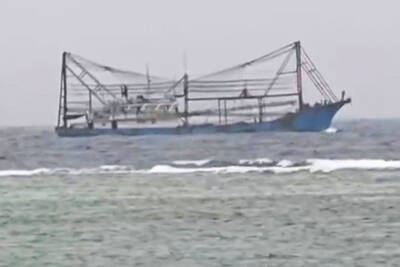
A Chinese ship ran aground in stormy weather in shallow waters off a Philippines-controlled island in the disputed South China Sea, prompting Filipino forces to go on alert, Philippine military officials said yesterday. When Philippine forces assessed that the Chinese fishing vessel appeared to have run aground in the shallows east of Thitu Island (Jhongye Island, 中業島) on Saturday due to bad weather, Philippine military and coast guard personnel deployed to provide help, but later saw that the ship had been extricated, Philippine navy regional spokesperson Ellaine Rose Collado said. No other details were immediately available, including if there were injuries among


 RSS
RSS