


All is not well in the real Toyland. Last month, thousands of workers went on strike. Millions more are seeking alternative employment. The running costs of Christmas are going through the roof. And ferocious haggling over prices is pushing toymakers out of business in record numbers.
That, at least, is one interpretation of recent trends in the workshop of the world: Guangdong Province in southern China, where labor -- until recently thought to be docile in nature and unlimited in supply -- is either drying up or squaring up to some of the most exploitative management practices in industrial history.
With its palm trees, high-rise apartment blocks and hangar-sized factories, Guang-dong could not be much more different from the north pole. But over the past 10 years, it has come to play an increasingly central role in the global Christmas experience.
By one estimate, more than 80 percent of the world's Christmas trees and 75 percent of the toys that are wrapped up under them are produced within an 80km radius of Shenzhen port. The dense cluster of production lines is also the origin of many gifts for adults, including clothes, shoes and electrical appliances.
International retailers and manufacturers outsource here because Guangdong's labor costs are among the lowest in the world. More than 80 percent of the 10 million population of Shenzhen and neighboring Dongguan are migrant workers from the countryside. They have no rights to residency, little or no support from trade unions and often get paid a lot less than the minimum wage of 610 yuan (US$74) a month.
For years, these conditions were grudgingly endured because labor supply far outstripped demand in China. With the world's biggest population -- 1.3 billion people -- and widespread rural poverty, many economists assumed that it would continue to do so for a long time to come, but there are growing signs that the tolerance of this floating workforce may be reaching its limit.
In the autumn, the labor ministry reported a shortfall of 2 million workers in Dongguan and Shenzhen. Local recruitment agencies say they are struggling to meet even a tenth of the demand from factories. Guangzhou city was so alarmed by the shortage that it raised its minimum wage by 35 percent. For the first time, Shenzhen's government has sent out recruitment teams to Sichuan, Yunnan and Henan instead of waiting for the workers to flock to the city.
Sociologists are divided about the causes of the labor shortage. Some say it is because conditions in the countryside are improving, while the threefold increase in wages in Guangdong over the past 15 years has failed to keep up with the fivefold rise in prices. Others argue that migrants are tired of being excluded from the benefits of a region that claims to be the richest in China.
With jobs easier to come by, workers are increasingly emboldened to take industrial action. Among the biggest of many recent strikes took place at the Haiyan Electronics factory, which makes DVD and CD players for the international market. Last month, 3,000 employees blocked the streets for five hours in protest at a basic monthly salary of 230 yuan.
Nine of the organizers were arrested, but the demonstration worked -- the vice-governor of Shenzhen intervened personally to fire the manager and triple salaries -- which brought them to just above the minimum wage. The blue-collar workers -- almost all of whom are middle-aged women supporting children left behind in the countryside -- say it was worth it.
"I was very frightened. I've never been on a strike before. But now things are a little better," said a Sichuanese woman who has spent most of the last two decades working 100-hour weeks for about one yuan an hour. "There has been almost no change in the past 20 years."
The ripples are likely to be felt overseas in higher retail prices. The Zhongmei Toy factory, one of the biggest toymakers in the country, expects to double its minimum monthly wage from 400 yuan to 800 yuan within the next five years.
A chunk of such increases will be passed on to shoppers in the west. It is still to be seen whether overseas buyers will begrudge the extra cost or Guangdong's workers will accept the tiny narrowing of the gap between the producers and the consumers of Christmas.
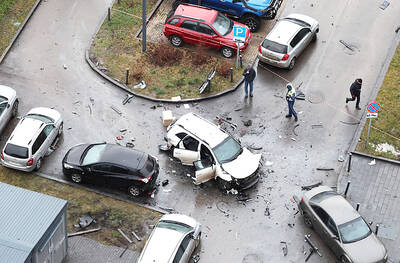
A car bomb killed a senior Russian general in southern Moscow yesterday morning, the latest high-profile army figure to be blown up in a blast that came just hours after Russian and Ukrainian delegates held separate talks in Miami on a plan to end the war. Kyiv has not commented on the incident, but Russian investigators said they were probing whether the blast was “linked” to “Ukrainian special forces.” The attack was similar to other assassinations of generals and pro-war figures that have either been claimed, or are widely believed to have been orchestrated, by Ukraine. Russian Lieutenant General Fanil Sarvarov, 56, head

SAFETY FIRST: Double the number of police were deployed at the Taipei Marathon, while other cities released plans to bolster public event safety Authorities across Taiwan have stepped up security measures ahead of Christmas and New Year events, following a knife and smoke bomb attack in Taipei on Friday that left four people dead and 11 injured. In a bid to prevent potential copycat incidents, police deployments have been expanded for large gatherings, transport hubs, and other crowded public spaces, according to official statements from police and city authorities. Taipei Mayor Chiang Wan-an (蔣萬安) said the city has “comprehensively raised security readiness” in crowded areas, increased police deployments with armed officers, and intensified patrols during weekends and nighttime hours. For large-scale events, security checkpoints and explosives
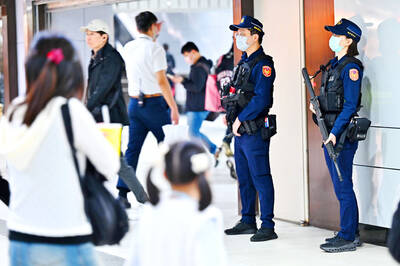
PUBLIC SAFETY: The premier said that security would be tightened in transport hubs, while President Lai commended the public for their bravery The government is to deploy more police, including rapid response units, in crowded public areas to ensure a swift response to any threats, President William Lai (賴清德) said yesterday after a knife attack killed three people and injured 11 in Taipei the previous day. Lai made the remarks following a briefing by the National Police Agency on the progress of the investigation, saying that the attack underscored the importance of cooperation in public security between the central and local governments. The attack unfolded in the early evening on Friday around Taipei Main Station’s M7 exit and later near the Taipei MRT’s Zhongshan
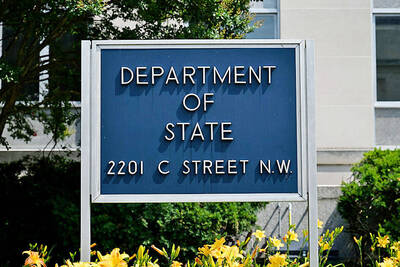
REBUFFED: In response to Chinese criticism over recent arms sales, Washington urged Beijing to engage in meaningful dialogue instead of threats and intimidation Washington’s long-term commitment to Taiwan would not change, the US Department of State said yesterday, urging Beijing to stop pressuring Taiwan and engage in meaningful bilateral dialogues. The remarks came in response to a backlash from Beijing about Washington’s latest approval of arms sales to Taiwan. The US Defense Security Cooperation Agency said in a statement on Wednesday that the Taipei Economic and Cultural Representative Office in the US has asked to purchase an arms package, including Tactical Mission Network Software; AH-1W helicopter spare and repair parts; M109A7 self-propelled howitzers; HIMARS long range precision strike systems; tube-launched, optically tracked, wire-guided missiles; Javelin


 RSS
RSS