


The French, who are never immune to fashion or status, have fallen in love with the sports utility vehicle (SUV) -- but at the worst possible time.
As sales of the macho four-wheel-drive vehicles continue to skyrocket, local and national governments are moving to nip this automotive fad in the bud.
According to figures provided by Toyota, SUV sales rose by nearly 20 percent in the first half of 2004 compared to the same period last year, with some 54,000 units sold in France.
This was the fifth consecutive six-month sales increase for the SUV and came at a time when sales of other types of cars were stagnating.
According to the French division of the manufacturer Land Rover, the success is easy to explain: "People like sitting high up in order to be able to see the landscape."
Whatever the reason, the increasing number of SUVs rolling down French streets and motorways has not pleased everyone and has provoked the first skirmishes in what increasingly is looking like a bitter war between car manufacturers and SUV enthusiasts on the one hand and elected officials on the other.
On June 8, the Paris City Council fired the first shot in voting a "wish to limit the use of" SUVs in the French capital because, according to the Paris Green Party, they produce "four times more carbon dioxide than other cars".
While this figure is not quite accurate, tests have shown that SUVs are the biggest polluters by far on four wheels, producing between 14 and 84 percent more carbon dioxide than other cars.
The reason is that it takes more power to propel the heavy all-terrain vehicle, which consequently requires a larger engine and more petrol. In the city, an SUV consumes 48 percent more petrol on the average than a classic automobile.
According to Green Party politician Denis Baupin, the Paris deputy mayor for transport who tabled the initiative, "SUVs have no reason to be in cities. They are unadapted to urban traffic because they pollute, take up to too much space and are a danger to pedestrians."
His comments echoed earlier statements by London Mayor Ken Livingstone, who labeled people that take their children to school in SUVs as "idiots."
The Paris City Council's move brought an immediate and angry response from the president of the French Association of SUVs, Eric Breteau.
Revenge of the SUVs
"SUVs have the right to drive everywhere, just like other vehicles," Breteau thundered, and denounced the Paris initiative as "whimsical and crude propaganda."
Breteau and his fellow SUV lovers have little to fear from the Paris undertaking; not yet, in any case.
More threatening is a move by the French government to tax purchasers of polluting vehicles such as the SUV and reward those who buy low-emission cars.
Beginning on Jan. 1, a person who buys an SUV equipped with a V8 diesel engine will pay a special tax of about 3,000 euros (US$3,700), while the buyer of a high-performance automobile will be asked to pay 1,500 euros.
On the other hand, someone who purchases a car such as the Peugeot 206 diesel equipped with a particulate filter -- that is, a low-emission vehicle -- will receive a bonus of about 800 euros.
The so-called "bonus/malus" plan is part of a wide-reaching environmental programme undertaken by the government of Prime Minister Jean-Pierre Raffarin to reduce air and water pollution in France.
The government is acting because cancer rates directly tied to air pollution have increased alarmingly since 1980, with 30,000 deaths now anticipated each year because of carbon dioxide and other atmospheric pollutants.
The concerted efforts of environmentalists and governments may just transform the fashionable SUV into a pariah, like the cigarette.
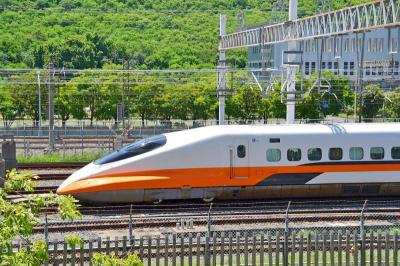
A signaling system malfunction disrupted high-speed rail (HSR) services beginning at 8am today, with trains temporarily reduced to three northbound and three southbound trains per hour as authorities conduct inspections. The malfunction occurred on a section of track in Miaoli County during pre-operation checks early this morning, forcing northbound and southbound trains to use a single track, the HSR operator said. The regular schedule has been replaced with three hourly trains offering only nonreserved seating in each direction, stopping at every station, it said, adding that business class cars would still have reserved seating. Departures from terminal stations are scheduled at the top

Taiwan is still in the process of assessing the possibility of recruiting workers from Eswatini, the Ministry of Foreign Affairs said yesterday, adding that its goal is to help Eswatini upgrade its vocational training centers. If there are plans to recruit workers from Eswatini, safeguarding national security, protecting public health and ensuring the employment rights of Taiwanese would be prerequisites, Department of West Asian and African Affairs Director-General Yen Chia-liang (顏嘉良) told a news conference. Key considerations would also include filling labor shortages in specific industries, and fostering bilateral professional and technical exchanges, he said. Yen was asked about the progress of labor

A US uncrewed surface vessel (USV) encountered multiple Chinese warships during an autonomous transit of the Taiwan Strait, US defense company Seasats said in a statement on Wednesday. Seasats announced that a Lightfish USV had completed the first autonomous transit of the Taiwan Strait. Over five days, the USV traversed the entire length of the Strait while constantly monitoring surface vessel traffic, the company said. The Lightfish encountered multiple Chinese warships, one of which was a Chinese People’s Liberation Army Navy (PLAN) Type 056 corvette, it said. The Chinese vessels were operating “well within Taiwan’s exclusive economic zone without transmitting their identity via the
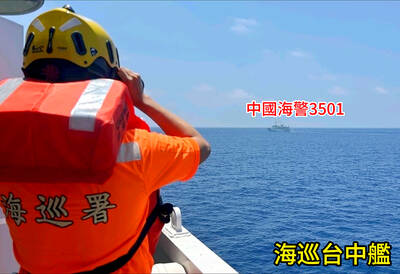
VERBOSE VESSELS: A CGA cutter and a China Coast Guard exchanged verbal barbs for more than a day in Taiwanese-controlled waters before the Chinese vessel left The Taiwanese and Chinese coast guards had a standoff near the strategically located Pratas Islands (Dongsha Islands, 東沙群島) in the north of the South China Sea, the Coast Guard Administration (CGA) said yesterday. The two sides engaged in intense radio exchanges over sovereignty claims during the 33-hour standoff. China Coast Guard vessel 3501 eventually left the restricted waters, 26.6 nautical miles (49.2km) west of the Pratas Islands, at 5pm yesterday, the CGA said. Lying approximately between southern Taiwan and Hong Kong, the Taiwan-controlled Pratas are seen by some security experts as vulnerable to Chinese attack due to their distance — more than


 RSS
RSS