


Two former executives of BNP Paribas North America, the New York-based unit of the large French bank, pleaded guilty Wednesday to stealing more than US$12 million from their employer, in a case brought by Robert Morgenthau, the Manhattan district attorney, and the Federal Reserve Bank of New York.
The two men, Edward Canale and Michael Connolly, who worked in the bank's junk bond trading and distressed real estate operations, set up shell companies that bought securities from BNP Paribas at prices significantly below those in the prevailing market.
The securities were later sold at considerable gains.
"This is about equal justice and about making sure that nobody is above the law," Morgenthau said. "We want to make people understand that when you steal, even though you are a banker with a suit and tie on, you're going to be prosecuted."
Canale and Connolly, who were arrested on Wednesday, have repaid US$8 million of the US$12.2 million that they stole, Morgenthau said, and have promised to pay back the rest.
Judge Michael Ambrecht of New York State Supreme Court, before whom the men pleaded guilty, said Canale would receive a sentence of two to six years in state prison and Connolly would be sentenced to 18 months to four and a half years. The two will be sentenced in February.
They were released on Wednesday on their own recognizance.
Three-year scheme
Canale, 56, and Connolly, 34, began their scheme in June 2001, prosecutors said, when they established two New York-based shell companies, Hydra Capital and Brel Associates.
The two companies profited by buying junk bonds and other debt securities from BNP Paribas at heavily discounted prices and then selling them for profits soon afterward.
The men also diverted payouts and equity conversions owed to BNP Paribas from companies that were being restructured.
Prosecutors said they learned of the scheme last March from a bank employee.
One transaction cited by pro-secutors involved bonds issued by Confederation Life Insurance, a company in liquidation, which netted US$5.6 million for Canale and Connolly. Another transaction, which produced gains of almost US$900,000, involved bonds of Rhythms Net-connections, a telecommunications company that filed for bankruptcy in August 2001.
quiet transactions
Securities of distressed compan-ies, like those used in the scheme, trade infrequently and are difficult to value because transactions are not posted publicly as they are in the stock market.
Canale, a managing director at BNP Paribas until he was put on leave earlier this year, joined the bank in 1992. Before that, he had been an executive at a savings and loan institution.
During the years that the theft occurred, Canale ran BNP Paribas' asset workout group, which deals in securities of distressed or bankrupt companies.
Canale hired Connolly to run the junk bond portfolio at BNP Paribas in 2001, prosecutors said.
The way the operation was set up, any sale of distressed debt from the bank's portfolio had to be approved by both Canale and Connolly.
BNP Paribas is among the largest banks in Europe by market value and the ninth-largest bank in the world. In North America, BNP Paribas offers commercial banking, investment banking and securities brokerage services.
Morgenthau said that the investigation was continuing and that the two men were cooperating with prosecutors.
That Canale and Connolly could steal US$12.2 million without attracting the attention of regulators might have been because the bank's primary regulator was the Federal Reserve of San Francisco, Morgenthau said.
Even though BNP Paribas is based in and conducts much of its business in New York City, the bank did not file regular reports with the New York state banking department, he said.
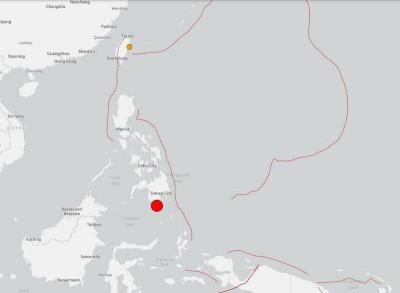
A magnitude 7.8 earthquake struck off the southern coast of Mindanao in the Philippines at 7:38am today, prompting the US Tsunami Warning System to issue an alert for neighboring countries, including Taiwan. The system issued a purple alert indicating a "tsunami threat." The potential threat zone includes Taiwan, the Philippines, Papua New Guinea, Yap and Palau. Philippine authorities were assessing the damage from the quake, with the office of civil defense seeking to verifying initial reports that 15 people had been killed and 129 injured in the region, mostly from falling debris. Arlene Hollero, disaster chief of Maasim town in the Philippines' Sarangani Province,
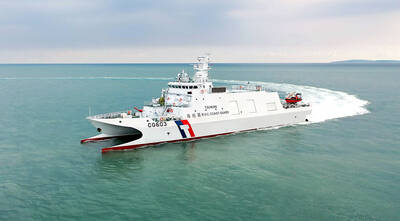
‘GRAY ZONE’ PRESSURE: Beijing’s activities are intended to create the deceitful impression that China has jurisdiction over the area around Taiwan, the CGA said Taiwan’s rights over its territorial waters and exclusive economic zone must not be violated by any country, the Mainland Affairs Council said yesterday, adding that it will not accept any unprovoked actions. The council issued the remarks in response to the China Coast Guard conducting maritime enforcement drills near eastern Taiwan and claiming to fully exercise China’s maritime administrative law enforcement authority. The Coast Guard Administration (CGA) has been closely monitoring the situation and is taking concrete steps to defend the nation’s sovereignty and secure its waters, the council said. China has no sovereign rights over the waters off eastern

RESILIENCE: Taiwan plays a key role in semiconductors, energy, information infrastructure and advanced manufacturing, AIT Director Raymond Greene said Taiwan’s continued investment in deterrence and resilience remains vital, especially in uncrewed systems and other emerging technologies, American Institute in Taiwan (AIT) Director Raymond Greene said yesterday. Greene made the remarks at the annual National Strategic Summit on Supply Chain Resilience held by the Research Institute for Democracy, Society and Emerging Technology (DSET), a government-backed think tank. As Taiwan last year became the US’ fourth-largest trading partner and supply chain security is becoming more important, cooperation in emerging technologies continues to deepen between the two countries, he said. The US is committed to accelerating innovation, building key infrastructure, strengthening cooperation

The National Chungshan Institute of Science and Technology yesterday showcased its locally developed variants of the Vision 60 robotic patrol dog, which it plans to deploy on the nation’s outlying territories in the South China Sea. The variants were produced under the Joint Lab project — created by the institute and domestic companies — and assembled with domestically produced motors, lenses and artificial intelligence (AI) systems alongside licensed tech from the US, Missile and Rocket Systems Research Division deputy director Jen Kuo-kang (任國光) told the media event at a military base in Taipei’s Dazhi (大直) area. Taiwan has built up its strengths


 RSS
RSS