


Toys R Us issued a stunning statement Wednesday that it plans to split off the babies-related division and sell the main toys business.
In an "update" on the company's strategic review, the struggling group said it had decided to separate the global toys and the Babies R Us businesses but it had not yet decided how to do so.
"As part of this comprehensive review, the company is taking steps, among other actions, to explore the possible sale of the global toy business as well as to prepare for a possible spin-off of Babies R Us," the statement said.
In the meantime, the board had decided to operate the baby-related and global toys businesses as separate entities within the current corporate structure.
Toys R Us, hurt by competition with major discounters such as Wal-Mart, said it also would restructure the toy business to "dramatically reduce operating and capital expenses" and boost cash flow.
"The series of steps we are announcing today reflect the fact that our global toy business and our Babies R Us business operate in distinct markets, and are at fundamentally different phases in their growth cycle," said chairman and chief executive John Eyler.
"Consequently, by ultimately operating them as separate entities, we will provide a better opportunity for Babies R Us to continue its healthy growth," he said.
"In addition, whatever form the separation takes, these steps should facilitate the execution of a restructured -- and substantially leaner and more focused -- global toy business that we believe can generate significant cash."
The group said it planned to:Separate the toys and babies divisions by the first half of fiscal 2005; restructure the headquarters in Wayne, New Jersey and cut headquarters and toy business operating costs by US$125 million by fiscal 2005 from last year.
It also planned to lower investment in global toys to less than US$150 million next year and take about US$150 million in markdowns in the second quarter primarily to liquidate selected US toy store inventory and generate extra cash.
"Overall, the strategic plan we are pursuing is intended to enable Babies R Us to continue to prosper as a separate entity while also putting our global toy business on a solid foundation," Eyler said.
Meanwhile, Toys R Us Japan Ltd, the Japanese unit of the world's largest toy-store chain, expects no immediate impact from its US parent's plan to separate its toy retailing and baby products businesses.
Toys R Us Japan doesn't plan to separate its toy and baby businesses, said Toshiaki Haruna, a spokesman for the Japanese retailer.
"We will proceed with our own business plans," he said.
Adopting the US company's strategy would counter the Japanese unit's expansion plan. Toys R Us Japan, based in Kanagawa Prefecture, near Tokyo, has said it intends to increase its outlets to 250 by 2010. It had 143 toy stores and three baby product outlets as of Jan. 31, according to its Web site.
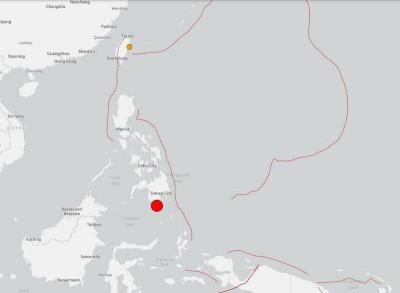
A magnitude 7.8 earthquake struck off the southern coast of Mindanao in the Philippines at 7:38am today, prompting the US Tsunami Warning System to issue an alert for neighboring countries, including Taiwan. The system issued a purple alert indicating a "tsunami threat." The potential threat zone includes Taiwan, the Philippines, Papua New Guinea, Yap and Palau. Philippine authorities were assessing the damage from the quake, with the office of civil defense seeking to verifying initial reports that 15 people had been killed and 129 injured in the region, mostly from falling debris. Arlene Hollero, disaster chief of Maasim town in the Philippines' Sarangani Province,
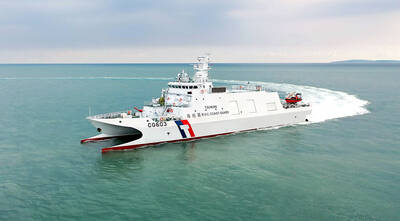
‘GRAY ZONE’ PRESSURE: Beijing’s activities are intended to create the deceitful impression that China has jurisdiction over the area around Taiwan, the CGA said Taiwan’s rights over its territorial waters and exclusive economic zone must not be violated by any country, the Mainland Affairs Council said yesterday, adding that it will not accept any unprovoked actions. The council issued the remarks in response to the China Coast Guard conducting maritime enforcement drills near eastern Taiwan and claiming to fully exercise China’s maritime administrative law enforcement authority. The Coast Guard Administration (CGA) has been closely monitoring the situation and is taking concrete steps to defend the nation’s sovereignty and secure its waters, the council said. China has no sovereign rights over the waters off eastern
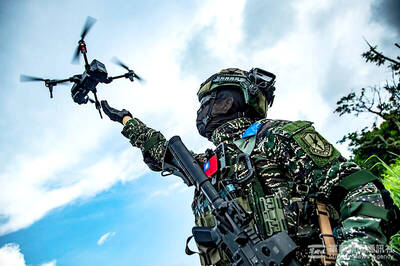
RESILIENCE: Taiwan plays a key role in semiconductors, energy, information infrastructure and advanced manufacturing, AIT Director Raymond Greene said Taiwan’s continued investment in deterrence and resilience remains vital, especially in uncrewed systems and other emerging technologies, American Institute in Taiwan (AIT) Director Raymond Greene said yesterday. Greene made the remarks at the annual National Strategic Summit on Supply Chain Resilience held by the Research Institute for Democracy, Society and Emerging Technology (DSET), a government-backed think tank. As Taiwan last year became the US’ fourth-largest trading partner and supply chain security is becoming more important, cooperation in emerging technologies continues to deepen between the two countries, he said. The US is committed to accelerating innovation, building key infrastructure, strengthening cooperation

The National Chungshan Institute of Science and Technology yesterday showcased its locally developed variants of the Vision 60 robotic patrol dog, which it plans to deploy on the nation’s outlying territories in the South China Sea. The variants were produced under the Joint Lab project — created by the institute and domestic companies — and assembled with domestically produced motors, lenses and artificial intelligence (AI) systems alongside licensed tech from the US, Missile and Rocket Systems Research Division deputy director Jen Kuo-kang (任國光) told the media event at a military base in Taipei’s Dazhi (大直) area. Taiwan has built up its strengths


 RSS
RSS