


■ Economies
Seoul raises interest rates
South Korea's central bank unexpectedly cut its key interest rate by a quarter percentage point to a record to spur the economy. Bank of Korea Governor Park Seung and his six fellow policy makers lowered the overnight call rate to 3.5 percent at a monthly policy meeting in Seoul. The decision reflects a slump in consumer demand caused by rising fuel costs and a crackdown on credit-card debt. "The real economy has exhibited a slowdown in its pace of recovery as there has been a delay in any marked improvement of private consumption," the Bank of Korea said in a statement. "The pace of economic growth may be even slower, largely due to the likelihood of the more stubborn than expected persistence of high oil prices and of a worldwide cooling of the information and technology sector."
■ Telecoms
Motorola has IRS woes
Motorola Inc said on Wednesday that the US Internal Revenue Service (IRS) is seeking US$500 million or more in back taxes in a dispute over the way the company calculated earnings. In a federal filing, Motorola said the IRS has concluded that the company should have reported an additional US$1.4 billion in income during the period of 1996 to 2000. Motorola said it is "vigorously" contesting that decision, which would require it pay an additional US$500 million in back taxes. The IRS could also dispute Motorola's reported results since 2000, resulting in additional tax payments. The dispute centers on so-called transfer pricing, which occurs when one unit of a diversified company "sells" goods to another part. The company said it does not expect the matter to affect its overall financial health, even if it loses the dispute, but said it could take a temporary hit to financial results in the quarter in which the dispute is finally resolved.
■ Economies
China's CPI rose 5.3%
China's inflation rate last month rose 5.3 percent year-on-year, its fastest growth rate in seven years, as food prices continued to surge, data showed yesterday. The sharply rising prices have put more pressure on the central bank to raise inter-est rates. The year-on-year rise in consumer prices last month was the highest since February 1997, but came within government fore-casts after prices rose 5 percent in June. Analysts said last month's data sig-nalled a further rise in the inflation rate with prices seen moving a little higher in the third quarter. The latest increase puts inflation level with the central bank's benchmark one-year lending rate, which analysts have warned could force China to raise interest rates, making it more expensive to borrow money. The consu-mer price index in the first seven months rose 3.8 percent year-on-year, com-pared with a rise of 3.6 percent in the first six months and 0.6 percent growth in the same period last year, the National Bureau of Statistics said.
■ Transportation
KLM hikes fares
KLM Royal Dutch Airlines said on Wednesday it will raise airfares by 1 percent
to 3 percent this month in response to rising demand for air travel. The higher rates will apply to all tickets worldwide, it said in a state-ment. KLM has been suf-fering from a slump in international travel blamed on terrorism fears, the war in Iraq, SARS and an eco-nomic recession. The fare hike will apply to tickets purchased from Aug. 17.
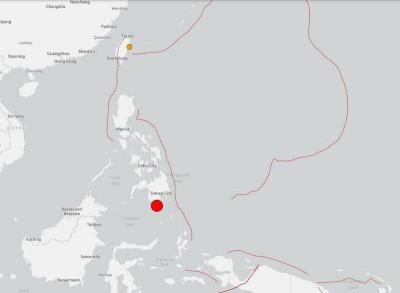
A magnitude 7.8 earthquake struck off the southern coast of Mindanao in the Philippines at 7:38am today, prompting the US Tsunami Warning System to issue an alert for neighboring countries, including Taiwan. The system issued a purple alert indicating a "tsunami threat." The potential threat zone includes Taiwan, the Philippines, Papua New Guinea, Yap and Palau. Philippine authorities were assessing the damage from the quake, with the office of civil defense seeking to verifying initial reports that 15 people had been killed and 129 injured in the region, mostly from falling debris. Arlene Hollero, disaster chief of Maasim town in the Philippines' Sarangani Province,

‘GRAY ZONE’ PRESSURE: Beijing’s activities are intended to create the deceitful impression that China has jurisdiction over the area around Taiwan, the CGA said Taiwan’s rights over its territorial waters and exclusive economic zone must not be violated by any country, the Mainland Affairs Council said yesterday, adding that it will not accept any unprovoked actions. The council issued the remarks in response to the China Coast Guard conducting maritime enforcement drills near eastern Taiwan and claiming to fully exercise China’s maritime administrative law enforcement authority. The Coast Guard Administration (CGA) has been closely monitoring the situation and is taking concrete steps to defend the nation’s sovereignty and secure its waters, the council said. China has no sovereign rights over the waters off eastern
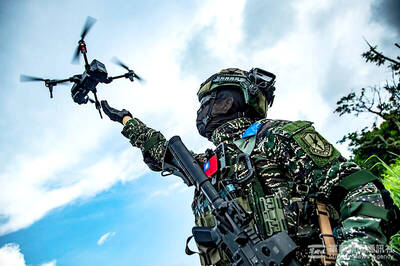
RESILIENCE: Taiwan plays a key role in semiconductors, energy, information infrastructure and advanced manufacturing, AIT Director Raymond Greene said Taiwan’s continued investment in deterrence and resilience remains vital, especially in uncrewed systems and other emerging technologies, American Institute in Taiwan (AIT) Director Raymond Greene said yesterday. Greene made the remarks at the annual National Strategic Summit on Supply Chain Resilience held by the Research Institute for Democracy, Society and Emerging Technology (DSET), a government-backed think tank. As Taiwan last year became the US’ fourth-largest trading partner and supply chain security is becoming more important, cooperation in emerging technologies continues to deepen between the two countries, he said. The US is committed to accelerating innovation, building key infrastructure, strengthening cooperation

The National Chungshan Institute of Science and Technology yesterday showcased its locally developed variants of the Vision 60 robotic patrol dog, which it plans to deploy on the nation’s outlying territories in the South China Sea. The variants were produced under the Joint Lab project — created by the institute and domestic companies — and assembled with domestically produced motors, lenses and artificial intelligence (AI) systems alongside licensed tech from the US, Missile and Rocket Systems Research Division deputy director Jen Kuo-kang (任國光) told the media event at a military base in Taipei’s Dazhi (大直) area. Taiwan has built up its strengths


 RSS
RSS