


The price of many staple foodstuffs has more than doubled in China's capital as residents stock up, alarmed by rumors that much of the city will close down due to atypical pneumonia.
In the Jingkelong supermarket, a popular chain in Beijing, eggs that cost 1.8 yuan last week are now 3.5 yuan (US$0.40).
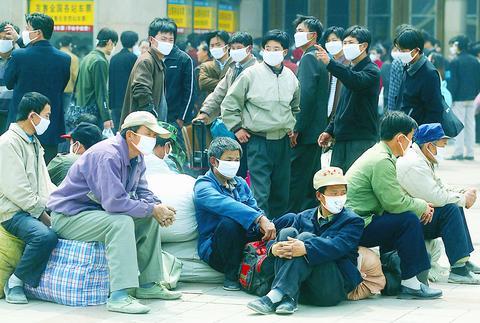
PHOTO: REUTERS
In the Huapu supermarket, onions now cost five yuan, five times the published price a week ago. Tomatoes have increased by 30 percent.
"The majority of prices are stable and the Communist Party will not let people die of hunger, but the government should not let them raise prices like this," said Wang Jian, an elderly man who complained the panic buying was an overeaction.
"Look at me, I do not carry a mask, it is ridiculous that all these people are stocking up. It's an overreaction," he said.
The rush on supermarkets started earlier this week as the rumor mill ground out reports that trains would stop running to Beijing, and the city of 13 million would be isolated with tough new quarantine measures in place.
"The panic started Tuesday afternoon. They are pouring in," said a cashier at a supermarket in eastern Beijing. "I'm buying this stuff because I heard the city is going to be isolated," said one elderly shopper.
It follows the government's admission that the extent of the severe acute respiratory syndrome (SARS) epidemic was far worse than it initially admitted, with the numbers of confirmed cases in Beijing jumping from 44 to 774 in a matter of days.
Add to that 39 deaths and Beijingers are a bag of nerves.
The rumors have been categorically denied in the state-run press, but many Beijing residents do not believe the rhetoric nor assurances from the government that shops will remain open and fully stocked.
Earlier this week, the government said it was urgently working to check price rises by launching a nationwide check on excessive charges for drugs and staple foodstuffs.
The State Development and Reform Commission said in an emergency notice that it would "severely punish" those profiting from SARS fears, but it appears not to have stopped vendors.
After disappearing from shops during the week as demand soared, many products have reappeared but at prices considered to be prohibitory.
At a market in Yonganli district, the price of green vegetables has doubled, and in some cases tripled, customers complain.
"I'm buying all this because then I will then not need to leave home," said one woman as she loaded her car with crates of vegetables and fruit.
The price of rice has also doubled in some street markets, if it can be found.
Many people complain it has become difficult to find basic products like rice, oil, noodles, sugar and salt

NO HUMAN ERROR: After the incident, the Coast Guard Administration said it would obtain uncrewed aerial vehicles and vessels to boost its detection capacity Authorities would improve border control to prevent unlawful entry into Taiwan’s waters and safeguard national security, the Mainland Affairs Council (MAC) said yesterday after a Chinese man reached the nation’s coast on an inflatable boat, saying he “defected to freedom.” The man was found on a rubber boat when he was about to set foot on Taiwan at the estuary of Houkeng River (後坑溪) near Taiping Borough (太平) in New Taipei City’s Linkou District (林口), authorities said. The Coast Guard Administration’s (CGA) northern branch said it received a report at 6:30am yesterday morning from the New Taipei City Fire Department about a

IN BEIJING’S FAVOR: A China Coast Guard spokesperson said that the Chinese maritime police would continue to carry out law enforcement activities in waters it claims The Philippines withdrew its coast guard vessel from a South China Sea shoal that has recently been at the center of tensions with Beijing. BRP Teresa Magbanua “was compelled to return to port” from Sabina Shoal (Xianbin Shoal, 仙濱暗沙) due to bad weather, depleted supplies and the need to evacuate personnel requiring medical care, the Philippine Coast Guard (PCG) spokesman Jay Tarriela said yesterday in a post on X. The Philippine vessel “will be in tiptop shape to resume her mission” after it has been resupplied and repaired, Philippine Executive Secretary Lucas Bersamin, who heads the nation’s maritime council, said

REGIONAL STABILITY: Taipei thanked the Biden administration for authorizing its 16th sale of military goods and services to uphold Taiwan’s defense and safety The US Department of State has approved the sale of US$228 million of military goods and services to Taiwan, the US Department of Defense said on Monday. The state department “made a determination approving a possible Foreign Military Sale” to the Taipei Economic and Cultural Representative Office in the US for “return, repair and reshipment of spare parts and related equipment,” the defense department’s Defense Security Cooperation Agency said in a news release. Taiwan had requested the purchase of items and services which include the “return, repair and reshipment of classified and unclassified spare parts for aircraft and related equipment; US Government

More than 500 people on Saturday marched in New York in support of Taiwan’s entry to the UN, significantly more people than previous years. The march, coinciding with the ongoing 79th session of the UN General Assembly, comes close on the heels of growing international discourse regarding the meaning of UN Resolution 2758. Resolution 2758, adopted by the UN General Assembly in 1971, recognizes the People’s Republic of China (PRC) as the “only lawful representative of China.” It resulted in the Republic of China (ROC) losing its seat at the UN to the PRC. Taiwan has since been excluded from


 RSS
RSS