


Japan’s commitment to the rights of its indigenous people has been questioned after organizers of this summer’s Tokyo Olympics dropped a performance by members of the Ainu ethnic minority from the Games’ opening ceremony.
Members of the Ainu community, originally from Japan’s northernmost island of Hokkaido, had been expecting to showcase their culture to the world in a dance at the New National Stadium, but have learned that the plans had been scrapped.
The performance had been dropped from the ceremony due to “logistical constraints,” the organizing committee said.
“Unfortunately, this particular Ainu dance performance could not be included because of logistical constraints related to the ceremonies,” the committee said in a statement.
“However, Tokyo 2020 is still deliberating other ways to include the Ainu community. We are not able to provide further details of the content of the opening and closing ceremonies,” it said.
Japan Broadcasting Corp last week said that an Ainu ceremonial dance would be included in a cultural exposition at the Tokyo National Museum next month, but Ainu representatives said that performers, who had already started rehearsing, had been anticipating an appearance on a much bigger stage.
“Everyone was looking forward to performing at the Olympic stadium,” said Kazuaki Kaizawa of the Ainu Association of Hokkaido, which started discussing the inclusion of an Ainu element in the opening ceremony with organizers three years ago.
“We are willing to talk to the organizers about how Ainu culture can be represented during the Olympics,” Kaizawa said, adding that the organizing committee had yet to explain its decision. “We’re hopeful something can be worked out.”
The decision sits uncomfortably with moves by Japan’s government to improve the status of the Ainu.
In May last year, the Japanese Diet passed a law that legally recognized them as Japan’s indigenous people, obliging the government to protect their cultural identity and ban discrimination in employment, education and other areas.
The law was intended to officially end more than a century of discrimination that began in the late 19th century, when Japan’s Meiji-era government took control of Hokkaido, where the Ainu had been hunting, fishing, practicing an animist religion and speaking their own language since the 1300s, experts said.
However, after opening the island to Japanese settlers, the government forced the Ainu, who it referred to as “former aborigines,” to assimilate.
An estimated 13,000 Ainu live in Hokkaido, according to a 2017 survey, although the actual number is thought to be much greater, as many are reluctant to identify themselves as Ainu and have moved to other parts of Japan.
Members of the Ainu community continue to encounter prejudice. They are half as likely to attend university as other Japanese, according to official data, and Ainu households can expect to earn significantly less than the national average.
In a 2017 survey, more 23 percent of Ainu people said that they had been discriminated against.
“Society was not accepting of the Ainu, and it still isn’t,” Hokkaido University anthropologist Mai Ishihara said. “There are still many people who keep their Ainu identity secret from their children.”
The lack of awareness of Japan’s indigenous people extends to the upper echelons of government.
Last month, Japanese Minister of Finance Taro Aso drew condemnation after he claimed that Japan had been racially homogeneous for 2,000 years.
“There is no other nation but Japan where a single race has spoken a single language at a single location, and maintained a single dynasty with a single emperor for over 2,000 years,” Aso told supporters in his constituency. “It is a great nation.”
Aso later apologized.
“If my remarks caused a misunderstanding, I apologize and will correct them,” he said.
Ainu representatives hope the opening in April of the National Ainu Museum and Park in Hokkaido will lead to wider recognition of their history and traditions.
Known as Upopoy — or “singing together” in the Ainu language — the US$220 million facility is part of a drive by Japanese Prime Minister Shinzo Abe to draw more visitors to Sapporo, the biggest city in Hokkaido and now the venue for the Olympic marathons.
The events were controversially moved to Sapporo from Tokyo after the International Olympic Committee acted on warnings about the threat the capital’s searing heat and humidity posed to athletes and spectators.
“We hope people from around the world come to the park, but we also want to see lots of visitors from Japan,” Kaizawa said. “Too many Japanese are still unaware of our existence and our culture.”
Additional reporting by Reuters

A coalition of civil rights groups on Tuesday asked a New York State judge to order one of its largest suburban counties to stop its deployment of nearly 600 license plate readers, calling it a warrantless and “indiscriminate surveillance system” that violates the state constitution. The class action lawsuit also alleged that Westchester County never got proper authorization to launch the program, which has amassed a database of 1.6 billion plate scans that has been shared with more than 50 outside law enforcement agencies. The complaint said the network “records the long-term travel patterns, daily habits, and intimate information of millions of
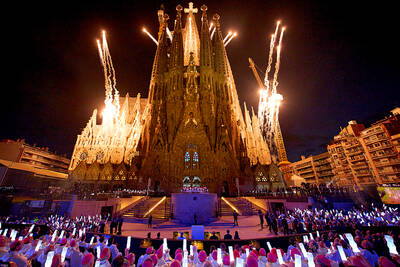
Pope Leo XIV on Wednesday blessed a giant new tower at Barcelona’s famed Sagrada Familia Basilica after celebrating mass inside what is now the world’s tallest church. A fireworks and light show illuminated the exterior of the temple at the end of the ceremony, bathing the unfinished basilica in shifting colours that highlighted its towering spires. A choir of 600 singers performed at the service which lasted around 90 minutes and was attended by Spanish Prime Minister Pedro Sanchez as well as King Felipe VI and Queen Letizia. The stained-glass windows in various colours shone brightly in between the tree-like

Voters in Switzerland yesterday cast their ballots on an initiative championed by the top right-wing party to cap the Alpine country’s population at 10 million. As of press time last night, early results showed that Swiss voters were leaning against it. The populist Swiss People’s Party, which has the most seats in parliament, has stirred up and fostered anti-migration sentiment over the years, notably about an influx of workers from the neighboring EU. Critics called the bid a self-inflicted wound, saying the boom in migration over the past generation has brought foreign labor and skills to sectors such as healthcare, finance, pharmaceuticals

Scientists have discovered communities of marine life — including jellyfish, tubeworms and brittle stars — thriving on a whale graveyard. The graveyards form when whale carcasses fall to the sea floor, becoming a sustaining snack for nearby critters. This one, which is up to 7km below the surface of the southeastern Indian Ocean, spans the largest area, and is so far the deepest found. A whale’s sheer size and the unique chemistry of its bones are the keys to forming these unique underwater neighborhoods, said Song Xikun (宋希坤), a biologist with the Chinese Academy of Sciences’ Institute of Deep-sea Science and Engineering


 RSS
RSS