


Uruguay’s long-dominant leftist ruling party was facing defeat in a presidential election runoff yesterday as the small South American country prepared to swing to the right.
Opinion polls showed that Uruguayan Senator Luis Lacalle Pou, the 46-year-old leader of the center-right National Party, was likely to win as voters appeared set to turn the page on 15 years of leftist rule.
Lacalle Pou trailed outgoing Montevideo Mayor Daniel Martinez, the ruling Broad Front’s candidate, in last month’s first round, but a pact with center-right and right-wing parties following simultaneous legislative elections has given him a majority in Uruguayan Congress as well as a significant lead heading into the runoff.

Photo: AP
“Polls suggest he has a 6-8 point lead, although the result may well tighten,” said Robert Wood, Latin America manager for the Economist Intelligence Unit.
A win for the right would “reflect a trend in the region of voters rejecting the incumbent party over disappointing results,” he said.
The runoff was effectively a referendum on 15 years of rule by the Broad Front — or Frente Amplio — which has won the last three elections.
“Voters are tired of economic stagnation, high unemployment and rising crime since the end of the commodity supercycle and will look to Mr Lacalle Pou for improvements,” Wood told reporters.
Inflation is running at 7.5 percent and unemployment at 9 percent.
The Broad Front, a coalition of leftist movements, can point to a record of progressive government since it broke a decades-long conservative stranglehold on government in 2005.
Uruguay stood out on the international stage by approving abortion and gay marriage, and the small nation pioneered the legalization of cannabis in 2013.
However, Lacalle Pau has tapped into voter concerns over the country’s high tax rates and promised to look elsewhere to raise the US$900 million needed to reduce the public deficit, nearly 5 percent of GDP.
“Uruguay can’t bear any more taxes,” he told supporters.
The latest polls showed Lacalle Pou at 51 percent, ahead of the 43 percent for Martinez.
Uruguay has long been considered a bastion of peace and stability in an often turbulent region.
“Uruguay continues to be cited as an example of a functioning democracy in the region, whilst rejecting extremist populists outcomes,” said Paul Hare of Boston University.
“It is an example for other regions, including the United States,” Hare told reporters.
However, security has been declining, with a sharp rise in some violent crimes reported last year.
South America’s second-smallest country last year registered a record 414 murders, up 45 percent on the year before. About 2.6 million voters were called to the polls yesterday.
The next president is to take office in March for five years.

PARLIAMENT CHAOS: Police forcibly removed Brazilian Deputy Glauber Braga after he called the legislation part of a ‘coup offensive’ and occupied the speaker’s chair Brazil’s lower house of Congress early yesterday approved a bill that could slash former Brazilian president Jair Bolsonaro’s prison sentence for plotting a coup, after efforts by a lawmaker to disrupt the proceedings sparked chaos in parliament. Bolsonaro has been serving a 27-year term since last month after his conviction for a scheme to stop Brazilian President Luiz Inacio Lula da Silva from taking office after the 2022 election. Lawmakers had been discussing a bill that would significantly reduce sentences for several crimes, including attempting a coup d’etat — opening up the prospect that Bolsonaro, 70, could have his sentence cut to

A plan by Switzerland’s right-wing People’s Party to cap the population at 10 million has the backing of almost half the country, according to a poll before an expected vote next year. The party, which has long campaigned against immigration, argues that too-fast population growth is overwhelming housing, transport and public services. The level of support comes despite the government urging voters to reject it, warning that strict curbs would damage the economy and prosperity, as Swiss companies depend on foreign workers. The poll by newspaper group Tamedia/20 Minuten and released yesterday showed that 48 percent of the population plan to vote

A powerful magnitude 7.6 earthquake shook Japan’s northeast region late on Monday, prompting tsunami warnings and orders for residents to evacuate. A tsunami as high as three metres (10 feet) could hit Japan’s northeastern coast after an earthquake with an estimated magnitude of 7.6 occurred offshore at 11:15 p.m. (1415 GMT), the Japan Meteorological Agency (JMA) said. Tsunami warnings were issued for the prefectures of Hokkaido, Aomori and Iwate, and a tsunami of 40cm had been observed at Aomori’s Mutsu Ogawara and Hokkaido’s Urakawa ports before midnight, JMA said. The epicentre of the quake was 80 km (50 miles) off the coast of
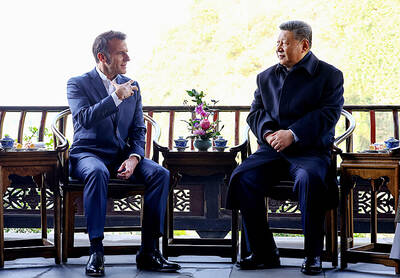
RELAXED: After talks on Ukraine and trade, the French president met with students while his wife visited pandas, after the pair parted ways with their Chinese counterparts French President Emmanuel Macron concluded his fourth state visit to China yesterday in Chengdu, striking a more relaxed note after tough discussions on Ukraine and trade with Chinese President Xi Jinping (習近平) a day earlier. Far from the imposing Great Hall of the People in Beijing where the two leaders held talks, Xi and China’s first lady, Peng Liyuan (彭麗媛), showed Macron and his wife Brigitte around the centuries-old Dujiangyan Dam, a World Heritage Site set against the mountainous landscape of Sichuan Province. Macron was told through an interpreter about the ancient irrigation system, which dates back to the third century


 RSS
RSS