


The Democratic Republic of the Congo’s (DR Congo) top court yesterday declared opposition leader Felix Tshisekedi the winner of disputed presidential elections after throwing out a legal challenge by the runner-up.
Announcing the final results of the much-delayed poll, the Congolese Constitutional Court said Tshisekedi had won by a simple majority, paving the way for him to take over from Congolese President Joseph Kabila.
Runner-up Martin Fayulu, who has previously described the outcome as an “electoral coup” forged by Tshisekedi and Kabila, immediately called on the international community to reject the results.
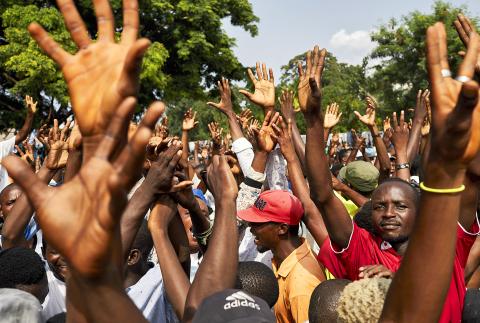
Photo: EPA-EFE
“I ask the entire international community not to recognize a power that has neither legitimacy nor legal standing to represent the Congolese people,” he said of Tshisekedi, declaring himself “the only legitimate president.”
Tshisekedi’s victory was provisionally announced earlier this month by the Independent National Election Commission (CENI), but it was challenged at home and abroad, with the African Union appealing for the final results to be delayed.
Yesterday, the Constitutional Court said Fayulu’s claims were “unfounded” and he had failed to prove any inaccuracies in the figures, describing his call for a recount as “absurd.”
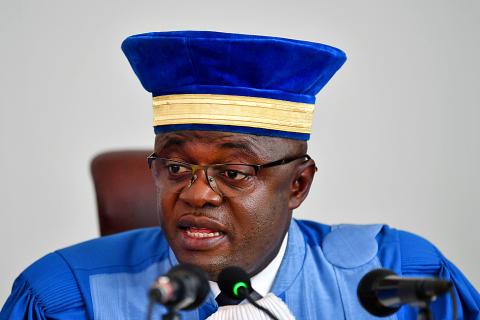
Photo: AFP
“Only the CENI has produced authentic and sincere results,” judge Noel Kilomba said.
The court declared Tshisekedi as the “president of the Democratic Republic of Congo by simple majority.”
Hundreds of supporters of Tshisekedi had gathered outside the court holding placards saying: “No to interference” and “Independent country” as riot police stood nearby.
The CENI has previously scheduled the swearing-in of the next president for tomorrow.
The election commission on Jan. 10 announced that Tshisekedi had provisionally won with 38.57 percent of the vote against Fayulu’s 34.8 percent.
The head of the country’s oldest and biggest opposition party, the Union for Democracy and Social Progress, 55-year-old Tshisekedi has never held high office or even a managerial role.
At a summit on Thursday, African Union leaders said there were “serious doubts” about the figures and called for the final results to be delayed.
However, Congolese government spokesman Lambert Mende had snubbed the demand, saying: “I don’t think it is the business of the government or even of the African Union to tell the court what it should do.”
The African Union had planned to send its commission chief, Moussa Faki Mahamat, and Rwandan President Paul Kagame, currently the African Union chairman, to DR Congo today.
The EU said it joined the African Union in inviting “all the Congolese players to work constructively with this [African Union] delegation to find a post-electoral solution which respects the Congolese people’s vote.”
The Financial Times and other foreign media have reported seeing documents that confirm Fayulu as the winner.
The Roman Catholic Church, which says it deployed 40,000 observers to monitor the poll, has also dismissed the official outcome as not reflecting the true result.
“If the court declares Tshisekedi victor, the risk of isolation would be enormous and untenable for a country positioned right in the middle of the continent,” Adeline van Houtte of the Economist Intelligence Unit wrote on Twitter.
Fayulu’s camp had hailed the African Union’s appeal for the final result to be put on hold, but Tshisekedi’s supporters branded it “scandalous.”
The dispute has raised fears that the political crisis that began when Kabila refused to step down at the end of his constitutional term in office two years ago could turn into a bloodbath.
An Internet shutdown, ordered by the authorities on Dec. 31 following the election, ended just before final results were announced in the early hours of yesterday morning.
The vast and chronically unstable country lived through two regional wars in 1996-1997 and 1998-2003, and the previous two elections, in 2006 and 2011, were marred by bloody clashes.
The Afrian Union has taken the firmest line of all major international bodies with regard to the post-election crisis.
The Southern African Development Community, a bloc that includes Angola and South Africa, initially called for a recount and a unity government.
However, in a later communique, it made no mention of those demands, instead calling on Congolese politicians to “address any electoral grievances in line with the Democratic Republic of Congo’s constitution and relevant electoral laws.”

It began as a satirical online project. Now millions of young people in India are flocking to it as an outlet for their frustration. A parody political party called the Cockroach Janta Party, with the insect as its symbol, has exploded across India’s social media by turning absurdist humor into protest. Memes and short videos mocking corruption, joblessness and political dysfunction have flooded social media sites, where millions of users are embracing the cockroach — known for its ability to survive harsh conditions — as a tongue-in-cheek symbol of endurance. The online movement’s rise has been unusually rapid. The Cockroach Janta Party (CJP)

SPEAKING OUT: After Siranudh Scott’s allegations surfaced, celebrities and public figures took to social media to share their own experiences of sexual misconduct and abuse A high-profile alleged sexual abuse case within a wealthy Thai beer brewing family has prompted a wave of painful accounts from survivors of unconnected abuse in the conservative nation. Siranudh Scott, a member of the billionaire Thai family that founded the ubiquitous Singha beer brand, posted an emotional video this month accusing his elder brother Sunit of repeatedly abusing him when he was a teenager. Sunit, who is in his 30s, later denied the allegations in a video posted online, but Singha parent Boonrawd dismissed him from his executive role with the company on Tuesday last week. “I felt I needed to speak
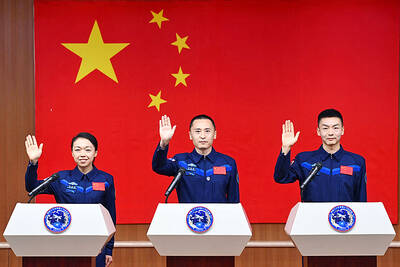
A Hong Kong astronaut is to join a Chinese space mission for the first time as part of a three-person crew launching today, as Beijing edges closer to its goal of landing people on the moon. The Tiangong space station — crewed by teams of three astronauts that are typically rotated every six months — is the crown jewel of China’s space program, boosted by billions in state investment in a bid to catch up with the US and Russia. The Shenzhou-23 mission is to blast off at 11:08pm from the Jiuquan Satellite Launch Center in northwestern China, carrying three astronauts to
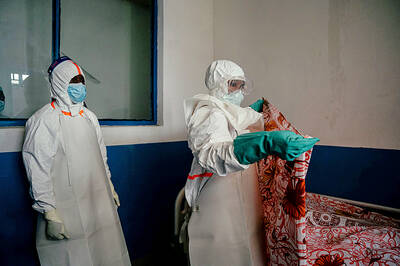
UPGRADED ALERT: The risk inside DR Congo is now considered ‘very high,’ while neighboring countries face a ‘high’ threat as the outbreak continues, the WHO said Ebola is spreading faster than responders can track it in eastern Congo, where health workers managed to follow up with barely one in five identified contacts in a single day. Authorities in the Democratic Republic of the Congo (DR Congo) reported 83 confirmed infections, 746 suspected cases and 1,603 identified contacts as of Thursday, but health workers were able to follow up on only 342 contacts that day — about 21 percent of the total under monitoring — data released by the DR Congo Ministry of Public Health on Friday showed. The figures suggest the response is falling behind the outbreak itself,


 RSS
RSS