


The launch of Sputnik 60 years ago opened the space era and became a major triumph for the Soviet Union, showcasing its military might and technological prowess. It also stunned the rest of the world.
Details of the development and the launch of the first artificial satellite were hidden behind the veil of secrecy that surrounded the Soviet space program and only became known decades later.
Amid a tense Cold War arms race with the US, the Soviet Union focused its efforts on building the world’s first intercontinental ballistic missile capable of delivering a hydrogen warhead to the US. The R-7 missile Semyorka was built by a team led by Sergei Korolyov, and tests of the rocket began in 1957.
Korolyov, a visionary scientist and a shrewd manager, pressed the reluctant military brass to use one of the first R-7s to put a satellite in orbit.
He warned Soviet leaders that the US was also developing a satellite and won the Kremlin’s permission for the launch.
While there already was a project for a full-fledged scientific satellite, Korolyov ordered his team of engineers to design a primitive orbiter to save time and beat the US into space. The craft, which was built in only a few months, was named PS-1, for prosteishiy sputnik — the simplest satellite.
The satellite, weighing less than 84kg and slightly larger than a basketball, was a pressurized sphere of polished aluminum alloy with two radio transmitters and four antennae.
An earlier satellite project envisaged a cone-shape vehicle, but Korolyov opted for the sphere.
“The Earth is a sphere and its first satellite also must have a spherical shape,” he was quoted as saying.
While the rest of the world was stunned by the Soviet accomplishment, the Kremlin’s leadership seemed to be slow to grasp the scope of the event.
The first official Soviet report of Sputnik’s launch was brief and buried deep inside the pages of Pravda, the Soviet Communist Party’s daily newspaper.
Only two days after the launch did it come out with a banner headline and quotes of the foreign accolades.
Sputnik contained a radio transmitter, broadcasting a distinctive “beep-beep-beep” sound.
Pravda published a description of Sputnik’s orbit to help people watch it pass.
However, it did not mention that the light seen moving across the night sky was the spent booster rocket’s second stage, which was in about the same orbit as the satellite. The tiny orbiter itself was invisible to the naked eye.
Sputnik orbited Earth for three months before burning up in the atmosphere.
Thrilled by the global furor caused by Sputnik’s launch, the Kremlin immediately ordered Korolyov to launch a new satellite to mark the Nov. 7 anniversary of the 1917 Bolshevik Revolution. His team succeeded in building a spacecraft in less than a month, and on Nov. 3 launched Sputnik 2, which weighed about 508kg.
It carried the world’s first passenger, a dog named Laika. While the dog died of the heat soon after the launch, the flight proved that a living being could survive in space.
On April 12, 1961, the Soviet Union made another giant leap ahead of the US when Yuri Gagarin became the first human in space.
The Soviet lead in space prompted the US to pour money into research and technology.
In 1969, the US won the race to land the first man on the moon, while the Soviet program collapsed in a series of booster rocket explosions.
Amid the shroud of secrecy around the Soviet rocket and space program, Korolyov was never mentioned in any contemporary accounts of the launch. His key role was known only to a small circle of senior Soviet officials and space engineers.
Korolyov was only allowed to publish the non-secret parts of his research under the pseudonym Professor K. Sergeyev, while Leonid Sedov, a member of the Soviet Academy of Sciences with no connection to space program, was erroneously praised in the West as the Father of Sputnik.
Then-premier of the Soviet Union Nikita Khrushchev rejected the Nobel Committee’s offer to nominate Sputnik’s designer for a prize, insisting it was the achievement of “the entire Soviet people.”
Korolyov’s daughter, Natalia, recalled later that her father sometimes felt bitter about the secrecy.
“We are like miners — we work underground,” she quoted him as saying. “No one sees or hears us.”


PHISHING: The con might appear convincing, as the scam e-mails can coincide with genuine messages from Apple saying you have run out of storage For a while you have been getting messages from Apple saying “your iCloud storage is full.” They say you have exceeded your storage plan, so documents are no longer being backed up, and photos you take are not being uploaded. You have been resisting Apple’s efforts to get you to pay a minimum of £0.99 (US$1.33) a month for more storage, but it seems that you cannot keep putting off the inevitable: You have received an e-mail which says your iCloud account has been blocked, and your photos and videos would be deleted very soon. To keep them you need
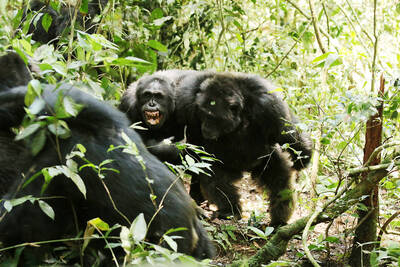
For two decades, researchers observed members of the Ngogo chimpanzee group of Kibale National Park in Uganda spend their days eating fruits and leaves, resting, traveling and grooming in their tropical rainforest abode, but this stable community then fractured and descended into years of deadly violence. The researchers are now describing the first clearly documented example of a group of wild chimpanzees splitting into two separate factions, with one launching a series of coordinated attacks against the other. Adult males and infants were targeted, with 28 deaths. “Biting, pounding the victim with their hands, dragging them, kicking them — mostly adult males,

The Israeli military has demolished entire villages as part of its invasion of south Lebanon, rigging homes with explosives and razing them to the ground in massive remote detonations. The Guardian reviewed three videos posted by the Israeli military and on social media, which showed Israel carrying out mass detonations in the villages of Taybeh, Naqoura and Deir Seryan along the Israel-Lebanon border. Lebanese media has reported more mass detonations in other border villages, but satellite imagery was not readily available to verify these claims. The demolitions came after Israeli Minister of Defense Israel Katz called for the destruction of
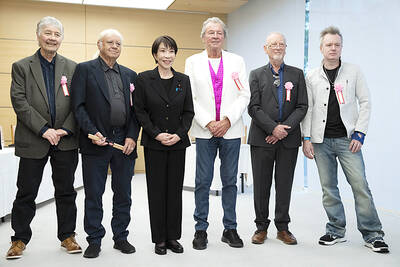
SUPERFAN: The Japanese PM played keyboard in a Deep Purple tribute band in middle school and then switched to drums at university, she told the British rock band Legendary British rock band Deep Purple yesterday made Japanese Prime Minister Sanae Takaichi’s day with a brief visit to their high-profile superfan as they returned to the nation they first toured more than half a century ago. Takaichi’s reputation as an amateur drummer, and a fan of hard rock and heavy metal has been well documented, and she has referred to Deep Purple as one of her favorite bands along with the likes of Black Sabbath and Iron Maiden. “You are my god,” a giddy Takaichi said in English to Deep Purple drummer Ian Paice, presenting him with a set of made-in-Japan


 RSS
RSS