


The Roman Catholic Church will allow priests throughout the world to grant absolution for abortion, the Vatican said on Monday, making permanent a policy that Pope Francis announced a year ago.
In a document marking the conclusion of the church’s year-long Jubilee of Mercy, the pope extended a policy of allowing priests — and not only bishops or special confessors — to grant forgiveness for abortion, which the church considers a sin. The announcement was a signal of the pope’s vision of a more welcoming, merciful and inclusive church.
While firmly restating his opposition to abortion as “a grave sin, since it puts an end to an innocent life,” the pope affirmed that “there is no sin that God’s mercy cannot reach and wipe away when it finds a repentant heart seeking to be reconciled with the Father.”
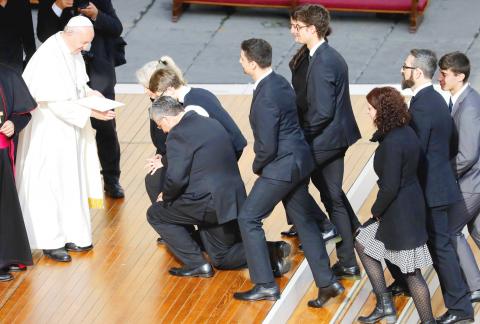
Photo: AP
The document, an apostolic letter, was signed on Sunday after a Mass denoting the end of the jubilee year. It was made public on Monday.
Pope Francis’ decision last year, at the start of the jubilee, followed in the footsteps of Pope John Paul II, who granted priests the same right during the previous holy year, in 2000.
Under canon law, abortion brings automatic excommunication unless the person receiving or performing it confesses and receives absolution. Abortion is considered a “reserved sin,” meaning that permission to grant forgiveness usually must come from a bishop.
Bishops could already delegate the authority to grant absolution to parish priests — and many bishops in the US had done so — but the practice varied widely by country and even by diocese. In parts of the world, observant Catholics who have sought absolution for abortions have faced delays at times, or even rejection.
In some places, priests have been delegated the power to absolve abortions during certain times of the year, like Lent, Archbishop Rino Fisichella, president of the Pontifical Council for Promoting the New Evangelization, said at a news conference at the Vatican on Monday.
“Now that right is extended to all priests,” he said, adding that changes would have to be made to canon law to reflect the new practice.
The decision underscores the pope’s idea of a church that leaves nobody outside its doors, and the apostolic letter calls on the clergy and the world’s 1.2 billion Catholics to reflect, and to act, upon the message at the heart of the year-long meditation on mercy.
In the document, a blend of religious teachings and acute social commentary, “Pope Francis delineates the path of the future life of the church so that it can always be an instrument of mercy toward everyone, without ever excluding anyone,” Fisichella said.
The archbishop said that the apostolic letter offered guidelines to priests who were called on to exercise forgiveness, referring to an April proclamation on family life that, among other things, created a path for divorced and remarried Catholics to receive holy communion.
Francis’ letter also noted that the church would celebrate a World Day of the Poor every November “to help communities and each of the baptized to reflect on how poverty is at the very heart of the Gospel.”
He also called on the faithful to “promote a culture of mercy based on the rediscovery of encounter with others, a culture in which no one looks at another with indifference or turns away from the suffering of our brothers and sisters.”
At a ceremony naming 17 new cardinals on Saturday, the pope warned against what he described as a “virus of polarization and animosity.”
He said that “in God’s heart there are no enemies,” and chided those who “raise walls, build barriers and label people.”
The comments were seen by some Vatican observers as a rebuke to calls by US president-elect Donald Trump to build a border wall and to restrict Muslims from entering the US.
Pope Francis did not single out any country, but he has expressed dismay over the harsh tone on immigration that Trump has taken.
In February, the pope suggested that Trump was “not Christian” because of the campaign promise to build a wall on the US-Mexico border. Trump, who is not Catholic, called the pope’s admonishments “disgraceful.”
The pope on Saturday decried the tendency to treat “a stranger, an immigrant or a refugee” as the enemy, warning that such thinking invited hatred.
“Little by little, our differences turn into symptoms of hostility, threats and violence,” he said.
Harassment and violence against immigrants and other marginalized groups surged after Election Day in the US, according to the Southern Poverty Law Center, which tracks hate crimes and domestic extremist groups.

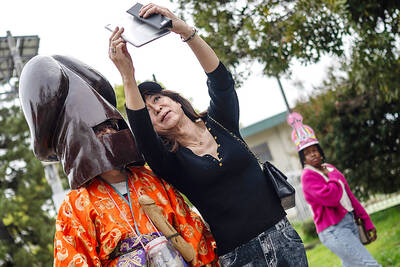
Showcasing phallus-shaped portable shrines and pink penis candies, Japan’s annual fertility festival yesterday teemed with tourists, couples and families elated by its open display of sex. The spring Kanamara Matsuri near Tokyo features colorfully dressed worshipers carrying a trio of giant phallic-shaped objects as they parade through the street with glee. The festival, as legend has it, honors a local blacksmith in the Edo Period (1603-1868) who forged an iron dildo to break the teeth of a sharp-toothed demon inhabiting a woman’s vagina that had been castrating young men on their wedding nights. A 1m black steel phallus sits in the courtyard of

JAN. 1 CLAUSE: As military service is voluntary, applications for permission to stay abroad for over three months for men up to age 45 must, in principle, be granted A little-noticed clause in sweeping changes to Germany’s military service policy has triggered an uproar after it emerged that the law requires men aged up to 45 to get permission from the armed forces before any significant stay abroad, even in peacetime. The legislation, which went into effect on Jan. 1 aims to bolster the military and demands all 18-year-old men fill out a questionnaire to gauge their suitability to serve in the armed forces, but stops short of conscription. If the “modernized” model fails to pull in enough recruits, parliament will be compelled to discuss the reintroduction of compulsory service, German
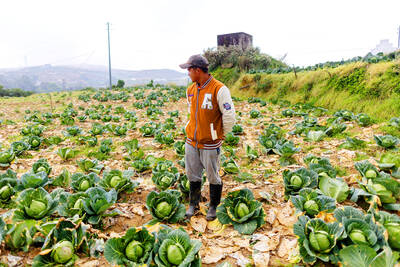
Filipino farmers like Romeo Wagayan have been left with little choice but to let their vegetables rot in the field rather than sell them at a loss, as rising oil prices linked to the Iran war drive up the cost of harvesting, labor and transport. “There’s nothing we can do,” said Wagayan, a 57-year old vegetable farmer in the northern Philippine province of Benguet. “If we harvest it, our losses only increase because of labor, transportation and packing costs. We don’t earn anything from it. That’s why we decided not to harvest at all,” he said. Soaring costs caused by the Middle East
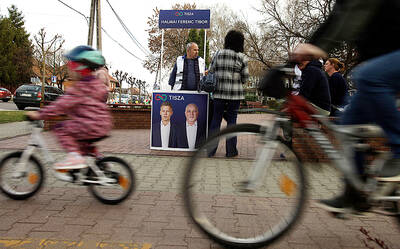
Hungarian Prime Minister Viktor Orban’s officially declared wealth is fairly modest: some savings and a jointly owned villa in Budapest. However, voters in what Transparency International deems the EU’s most corrupt country believe otherwise — and they might make Orban pay in a general election this Sunday that could spell an end to his 16-year rule. The wealth amassed by Orban’s inner circle is fueling the increasingly palpable frustration of a population grappling with sluggish growth, high inflation and worsening public services. “The government’s communication machine worked well as long as our economic situation remained relatively good,” said Zoltan Ranschburg, a political analyst


 RSS
RSS