


Astronomers on Wednesday presented new research on the possibility of a gigantic, unseen planet beyond Neptune, saying the hypothetical world might have set the solar system at a tilt.
Researchers first suggested a massive ninth planet in January, saying that although this putative world would be about 10 times the size of Earth, it could have escaped a telescope’s notice because of its extreme distance from the sun.
According to their calculations, one year on this planet would last 17,000 years on Earth, and it would travel as far away as 150 billion kilometers from the sun, where it would take light a week to arrive.
Astronomers at the California Institute of Technology presented new evidence at the annual meeting of planetary scientists of the American Astronomical Society in Pasadena.
“The search for planet nine is as much about understanding the effects of planet nine on the solar system, the physics of planet nine, as it is about understanding where it is,” Caltech astronomer Mike Brown said.
Brown said that his team had calculated how a hypothetical planet could be responsible for making the sun appear to tilt at an angle.
Though the eight planets orbit in an essentially flat plane around the sun, the plane itself rotates at nearly a six-degree angle, making it look like the sun itself is angled. A giant planet with a strange orbit, about 30 degrees off the other planets’ plane, could account for that wobble, the scientists said.
“Because planet nine is so massive and has an orbit tilted compared to the other planets, the solar system has no choice but to slowly twist out of alignment,” said Elizabeth Bailey, the study’s author.
“It’s such a deep-rooted mystery and so difficult to explain that people just don’t talk about it,” Brown said.
“If you ask yourself where the sun is tilted in real life, there’s where we predict it should be,” he added, adding that the calculations of mass and orbital angle had results of six degrees.
“The amazing thing is for these very standard [observations] it tilts it nearly exactly correctly,” Brown said. “At this stage we have so many lines of evidence that there’s a massive planet out there that if there’s not a massive planet out there, it has to be that there was one there yesterday and disappeared.”
Brown suggested that scientists might be able to locate the planet, if it exists, in the next few years, and that his team’s work would be published in an upcoming issue of the Astrophysical Journal.
Another team of researchers, led by the University of Arizona’s Renu Malhotra, also shared new research suggesting a hypothetical planet, but said that it was by no means proof of the world.
They found that the four objects with the longest-known orbits in the Kuiper Belt, a ring of rocks and dwarf planets, would be most easily explained by a mammoth new planet.
These “extreme” Kuiper Belt objects, which have highly elongated orbits around the sun, have “very simple orbital ratios [suggesting] they are in resonances with an unseen massive planet,” Malhotra said.
Brown and Malhotra both said that there are reasons to be skeptical, despite the former’s optimism for discovery.
“There are observational biases all over the Kuiper Belt,” Brown said. “We always worry about them. We don’t think they’re affecting results.”
Massachusetts Institute of Technology-trained Walt Brown told the Taipei Times in January that a ninth planet would not be found to be causing the correlation of the Kuiper Belt objects.
He said the reason their orbits were synchronized was because they were produced at the same time and were affected in the same way in their migration outward through the solar system.
Additional reporting by staff writer

A humanoid robot that won a half-marathon race for robots in Beijing on Sunday ran faster than the human world record in a show of China’s technological leaps. The winner from Honor, a Chinese smartphone maker, completed the 21km race in 50 minutes and 26 seconds, said a WeChat post by the Beijing Economic-Technological Development Area, also known as Beijing E-Town, where the race began. That was faster than the human world record holder, Ugandan Jacob Kiplimo, who finished the same distance in about 57 minutes in March at the Lisbon road race. The performance by the robot marked a significant step forward
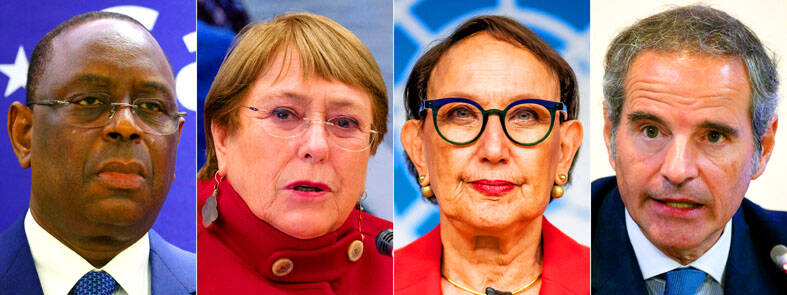
Four contenders are squaring up to succeed Antonio Guterres as secretary-general of the UN, which faces unprecedented global instability, wars and its own crushing budget crisis. Chile’s Michelle Bachelet, Argentina’s Rafael Grossi, Costa Rica’s Rebeca Grynspan and Senegal’s Macky Sall are each to face grillings by 193 member states and non-governmental organizations for three hours today and tomorrow. It is only the second time the UN has held a public question-and-answer, a format created in 2016 to boost transparency. Ultimately the five permanent members of the UN’s top body, the Security Council, hold the power, wielding vetoes over who leads the
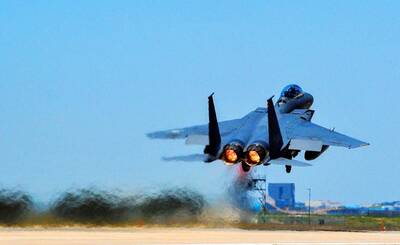
South Korea’s air force yesterday apologized for a 2021 midair collision involving two fighter jets, a day after auditors said the pilots were taking selfies and filming during the flight and held them responsible for the accident. “We sincerely apologize to the public for the concern caused by the accident that occurred in 2021,” an air force spokesman told a news conference, adding that one of the pilots involved had been suspended from flying duties, received severe disciplinary action and has since left the military. The apology followed a report released on Wednesday by the South Korean Board of Audit and Inspection,

An earthquake registering a preliminary magnitude of 7.7 off northern Japan on Monday prompted a short-lived tsunami alert and the advisory of a higher risk of a possible mega-quake for coastal areas there. The Cabinet Office and the Japan Meteorological Agency said there was a 1% chance for a mega-quake, compared to a 0.1% chance during normal times, in the next week or so following the powerful quake near the Chishima and Japan trenches. Officials said the advisory was not a quake prediction but urged residents in 182 towns along the northeastern coasts to raise their preparedness while continuing their daily lives. Prime


 RSS
RSS