


Patients arrived every 10 or 15 minutes, brought on motorcycles by relatives with vomit-covered shoulders and hoisted up the stairs into southwest Haiti’s Port-a-Piment hospital, where they could rest their weak, cholera-sapped limbs.
Less than a week since Hurricane Matthew slammed into Haiti, killing at least 1,000 people according to a tally of numbers from local officials, devastated corners of the nation are facing a public health crisis as cholera gallops through rural communities lacking clean water, food and shelter.
Reuters visited the Port-a-Piment hospital early on Sunday morning, the first day southwestern Haiti’s main coastal road had become navigable by car.
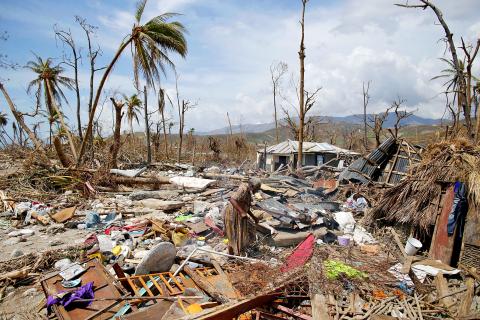
Photo: Reuters
At that time, there were 39 cases of cholera, medical director Missole Antoine said.
By the early afternoon, there were nearly 60, and four people had died of the waterborne illness.
“That number is going to rise,” said Antoine, as she rushed between patients laid out on the hospital floor.
Although there were 13 cases of cholera before Matthew hit, Antoine said the cases had risen drastically since the hurricane cut off the desperately poor region.
The hospital lacks an ambulance, or even a car, and Antoine said many new patients were coming from kilometers away, carried by family members on camp beds.
Inside the hospital, grim-faced parents cradled young children, whose eyes had sunk back and were unable to prop up their own heads.
“I believe in the doctors and also in God,” said 37-year-old Roosevelt Dume, holding the head of his son, Roodly, as he tried to remain upbeat.
Out on the streets, the scene was also shocking. For kilometers, almost all the houses were reduced to little more than rubble and twisted metal. Colorful clothes were littered among the chaos.
The region’s banana crop was destroyed, with vast fields flattened into a leafy mush. With neither government or foreign aid arriving quickly, people were relying on felled coconuts for food and water.
The stench of death, be it human or animal, was everywhere.
In the village of Labei, near Port-a-Piment, locals said the river had washed down cadavers from villages upstream. With nobody coming to move the corpses, residents used planks of driftwood to push them down the river and into the sea.
Down by the shore, the corpse of one man lay blistering in the sun. A few hundred meters to his left in a roadside gully, three dead goats stewed in the toxic slime.
“It seems to me like a nuclear bomb went off,” said Paul Edouarzin, a UN Environmental Program employee based near Port-a-Piment.
“In terms of destruction — environmental and agricultural — I can tell you 2016 is worse than 2010,” he added, referring to the devastating 2010 earthquake from which Haiti has yet to recover.
Diarrhea-stricken residents in the village of Chevalier were well aware of the nearby cholera outbreak, but had little option except to drink the brackish water from the local well that they believed was already contaminated by dead livestock.
“We have been abandoned by a government that never thinks of us,” Marie-Ange Henry said, as she surveyed her smashed home.
She said Chevalier had yet to receive any aid and many, like her, were coming down with fever. Cholera, she feared, was on its way.
Pierre Moise Mongerard, a pastor, was banking on divine assistance to rescue his roofless church in the village of Torbeck. In his Sunday best — a sports coat, chinos and brown leather shoes — he joined a small choir in songs that echoed out into the surrounding rice fields.
“We hope that God gives us the possibility to rebuild the church and help the victims here in this area,” he said, before the music seized him and he slowly joined in the chant, closing his eyes and turning his palms up toward the sky.

Crowds in Bangladesh are flocking to snap photographs with an unlikely social media star — an albino buffalo with flowing blond hair nicknamed “Donald Trump” that is due to be sacrificed within days. Owner Zia Uddin Mridha, 38, said his brother named the 700kg bull over its flowing helmet of hair resembling the signature look of the US president. “My younger brother picked this name because of the buffalo’s extraordinary hair,” he said at his farm in Narayanganj, just outside the capital, Dhaka. Mridha said that a constant stream of curious visitors — social media fans, onlookers and children — have come throughout

It began as a satirical online project. Now millions of young people in India are flocking to it as an outlet for their frustration. A parody political party called the Cockroach Janta Party, with the insect as its symbol, has exploded across India’s social media by turning absurdist humor into protest. Memes and short videos mocking corruption, joblessness and political dysfunction have flooded social media sites, where millions of users are embracing the cockroach — known for its ability to survive harsh conditions — as a tongue-in-cheek symbol of endurance. The online movement’s rise has been unusually rapid. The Cockroach Janta Party (CJP)
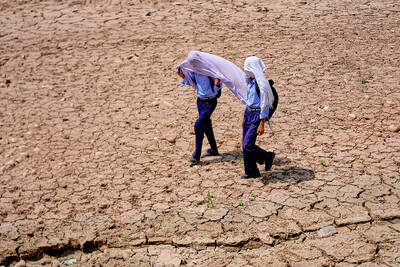
HOTTER: While Indians are accustomed to summer heat, climate change has caused northwestern India to warm faster than other parts of the country, an academic said Roads and markets have emptied during afternoons and some farmers have switched to nighttime work to avoid scorching temperatures as a heat wave grips large parts of India. The India Meteorological Department forecast maximum temperatures for yesterday of about 45°C in the capital, New Delhi, where authorities have opened temporary “cooling zones” to help people cope. The weather department warned that conditions would likely persist across several northern regions in the coming days, with temperatures staying well above seasonal averages. Authorities urged people to stay indoors during the hottest hours and take precautions against heat-related illnesses. India declares a heat wave whenever maximum temperatures

A Hong Kong astronaut is to join a Chinese space mission for the first time as part of a three-person crew launching today, as Beijing edges closer to its goal of landing people on the moon. The Tiangong space station — crewed by teams of three astronauts that are typically rotated every six months — is the crown jewel of China’s space program, boosted by billions in state investment in a bid to catch up with the US and Russia. The Shenzhou-23 mission is to blast off at 11:08pm from the Jiuquan Satellite Launch Center in northwestern China, carrying three astronauts to


 RSS
RSS