


Two Russians have been identified as suspected Islamic State group suicide bombers in the attack on Istanbul Ataturk Airport that is thought to have been masterminded by a Chechen, Turkish media said on Friday.
Forty-four people were killed in Tuesday’s bombings and shootings, which targeted one of the world’s busiest airports. Prosecutors have identified two of the three suspected attackers as Russians Rakim Bulgarov and Vadim Osmanov, the state-run Anadolu Agency said.
Turkish officials declined to comment.
One government official had previously said the attackers were Russian, Uzbek and Kyrgyz nationals.
The pro-government Yeni Safak newspaper has said the organizer of the attack, the deadliest in a series of suicide bombings in NATO member Turkey this year, was suspected to be a Chechen double-amputee named Akhmed Chatayev.
Chatayev is identified on a UN sanctions list as an Islamic State leader responsible for training Russian-speaking militants.
He was arrested in Bulgaria five years ago on a Russian extradition request, but freed because he had refugee status in Austria, a Bulgarian judge said.
A year later he was wounded and captured in Georgia, but again released.
Turkish police on Friday detained 11 foreigners in Istanbul on suspicion of belonging to an Islamic State cell linked to the attack, Anadolu reported, bringing the number of people detained in the investigation to 24.
A police spokesman could not confirm the report.
In a separate operation, 17 Islamic State militants were detained in the southeastern city of Gaziantep on Friday, the city’s governor office said in a statement.
Turkish officials have not given many details beyond confirming the attackers’ nationalities. They have previously said that forensic teams were struggling to identify the suicide bombers from their limited remains.
Yeni Safak has said one of the bombers was from Dagestan, Russia, which borders Chechnya where Moscow has led two wars against separatists and militants since the Soviet Union collapsed in 1991.
Chatayev lost his arm after being captured by Russian forces during fighting in Chechnya in 2000 and later claimed he was tortured, according to a 2010 statement from Amnesty International, which had called on Ukraine not to extradite him to Russia at the time.
In 2012, Georgian officials said Chatayev had been wounded in a special forces operation against an unidentified group in the remote Lopota Gorge near the border with Dagestan.
The group was believed to be made up of Russian insurgents fighting against Moscow’s rule in the North Caucasus.
Chatayev, whose foot was later amputated due to his injuries, was arrested on charges of weapons possession.
He denied this and said that he had been sent to the gorge as a negotiator at the request of Georgian officials.
He was released on the orders of a Georgian court later that year and cleared of all charges in January 2013.
“He was released lawfully, whether it was a mistake or not,” former Georgian minister of the interior Vakhtang Gomelauri said this year.
Separately, Turkish security forces detained four Turkish citizens on Wednesday at Turkey’s Oncupinar border crossing with Syria on suspicion of membership of a terrorist group, the local governor’s office said in a statement.
The four were attempting to return to Turkey from a conflict zone in Syria under Islamic State group control, it said.
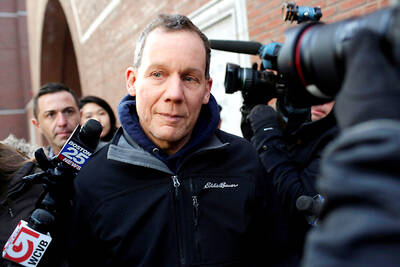
An American scientist convicted of lying to US authorities about payments from China while he was at Harvard University has rebuilt his research lab in Shenzhen, China, to pursue technology the Chinese government has identified as a national priority: embedding electronics into the human brain. Charles Lieber, 67, is among the world’s leading researchers in brain-computer interfaces. The technology has shown promise in treating conditions such as amyotrophic lateral sclerosis and restoring movement in paralyzed people. It also has potential military applications: Scientists at the Chinese People’s Liberation Army have investigated brain interfaces as a way to engineer super soldiers by boosting
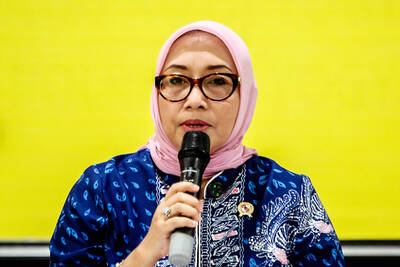
Indonesian police have arrested 13 people after shocking images of alleged abuse against small children at a daycare center went viral, sparking outrage across the nation, officials said on Monday. Police on Friday last week raided Little Aresha, a daycare center in Yogyakarta on Java island, following a report from a former employee. CCTV footage circulating on social media showed children, most younger than two, lying on the floor wearing only diapers, their hands and feet bound with rags. The police have confirmed that the footage is authentic. Police said they also found 20 children crammed into a room just 3m by 3m. “So
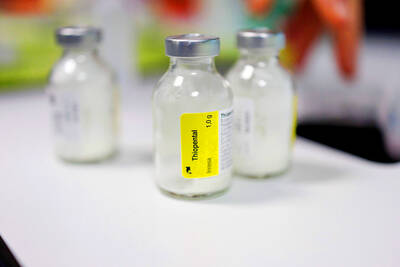
A grieving mother has ended her life at a clinic in Switzerland four years after the death of her only child. Wendy Duffy, 56, a physically healthy woman, died at the Pegasos clinic in Basel after struggling to cope with the death of her 23-year-old son, Marcus. The former care worker, from the West Midlands, England, had previously attempted to take her own life. The case comes as assisted dying would not become law in England and Wales after proposed legislation, branded “hopelessly flawed” by opponents, ran out of time. Ruedi Habegger, the founder of Pegasos, described Duffy’s death as

From post offices and parks to stations and even the summit of Mount Fuji, Japan’s vending machines are ubiquitous, but with the rapid pace of inflation cooling demand for their drinks, operators are being forced to rethink the business. Last month beverage giant DyDo Group Holdings announced it would remove about 20,000 vending machines — about 7 percent of their stock nationwide — by January next year, to “reconstruct a profitable network.” Pokka Sapporo Food & Beverage, based in Nagoya, also said last month it would sell its 40,000-machine operation to Osaka-based Lifedrink Co. “The strength of the vending machine


 RSS
RSS