


Hundreds of firefighters battled a devastating “Armageddon-like” blaze for a second day in Australia yesterday that has left two dead and at least 13 in hospital, with grave fears the death toll will rise.
Cooler conditions and lighter winds aided crews as dawn broke with the bushfire not increasing in size, although South Australia State Premier Jay Weatherill said it would be days before it was fully brought under control.
“Even though a significant proportion of the fire perimeter is under control and the conditions were milder overnight, many fire fronts are still active within the fire grounds and they’ll continue to be battled for some days,” he said.
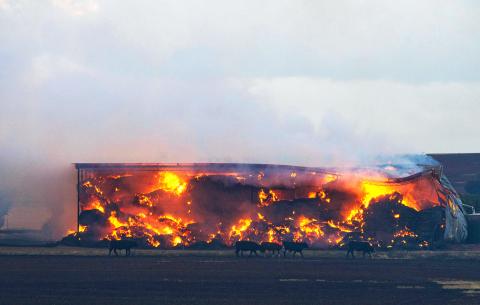
Photo: EPA
The premier late on Wednesday said two people had died in the inferno around the town of Pinery, about 70km north of Adelaide.
Unconfirmed reports said three people were missing.
“Obviously, we have had the awful news of the tragic death of at least two people and we hold grave fears for many more,” Weatherill said. “We can’t be entirely sure that we have identified every single person within the fire ground. That work will continue this morning as we carry out a more detailed search of the fire area.”
He added that 13 people were in hospital with five in either a critical or serious condition with significant burns.
South Australia Health later tweeted that it had taken 15 people to hospital for burns, smoke inhalation and minor injuries.
“We know that one of those people has burns to more than 80 percent of their body. Their condition is being closely monitored, but we do hold grave concerns for them,” Weatherill said.
The blaze incinerated at least 16 homes, as well as outbuildings, farm machinery and vehicles as it raged across a 40km front, driven by strong, swirling winds late on Wednesday, he added.
Livestock was also lost with reports that thousands of chickens and pigs were killed.
Country Fire Service chief officer Greg Nettleton said it might still be early in the fire season, but the land in South Australia was incredibly dry and only long, soaking rain would cut the fire risk.
“Until we get really substantial rainfall across the state, we’re in a dangerous fire situation for the summer,” he said.
Brendan Moten described how the sky darkened with ash as he fled his rural property and sought safety in the town of Kapunda as the fire raged around him and his family.
“A lot of people were gathered in the main street and there was smoke and ash and it was Armageddon for a while,” he told reporters. “I feel lucky. Our place was under threat for a while... It was heading our way, but it didn’t get there. It went around.”
The fire has hit rural communities in the area hard, with about 90,000 hectares of land destroyed and crops ruined.
“There’s nothing left, it’s absolutely devastation,” grain farmer Peter March told the Australian Broadcasting Corp. “This is my 59th harvest and I’ve never seen anything like it before.”

When a hiker fell from a 55m waterfall in wild New Zealand bush, rescuers were forced to evacuate the badly hurt woman without her dog, which could not be found. After strangers raised thousands of dollars for a search, border collie Molly was flown to safety by a helicopter pilot who was determined to reunite the pet and the owner. A week earlier, an emergency rescue helicopter found the woman with bruises and lacerations after a fall at a rocky spot at the waterfall on the South Island’s West Coast. She was airlifted on March 24, but they were forced to

HIGH HOPES: The power source is expected to have a future, as it is not dependent on the weather or light, and could be useful for places with large desalination facilities A Japanese water plant is harnessing the natural process of osmosis to generate renewable energy that could one day become a common power source. The possibility of generating power from osmosis — when water molecules pass from a less salty solution to a more salty one — has long been known. However, actually generating energy from that has proved more complicated, in part due the difficulty of designing the membrane through which the molecules pass. Engineers in Fukuoka, Japan, and their private partners think they might have cracked it, and have opened what is only the world’s second osmotic power plant. It generates

Hundreds of Filipinos and tourists flocked to a sun-bleached field north of Manila yesterday, on Good Friday, to witness one of the country’s most blood-soaked displays of religious fervor, undeterred by rising fuel prices. Scores of bare-chested flagellants with covered faces walked barefoot through the dusty streets of Pampanga Province’s San Fernando as they flogged their backs with bamboo whips in the scorching heat. Agence France-Presse (AFP) journalists said they saw devotees deliberately puncturing their skin with glass shards attached to a small wooden paddle to ensure their bleeding during the ritual, a way to atone for sins and seek miracles from

Chinese dissident artist Gao Zhen (高兟), famous for making provocative satirical sculptures of former Chinese leader Mao Zedong (毛澤東), was tried on Monday over accusations of “defaming national heroes and martyrs,” his wife and a rights group said. Gao, 69, who was detained in 2024 during a visit from the US, faces a maximum three-year prison sentence, said his wife, Zhao Yaliang (趙雅良), and Shane Yi, a researcher at the Chinese Human Rights Defenders group which operates outside the nation. The closed-door, one-day trial took place at Sanhe City People’s Court in Hebei Province neighboring the capital, Beijing, and ended without a


 RSS
RSS