


Vo Van Duong’s bamboo and coconut leaf house looks much like others deep in Vietnam’s Mekong Delta. However, unlike them, his abode is designed to withstand typhoons, flooding and earthquakes — and at a cost of less than US$4,000 could herald a new wave of low-cost, sustainable housing.
The natural materials on its surface belie the high-tech internal structure of the farmer’s new home, which uses steel struts and wall panels to defend against the elements in this disaster-prone region.
“The new house is safer; I am not afraid that it will collapse,” the 48-year-old papaya farmer told reporters inside the house he moved into nine months ago.
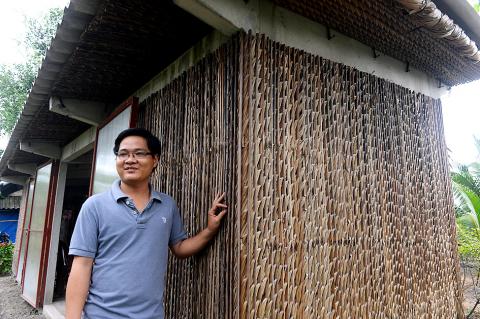
Photo: AFP
Duong is testing a prototype by an award-winning Vietnamese architecture firm that is developing low-cost housing solutions for communities vulnerable to climate change.
His “S-House 2” was free, but if rolled out on a wider scale could be sold for less than US$4,000.
“There was water coming down from the roof in my old house. Sometimes, when there was a strong wind, I was so afraid the house would not survive,” Duong said, adding that his new home was the envy of his neighbors.
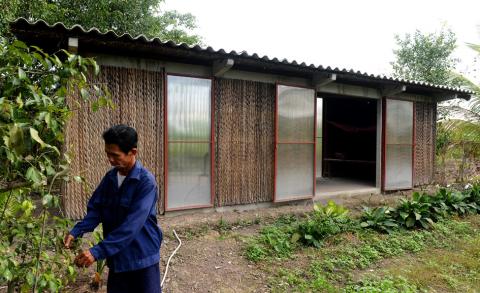
Photo: AFP
The home is the brainchild of architect Vo Trong Nghia, who joins other architects around the world in trying to fill a demand for cheap and easy to assemble housing.
He says that all architects have a duty to help impoverished people.
“I do not want people to be looking at it as ‘cheap houses,’ but as resort-quality accommodation close to nature, so [residents] can live a life of the highest quality,” he says.
The design is still being refined by his team, who aim to create a flat-pack home. The newest version, S-House 3, can be built by five people in three hours.
“Our goal for S-House is for the owner to construct it by themselves,” firm partner Kosuke Nishijima said.
The latest design also allows for multiple houses to be tacked together, a function that could allow the construction of a storm-proof school that is easily transportable to remote areas or a larger family home, for example.
Nghia has been approached by non-governmental agencies in Bangladesh and the Philippines, but is not yet ready to supply the house commercially.
Nghia’s firm found that one of the problems facing Vietnamese who live in traditional bamboo shelters or stilted riverbank houses is the costly upkeep that the homes require to withstand extreme weather.
Although the S-House 2’s outer casing of coconut leaves needs replacing every four years, the structure itself should require no expensive maintenance, engineer Lien Phuoc Huy Phuong said.
“It can last a long time; the structure is sound,” he said during a tour of the small building.
Despite its solid exterior, the house is spacious and airy inside, with large windows and doors.
“We tried to design this house with the best ventilation system, with spaces by the roof and windows for better air flow,” Phuong said.
Nghia, who used bamboo as a key element in Vietnam’s national pavilion for the 2010 World Expo in Shanghai, has long sought to incorporate natural and local materials into his work.
One of his first projects in Ho Chi Minh City was an ecologically conscious take on a traditional Vietnamese tube home, known as the Stacking Green house.
Built for about US$150,000 in 2011, the home is made of a series of concrete slabs and gaps filled with plants to provide privacy while still admitting plenty of air and light.
Nghia is in strong demand for high-end projects from hotels to private houses, but said the low-cost S-House is his personal obsession.
“I want to live in S-House. If my family will agree,” he said.

Through the noise of rushing papers and whirring belts at a print factory in Kyoto, two creators watch their photo essay come to life in broadsheet form — part of an effort to win new audiences in the age of artificial intelligence (AI). Despite the decline of the publishing industry, self-publication and handmade “zine” magazines are growing in popularity in Japan, reflecting the nation’s enduring love of paper in the digital era. While speaking to Agence France-Presse at the plant, his hands black with ink, one of the creators, Kazuma Obara, said: “I think [paper] is a medium that engages all five
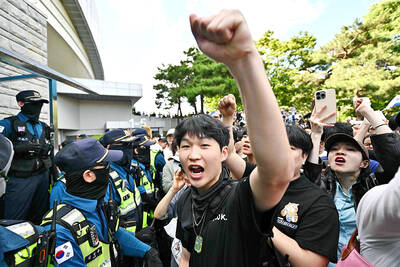
‘ABSURD MISTAKE’: The election commission said that there had been a failure to anticipate turnout after 14 polling stations ran short of ballot papers South Korean riot police yesterday cleared protesters from a Seoul polling station after a 35-hour blockade sparked by a shortage of ballot papers during local elections earlier this week. Wednesday’s election was the first nationwide vote since South Korean President Lee Jae-myung took office following the ouster of Yoon Suk-yeol over his short-lived martial law declaration. Lee’s ruling Democratic Party swept most races, but failed to flip the crucial Seoul mayoral seat. The South Korean National Election Commission apologized, blaming a failure to anticipate turnout after 14 polling stations in Seoul ran short of ballot papers. Some polling stations stayed open until 10pm to

Australian researchers have trained lab-grown brain cells on a silicon computer chip to play the 1990s shooter game Doom and said they are just scratching the surface of what the neurons could be capable of doing. It is the science-fiction work of biotech boffins at Cortical Labs, who researched and developed the technology that harnesses the workings of the brain’s networking system. Each so-called “biological computer” contains about 200,000 living human brain cells, grown from stem cells that were harvested from blood donations. Having mastered the simple computer game Pong, where a paddle is moved up and down to send a ball

France experienced its hottest spring on record, the French weather service said on Tuesday, after an exceptional early heat wave that also broke highs for the season in England and Wales. Meteo-France said the average nationwide temperature over March to May was 13.8°C — about 1.7°C above the norm, and surpassing records set in 2011 and 2020. “The warmest spring since records began in 1900,” it said in a bulletin. All three months were warmer than average, but the onset of an “unprecedented heatwave” late last month pushed the mercury to highs typically seen at the height of the summer. “Our country had never


 RSS
RSS