


EU leaders yesterday agreed on what they hailed as the world’s most ambitious climate change targets for 2030, paving the way for a new UN-backed global treaty next year.
The 28 leaders overcame deep divisions at a summit in Brussels to reach a deal including a commitment to cut greenhouse gas emissions by at least 40 percent compared with 1990 levels. They also agreed on 27 percent targets for renewable energy supply and efficiency gains, in spite of reservations from some member states about the cost of the measures.
“Deal! At least 40 percent emissions cut by 2030. World’s most ambitious, cost-effective, fair EU 2030 climate energy policy agreed,” EU President Herman Van Rompuy tweeted.

Photo: AFP
The EU wanted to agree on the targets ahead of a summit in Paris in November and December next year, where it is hoped the world would agree to a new phase of the Kyoto climate accords which run until 2020.
The agreement puts the EU “in the driving seat” ahead of the Paris conference, European Commission President Jose Manuel Barroso said. Environmental groups said that the deal did not go far enough to cut global warming.
European leaders haggled late into the night amid a split between richer, greener nations and poorer countries that depend heavily on fossil fuels or on gas from Russia.
Poland had previously threatened to veto a deal, fearing that its heavy reliance on coal would have made it prohibitively expensive to meet the targets. German Chancellor Angela Merkel and French President Francois Hollande had talks with Polish Prime Minister Eva Kovacsz on the sidelines of the summit in a bid to gain her support.
Merkel said the deal would “give Europe a voice and a negotiation position in the international climate talks.”
The accord also promotes new links among member states allowing them to export up to 15 percent of their power output when they are in surplus and import up to 15 percent when they are in deficit.
Van Rompuy said these power transmission interconnection links were a key part of developing the EU’s energy market and would provide insurance against supply disruption. He referenced both the Ukraine crisis and turmoil in the Middle East as good reasons for the EU to act now to bolster its energy security.
The climate deal builds on the EU’s targets for 2020 of a 20 percent cut in greenhouse gases blamed for global warming, a 20 percent boost in the use of renewable sources of energy such as solar and wind power and a 20 increase in energy efficiency.
While the new 40 percent target for greenhouse gases and 27 percent for the use of renewable energy sources agreed upon yesterday were as expected, a 30 percent goal for an increase in energy efficiency set in July by the commission was watered down to 27 percent.
Greenpeace said the EU had “pulled the handbrake on clean energy [generation].”
“These targets are too low, slowing down efforts to boost renewable energy [production] and keeping Europe hooked on polluting and expensive fuel,” it said.
British-based humanitarian group Oxfam called for targets of 55 percent in emissions cuts, 40 percent for energy savings and 45 percent for use of renewable energy.

SPEAKING OUT: After Siranudh Scott’s allegations surfaced, celebrities and public figures took to social media to share their own experiences of sexual misconduct and abuse A high-profile alleged sexual abuse case within a wealthy Thai beer brewing family has prompted a wave of painful accounts from survivors of unconnected abuse in the conservative nation. Siranudh Scott, a member of the billionaire Thai family that founded the ubiquitous Singha beer brand, posted an emotional video this month accusing his elder brother Sunit of repeatedly abusing him when he was a teenager. Sunit, who is in his 30s, later denied the allegations in a video posted online, but Singha parent Boonrawd dismissed him from his executive role with the company on Tuesday last week. “I felt I needed to speak

SEEKING ORDER: Rodrigo Paz said that ‘anyone who wants to destroy the nation will have to deal with this president and the full force of the constitution’ Bolivian President Rodrigo Paz on Wednesday said that the nation was at a “breaking point” after nearly a month of protests that have caused shortages of food, fuel and medicine. Paz, who took office six months ago amid the worst economic crisis there in four decades, is battling a groundswell of fury over his policies. The political capital, La Paz, has been besieged by low-income workers and members of the indigenous majority calling for his resignation. “The country needs order and is reaching breaking point,” the 58-year-old said at a public event in La Paz, renewing his appeal for dialogue. On Tuesday, the Bolivian
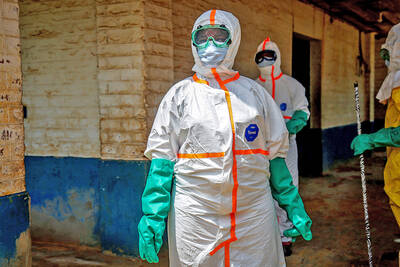
COMMUNITY CONFLICT: Concerns about disease spread from corpses has run up against friends and families’ desire to bury their dead as infection spreads in the area Angry residents of a town at the epicenter of the Ebola outbreak in the Democratic Republic of the Congo (DR Congo) attacked and burned a tent that was part of a health center where people are being treated for the virus, the staff there said Saturday. It was the second such attack in the region in a week. No one was hurt in the attack, according to reports but as patients ran out to escape the fire, 18 people with suspected Ebola infections fled the facility and are unaccounted for, a hospital director said. Angry residents arrived at the clinic in the

Forecasters in Europe yesterday warned of exceptional heat as record temperatures driven by a “heat dome” push temperatures well above seasonal norms across the continent. The surge follows a record-breaking Monday, with France logging its hottest day in the month of May on record, its weather agency said, and the UK also posting unprecedented highs. A so-called “heat dome” of warm air from northern Africa trapped under a high-pressure system over western Europe is behind the high temperatures not usually seen until high summer. Restrictions on outdoor work were imposed in parts of Italy, beaches in southwest France filled earlier than usual and


 RSS
RSS