


A Danish man joined eight Filipinos in re-enacting the death of Jesus Christ on Friday by being nailed to crosses in a bloody annual Easter spectacle in the Philippines before thousands of surprised onlookers.
The crucifixion ritual — held every year on Good Friday in Asia’s bastion of Catholicism — has been marked for decades in farming districts in the city of San Fernando, 65km north of Manila, becoming a major tourist draw despite official disapproval from church leaders.
However, local residents were surprised to see the Dane, identified by a local tourism officer as 48-year-old filmmaker Lasse Spang Olsen, participate in an act restricted to Philippine citizens after a series of embarrassing incidents involving foreigners in the past.
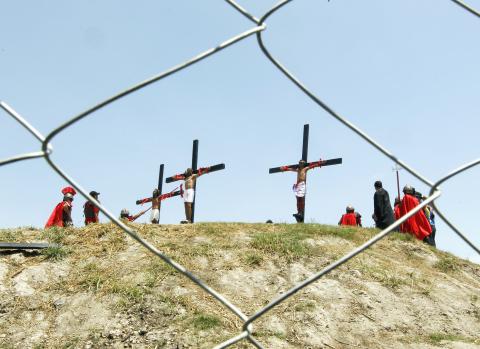
Photo: EPA
On separate occasions, a Japanese and an Australian national underwent crucifixions in the same region, with the former later revealing that footage of the ritual was used in a pornographic movie, while the Australian man was subsequently exposed as a TV comedian.
Olsen, wearing a small video camera to record the act, stoically endured having nails driven through his hands and feet, and hung on the wooden cross for 10 minutes before being taken down. He made no comments to the press afterward, but was overheard describing the event as a “great experience.”
Onlookers were surprised to see him take part, with one saying: “It’s a foreigner, a foreigner,” while another man said: “He didn’t cry out. He took it well.”
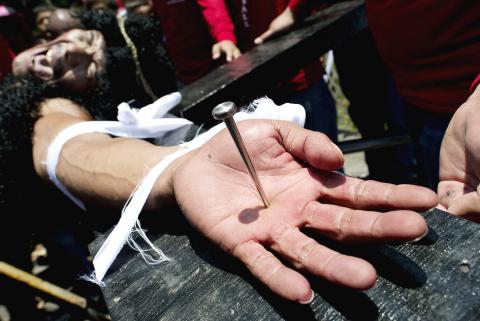
Photo: AFP
Others were skeptical of Olsen’s intentions.
“He might be like that Japanese before,” one spectator said, referring to the incident involving the Japan national in 1996.
Eight Filipinos were also nailed to wooden crosses, some of them having undergone the ordeal numerous times already as part of a religious vow.
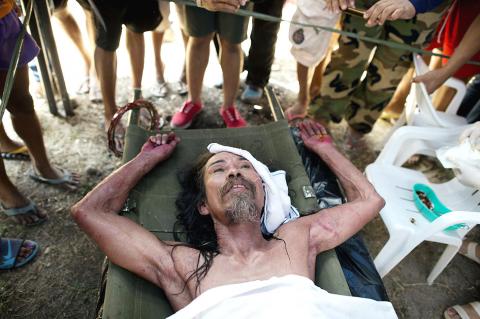
Photo: AFP
Danilo Ramos, a 43-year-old pedicab driver, participated in the ritual for the 24th time, despite having collapsed earlier while carrying a heavy wooden cross under the scorching heat to the crucifixion site.
After getting some rest and water, Ramos underwent crucifixion, crying out loudly as the nails were driven into his palms.
“I hardly feel the pain anymore. I am used to it ... I will continue this, as long as I can, for my family’s health,” Ramos said, adding that his wife and two children had all been in poor health.
The Good Friday tradition also included hundreds of hooded “penitents” flogging themselves with makeshift whips on the sidelines, sometimes accidentally splattering their blood onto onlookers.
Tourism officer Ching Pangilinan, who identified Olsen as a filmmaker, said village officials had allowed the Dane to participate after he presented a waiver of liability from the Danish embassy.
Foreigners have been banned from participating in the crucifixions after a British national backed out from the ritual at the last minute in 2006.
Asked why the ban was violated for Olsen, the district chairman in charge of the event, Zoilo Castro, declined to comment.
Police estimated that about 40,000 people attended the spectacle, about 5 percent of them foreigners, Pangilinan said.
Organizers changed the schedule this year to minimize overcrowding — instead of having all the crucifixions take place in one district at midday, they were staggered throughout the day in different parts of San Fernando.
Pangilinan said the spectacle has been a big revenue-earner for hotels and vendors hawking drinks, food and souvenirs, but denied that they were commercializing the event.
“It’s not a moneymaking scheme for the city government. Although we are not promoting it as a tourist destination, we cannot stop the influx of people to this district during Holy Week,” she said.
Many foreign onlookers were baffled by the spectacle.
Dana Johnson, an American teacher in Bangkok, said she came due to an interest in other cultures.
“I wonder why they do this. At first it was a bit shocking. I still have a lot of questions about it. It is not a part of my culture so I can’t fully understand it,” the 37-year-old said.
Father Joselito Jopson, an executive secretary of the Catholic Bishops’ Conference of the Philippines, said that the church does not endorse the practice.
“These are private expressions of faith. It depends on the faithful. We cannot prohibit them if they want to express their faith in that way,” he added.

‘CROSSING THE LINE’: China’s embassy in Seoul criticized US Forces Korea Commander General Xavier Brunson, asking if his ‘hostile’ remarks were authorized by Washington South Korea and the US are in talks over recent public remarks by the commander of US Forces Korea, Seoul’s presidential office said yesterday, after the comments drew sharp criticism from China. In a recent podcast interview, US Forces Korea Commander General Xavier Brunson described South Korea as “the dagger in the heart of Asia” from China’s east coast, prompting the Chinese embassy in Seoul to say that he had “truly crossed the line.” The interview came amid growing speculation that Washington might seek to expand the role of US Forces Korea in countering the growing regional influence of China, a key

SEEKING ORDER: Rodrigo Paz said that ‘anyone who wants to destroy the nation will have to deal with this president and the full force of the constitution’ Bolivian President Rodrigo Paz on Wednesday said that the nation was at a “breaking point” after nearly a month of protests that have caused shortages of food, fuel and medicine. Paz, who took office six months ago amid the worst economic crisis there in four decades, is battling a groundswell of fury over his policies. The political capital, La Paz, has been besieged by low-income workers and members of the indigenous majority calling for his resignation. “The country needs order and is reaching breaking point,” the 58-year-old said at a public event in La Paz, renewing his appeal for dialogue. On Tuesday, the Bolivian

Through the noise of rushing papers and whirring belts at a print factory in Kyoto, two creators watch their photo essay come to life in broadsheet form — part of an effort to win new audiences in the age of artificial intelligence (AI). Despite the decline of the publishing industry, self-publication and handmade “zine” magazines are growing in popularity in Japan, reflecting the nation’s enduring love of paper in the digital era. While speaking to Agence France-Presse at the plant, his hands black with ink, one of the creators, Kazuma Obara, said: “I think [paper] is a medium that engages all five

Australian researchers have trained lab-grown brain cells on a silicon computer chip to play the 1990s shooter game Doom and said they are just scratching the surface of what the neurons could be capable of doing. It is the science-fiction work of biotech boffins at Cortical Labs, who researched and developed the technology that harnesses the workings of the brain’s networking system. Each so-called “biological computer” contains about 200,000 living human brain cells, grown from stem cells that were harvested from blood donations. Having mastered the simple computer game Pong, where a paddle is moved up and down to send a ball


 RSS
RSS