


Somalia is suffering an “explosive” outbreak of polio and now has more cases than the rest of the world combined, an official said on Friday.
Vaccine-wielding health workers face a daunting challenge: accessing areas of Somalia controlled by militants, where 7 out of 10 children are fully immunized.
Polio is mostly considered eliminated globally except mainly in three countries where it is considered endemic: Afghanistan, Nigeria and Pakistan. India marked a major success in February last year by being removed from the WHO’s list of countries plagued by the disease.
Somalia now has 105 cases, figures released on Friday show, and another 10 cases have been confirmed across the border in a Kenyan refugee camp filled with Somalians. Globally there have been 181 cases of polio this year, including those in Somalia and Kenya.
Vaccination campaigns in Somalia have reached 4 million people since the outbreak began in May, but those health officials have limited access to about 600,000 children who live in areas of Somalia controlled by the armed Islamist group al-Shabaab.
“It’s very worrying because it’s an explosive outbreak and of course polio is a disease that is slated for eradication,” said Oliver Rosenbauer, a spokesman for the Global Polio Eradication Initiative at the WHO in Geneva.
Somalia was removed from the list of endemic polio countries in 2001, and this year’s outbreak is the second since then.
It began one month after Microsoft founder Bill Gates helped unveil a six-year plan to eradicate polio at the Global Vaccine Summit. That effort will cost US$5.5 billion, three-quarters of which has already been pledged, including US$1.8 billion from the Bill and Melinda Gates Foundation.
The outbreak in Somalia does not set back the six-year plan, Rosenbauer said, because unpredictable and intermittent outbreaks were programmed into the timeline.
In al-Shabaab-controlled south-central Somalia, disease surveillance is functioning, but health officials are likely not to able to detect all polio cases.
Mohamud Yasin, a retired doctor who has treated polio throughout his career, said: “It’s indeed worrying because this comes at a time when the country is still hugely affected by the raging fighting, which prevents volunteers from accessing people in need of vaccines. It may take time before we can confidently say we have universal coverage of the immunization.”
In a sign of how difficult it is for medical providers to operate in Somalia, the aid group Doctors Without Borders announced this week it was pulling out of the country after 22 years because of attacks on its staff members. MSF, as the group is also known, was not taking part in the polio vaccination campaign.
Somalia shares one significant trait with the three endemic countries: pockets of severe violence where populations can be hostile to health care workers.
In February, gunmen believed to belong to a radical Islamic sect known as Boko Haram shot and killed at least nine women taking part in a polio vaccination drive in northern Nigeria.

Crowds in Bangladesh are flocking to snap photographs with an unlikely social media star — an albino buffalo with flowing blond hair nicknamed “Donald Trump” that is due to be sacrificed within days. Owner Zia Uddin Mridha, 38, said his brother named the 700kg bull over its flowing helmet of hair resembling the signature look of the US president. “My younger brother picked this name because of the buffalo’s extraordinary hair,” he said at his farm in Narayanganj, just outside the capital, Dhaka. Mridha said that a constant stream of curious visitors — social media fans, onlookers and children — have come throughout

The Bolivian government on Friday struck a deal with protesting miners, but was still grappling with blockades and demonstrations by other workers across La Paz. Other groups are still blocking access roads into the city, which is also the seat of the government. Police on Thursday prevented the miners from entering the main square by using tear gas, while the demonstrators hurled stones and explosives with slingshots. Protests against the policies of Bolivian President Rodrigo Paz have convulsed the Andean nation since early this month, and roadblocks were choking routes into La Paz throughout Friday, the national road authority said. Miners demanded that Paz
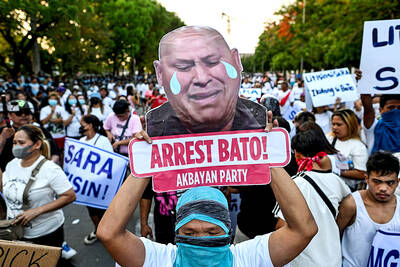
The Philippines said it has asked the country’s Supreme Court to allow it to arrest former Philippine president Rodrigo Duterte’s chief drug war enforcer to stand trial in an international tribunal. The International Criminal Court (ICC) last week unsealed an arrest warrant against Philippine Senator Ronald dela Rosa, accusing him along with Duterte and other “coperpetrators” of the “crime against humanity of murder.” Dela Rosa briefly sought refuge in the Philippine Senate last week while asking the Philippine Supreme Court to stop an ongoing attempt by government agents to arrest him. “By his own conduct, he has placed himself outside the protection of

The researchers in Ireland looked at their computer screen, marveling at a medieval book tracked down in a Roman library. They flipped through its digitized pages and found their sought-after treasure: the oldest surviving English poem. “We were extremely surprised. We were speechless. We couldn’t believe our eyes when we first saw that,” said Elisabetta Magnanti, a visiting research fellow at Trinity College Dublin’s school of English. The poem was also within the main body of Latin text, she said, calling it “extraordinary.” Composed in Old English by a Northumbrian agricultural worker in the 7th century, Caedmon’s Hymn appears within some copies of


 RSS
RSS