


Fugitive US spy agency contractor Edward Snowden’s hopes of leaving Moscow’s Sheremetyevo Airport for the first time in a month on Wednesday were dashed when he failed to secure permission from Russia to leave.
An airport source said Snowden, who is wanted by the US on espionage charges for revealing details of government intelligence programs, was handed documents by his lawyer that were expected to include a pass to leave the transit area.
However, Snowden did not go through passport control, and lawyer Anatoly Kucherena, who is helping him with his request for temporary asylum in Russia until he can reach a country that will shelter him, said the American did not have the pass he needed.
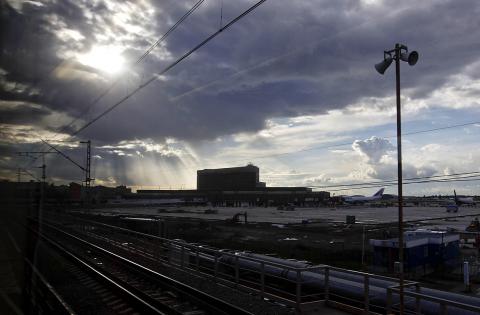
Photo: Rueters
It was not clear whether there had been last-minute political intervention or a hitch, or whether the pass had never been in his possession.
Kucherena said he hoped Snowden’s status would be resolved soon.
“I must say he is of course anxious about it and I hope that this situation will be resolved in the nearest future,” Kucherena said at Sheremetyevo. “This is the first time Russia is facing such a situation, and this issue of course requires time for the immigration workers.”
In Washington, the White House said it was seeking clarification of Snowden’s status, the US State Department made clear that allowing him to leave the airport would be “deeply disappointing” and US Secretary of State John Kerry telephoned Russian Minister of Foreign Affairs Sergei Lavrov about the situation.
“The secretary spoke with Foreign Minister Lavrov this morning,” State Department spokeswoman Jen Psaki said. “He reiterated our belief ... that Mr Snowden needs to be returned to the United States, where he will have a fair trial.”
Bolivia, Nicaragua and Venezuela have said they could offer sanctuary to Snowden, who arrived on June 23 from Hong Kong, where he had fled to escape capture and trial in the US on espionage charges.
None of the three Latin American countries can be reached by a direct commercial flight from Moscow, so Snowden has requested temporary asylum in Russia until he believes he can safely reach one of them.
The US wants him extradited to face prosecution and has revoked his passport.
Russia has refused to send him home and risks damage to its relations with the US if it grants him temporary asylum — a process that could take three months.
Kucherena confirmed Snowden was staying somewhere in the many corridors and rooms of the transit area between the runway and passport control — an area Russia considers neutral territory — and that he had learned the Russian for “Hi,” “Bye-bye” and “I’ll ring you.”
The 30-year-old had received calls from across Russia, with offers to give him money and a place to stay, and even a suggestion by one woman to adopt him. He said he had enough money to get by for now.
Kucherena said he had brought him fresh underwear and shirts and added that he had given him the novel Crime and Punishment by 19th-century writer Fyodor Dostoevsky and short stories by Anton Chekhov.

‘CROSSING THE LINE’: China’s embassy in Seoul criticized US Forces Korea Commander General Xavier Brunson, asking if his ‘hostile’ remarks were authorized by Washington South Korea and the US are in talks over recent public remarks by the commander of US Forces Korea, Seoul’s presidential office said yesterday, after the comments drew sharp criticism from China. In a recent podcast interview, US Forces Korea Commander General Xavier Brunson described South Korea as “the dagger in the heart of Asia” from China’s east coast, prompting the Chinese embassy in Seoul to say that he had “truly crossed the line.” The interview came amid growing speculation that Washington might seek to expand the role of US Forces Korea in countering the growing regional influence of China, a key

SEEKING ORDER: Rodrigo Paz said that ‘anyone who wants to destroy the nation will have to deal with this president and the full force of the constitution’ Bolivian President Rodrigo Paz on Wednesday said that the nation was at a “breaking point” after nearly a month of protests that have caused shortages of food, fuel and medicine. Paz, who took office six months ago amid the worst economic crisis there in four decades, is battling a groundswell of fury over his policies. The political capital, La Paz, has been besieged by low-income workers and members of the indigenous majority calling for his resignation. “The country needs order and is reaching breaking point,” the 58-year-old said at a public event in La Paz, renewing his appeal for dialogue. On Tuesday, the Bolivian

Through the noise of rushing papers and whirring belts at a print factory in Kyoto, two creators watch their photo essay come to life in broadsheet form — part of an effort to win new audiences in the age of artificial intelligence (AI). Despite the decline of the publishing industry, self-publication and handmade “zine” magazines are growing in popularity in Japan, reflecting the nation’s enduring love of paper in the digital era. While speaking to Agence France-Presse at the plant, his hands black with ink, one of the creators, Kazuma Obara, said: “I think [paper] is a medium that engages all five

Australian researchers have trained lab-grown brain cells on a silicon computer chip to play the 1990s shooter game Doom and said they are just scratching the surface of what the neurons could be capable of doing. It is the science-fiction work of biotech boffins at Cortical Labs, who researched and developed the technology that harnesses the workings of the brain’s networking system. Each so-called “biological computer” contains about 200,000 living human brain cells, grown from stem cells that were harvested from blood donations. Having mastered the simple computer game Pong, where a paddle is moved up and down to send a ball


 RSS
RSS