


About 30m from the end of the 42km Boston Marathon, explosions shook the street and sent runners frantically racing for cover. The marathon finish line, normally a festive zone of celebration and exhaustion, was suddenly like a war zone.
“These runners just finished and they don’t have legs now,” said Roupen Bastajian, 35, a Rhode Island state trooper and former US Marine. “So many of them. There are so many people without legs. It’s all blood. There’s blood everywhere. You got bones, fragments. It’s disgusting.”
Had Bastajian run a few strides slower, as he did in 2011, he might have been among the dozens of victims wounded in Monday’s bomb blasts. Instead, he was among the runners treating other runners, a makeshift emergency medical service of exhausted athletes.
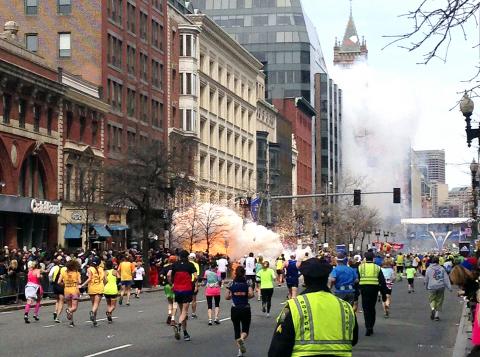
Photo: Reuters
“We put tourniquets on,” Bastajian said. “I tied at least five, six legs with tourniquets.”
The Boston Marathon, which takes place on Patriots’ Day, a state holiday, is usually an opportunity for the city to cheer with a collective roar.
However, the explosions turned an uplifting day into a nightmarish swirl of bloodied streets and torn-apart limbs as runners were toppled, children on the sidelines were maimed, and a panicked city watched its signature athletic spectacle destroyed.
The timing of the explosions — about 2:50pm — was especially devastating because they happened when a high concentration of runners in the main field were arriving at the finish line on Boylston Street. In last year’s Boston Marathon, for example, more than 9,100 crossed the finish line — 42 percent of all finishers — in the 30 minutes before and after the time of the explosions.
This year, more than 23,000 people started the race in near-perfect conditions. Only about 17,580 finished.
Three people were killed in the blast and more than 100 were injured, officials said.
Deirdre Hatfield, 27, was steps away from the finish line when she heard a blast. She saw bodies flying out into the street. She saw a couple of children who appeared lifeless. She saw people without legs.
“When the bodies landed around me I thought: ‘Am I burning? Maybe I’m burning and I don’t feel it. If I blow up, I just hope I won’t feel it,’” she said.
She looked inside the Starbucks to her left, which seemed to be where the blast occurred.
“What was so eerie, you looked in you knew there had to be 100 people in there, but there was no sign of movement,” she said.
Hatfield wondered where another explosion might occur. She turned down a side street and ran to the hotel where she had agreed to meet her boyfriend and family after the race.
Amid the chaos, the authorities directed runners and onlookers to the area designated for family members awaiting loved ones at the end of the race. It was traditionally a place of panting pride, sweaty hugs and exhausted relief.
However, on Monday, it became a place of dread, as news of the attack spread through the crowd and people awaited word.
One woman screamed over the din toward the streets roped off for runners: “Lisa! Lisa!”
Some people saw the explosions as clouds of white smoke. To others, they looked orange — a fireball that nearly reached the top of a nearby traffic light.
Groups of runners, including a row of women in pink and neon tank tops and a man in a red windbreaker — kept going a few paces at least, as if unsure of what they were seeing.
Some runners stopped in the middle of the street, confused and frightened. Others turned around and started running back the way they came.
“It is kind of ironic that you just finished running a marathon and you want to keep running away,” said Sarah Joyce, 21, who had just finished her first marathon when she heard the blast.
Bruce Mendelsohn, 44, was at a party in a third-floor office above where the bombs went off. His brother, Aaron, had finished the race earlier.
“There was a very loud boom, and three to five second later, there was another one,” said Bruce Mendelsohn, a US Army veteran who now works in public relations.
He ran outside.
“There was blood smeared in the streets and on the sidewalk,” he said.
Mendelsohn could not be sure how many people had been killed or wounded, but among the bodies he said he saw women, children and runners.
The wounds, he said, appeared to be “lower torso.”
As Melissa Fryback, 42, was heading into the home stretch, she realized she was on pace for one of her best times ever. She steeled herself for the last 5km and finished in 3 hours, 44 minutes. She met up with her boyfriend, and the two had made it about two blocks from the finish line when they heard the blasts.
“I can’t help but wonder that if I hadn’t pushed like that, it could have been me,” she said.

Crowds in Bangladesh are flocking to snap photographs with an unlikely social media star — an albino buffalo with flowing blond hair nicknamed “Donald Trump” that is due to be sacrificed within days. Owner Zia Uddin Mridha, 38, said his brother named the 700kg bull over its flowing helmet of hair resembling the signature look of the US president. “My younger brother picked this name because of the buffalo’s extraordinary hair,” he said at his farm in Narayanganj, just outside the capital, Dhaka. Mridha said that a constant stream of curious visitors — social media fans, onlookers and children — have come throughout
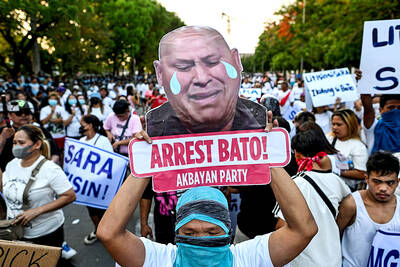
The Philippines said it has asked the country’s Supreme Court to allow it to arrest former Philippine president Rodrigo Duterte’s chief drug war enforcer to stand trial in an international tribunal. The International Criminal Court (ICC) last week unsealed an arrest warrant against Philippine Senator Ronald dela Rosa, accusing him along with Duterte and other “coperpetrators” of the “crime against humanity of murder.” Dela Rosa briefly sought refuge in the Philippine Senate last week while asking the Philippine Supreme Court to stop an ongoing attempt by government agents to arrest him. “By his own conduct, he has placed himself outside the protection of
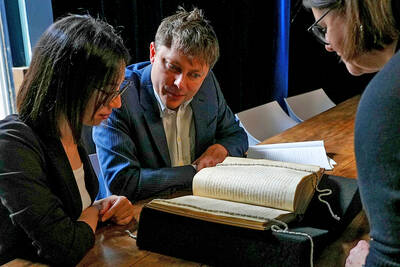
The researchers in Ireland looked at their computer screen, marveling at a medieval book tracked down in a Roman library. They flipped through its digitized pages and found their sought-after treasure: the oldest surviving English poem. “We were extremely surprised. We were speechless. We couldn’t believe our eyes when we first saw that,” said Elisabetta Magnanti, a visiting research fellow at Trinity College Dublin’s school of English. The poem was also within the main body of Latin text, she said, calling it “extraordinary.” Composed in Old English by a Northumbrian agricultural worker in the 7th century, Caedmon’s Hymn appears within some copies of
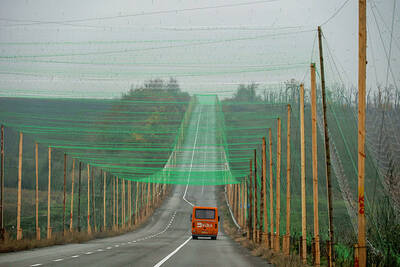
BIGGER ROLE: Beijing has said it maintains an impartial stance on the war in Ukraine, but by training Russian troops, China is far more involved than previously known China’s armed forces secretly trained about 200 Russian military personnel in China late last year, and some have since returned to fight in Ukraine, according to three European intelligence agencies and documents seen by Reuters. While China and Russia have held a number of joint military exercises since Moscow’s full-scale invasion of Ukraine in 2022, Beijing has repeatedly said that it is neutral in the conflict and presents itself as a peace mediator. The covert training sessions, which predominantly focused on the use of drones, were outlined in a dual-language Russian-Chinese agreement signed by senior Russian and Chinese officers in Beijing on


 RSS
RSS