


Central African Republic strongman Michel Djotodia was facing international isolation yesterday after dissolving the country’s institutions and announcing he would rule by decree after the weekend coup.
The former diplomat turned rebel leader, whose Seleka coalition took over the capital, Bangui, in a rapid-fire weekend assault, announced late on Monday that he would rule by decree until elections are organized in three years.
Earlier on Monday, the African Union suspended the coup-prone landlocked nation from its membership and the EU condemned the coup as “unacceptable.”
The 15-member UN Security Council emerged from an emergency meeting on the crisis called by former colonial power France to condemn the coup.
However, while it threatened “further measures,” it made no explicit threat of sanctions.
UN Secretary-General Ban Ki-moon had already condemned Seleka’s power grab and called for “the swift restoration of constitutional order.”
Djotodia announced the suspension of the constitution, as well as the dissolution of parliament and the government late on Monday in Bangui.
“During that transition period which will lead us to free, credible and transparent elections, I will legislate by decree,” he told reporters.
Earlier on Monday, in an interview with Radio France Internationale, Djotodia made it clear he would not rule out running in polls he promised for 2016.
The power change in Bangui came after a lightning offensive that shattered a Jan. 11 power-sharing deal between the old regime and Seleka.
Ousted Central African Republic president Francois Bozize, who himself seized power in a 2003 coup, fled the country over the weekend and on Monday he was in Cameroon. However, the authorities there said he would moving on “to another host country.”
Djotodia, who is about 60, is a former civil servant and diplomat, but since 2005 he has been one of the leading figures among the rebels.
In his address on Monday night, he promised to restore order, announcing a night-time curfew between 7pm and 6am.
The Seleka rebels were initially welcomed by residents waving palm leaves in celebration, but the mood quickly darkened as looters took to the streets.
During the day, shops were closed on Monday while rebel fighters fired their Kalashnikovs in the air as they patrolled the streets.
Djotodia vowed to press on with the disarmament, demobilization and reintegration of former rebels that has been the core grievance of his Seleka movement.
With Bangui still without electricity or radio on Monday, it was difficult to assess casualties from the weekend’s fighting. However, 13 South African soldiers were killed in the fighting, the nation’s heaviest post-apartheid military loss.
South African President Jacob Zuma said they had died in a nine-hour “high-tempo battle” against “bandits,” but said there were no immediate plans to withdraw troops who were deployed alongside the weak national army.
France, which sent 300 troops over the weekend to reinforce 250 soldiers stationed there, said its forces had shot dead two Indian nationals who were approaching the airport in speeding vehicles on Monday.
The shooting happened “in a particularly confusing situation” after French troops had been fired upon “from an unknown source,” the French defense ministry said.
A statement from Indian Prime Minister Manmohan Singh expressed “deep distress” over the deaths. French President Francois Hollande had written to him expressing his regret and promising an investigation, it added.
Bangui is heavily reliant on foreign aid and in an apparent attempt to reassure donors, Djotodia had earlier vowed there would be no witch-hunt and that he would respect the terms of a January peace agreement.
That deal came after a month-long Seleka offensive that was only stopped thanks to Chadian military intervention.
As well as suspending Bangui, the African Union announced “sanctions, travel restrictions and an asset freeze on Seleka’s leaders” naming seven individuals including Djotodia.
Bozize never delivered on his promises to harness the oil, gold and uranium wealth that has remained largely untapped since independence from France in 1960.
The Central African Republic, despite its mineral riches, remains woefully underdeveloped thanks in large part to chronic political instability.

An American scientist convicted of lying to US authorities about payments from China while he was at Harvard University has rebuilt his research lab in Shenzhen, China, to pursue technology the Chinese government has identified as a national priority: embedding electronics into the human brain. Charles Lieber, 67, is among the world’s leading researchers in brain-computer interfaces. The technology has shown promise in treating conditions such as amyotrophic lateral sclerosis and restoring movement in paralyzed people. It also has potential military applications: Scientists at the Chinese People’s Liberation Army have investigated brain interfaces as a way to engineer super soldiers by boosting
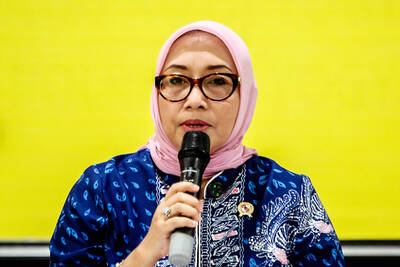
Indonesian police have arrested 13 people after shocking images of alleged abuse against small children at a daycare center went viral, sparking outrage across the nation, officials said on Monday. Police on Friday last week raided Little Aresha, a daycare center in Yogyakarta on Java island, following a report from a former employee. CCTV footage circulating on social media showed children, most younger than two, lying on the floor wearing only diapers, their hands and feet bound with rags. The police have confirmed that the footage is authentic. Police said they also found 20 children crammed into a room just 3m by 3m. “So
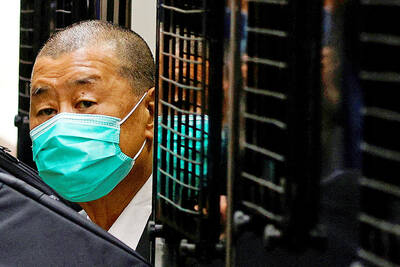
Jailed media entrepreneur Jimmy Lai (黎智英) has been awarded Deutsche Welle’s (DW) freedom of speech award for his contribution to Hong Kong’s pro-democracy movement. The German public broadcaster on Thursday said Lai would be presented in absentia with the 12th iteration of the award on June 23 at the DW Global Media Forum in Bonn. Deutsche Welle director-general Barbara Massing praised the 78-year-old founder of the now-shuttered news outlet Apple Daily for standing “unwaveringly for press freedom in Hong Kong at great personal risk.” “With Apple Daily, he gave journalists a platform for free reporting and a voice to the democracy movement in
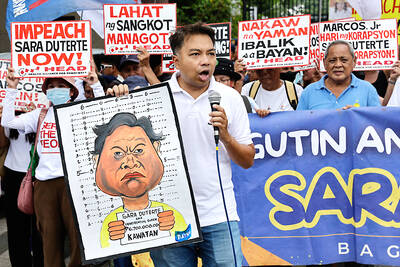
PHILIPPINE COMMITTEE: The head of the committee that made the decision said: ‘If there is nothing to hide, there is no reason to hide, there is no reason to obstruct’ A Philippine congressional committee on Wednesday ruled that there was “probable cause” to impeach Philippine Vice President Sara Duterte after hearing allegations of unexplained wealth, misuse of state funds and threats to have the president assassinated. The unanimous decision of the 53-member committee in the Philippine House of Representatives sends the two impeachment complaints to deliberations and voting by the entire lower chamber, which has more than 300 lawmakers. The complaints centered on Duterte’s alleged illegal use and mishandling of intelligence funds from the vice president’s office, and from her time as education secretary under Philippine President Ferdinand Marcos Jr. Duterte and the


 RSS
RSS