


Hundreds of opposition protesters marched in Caracas on Sunday, chanting “We want the truth,” as they demanded that the Venezuelan government reveal more about the health of cancer-stricken Venezuelan President Hugo Chavez.
Waving Venezuelan national flags, the protesters rallied to a street where about 50 university students have staged a week-long sit-in to demand more transparency about Chavez’s condition.
“We want to know what is going with Chavez’s health, if he is alive or dead, and we want elections,” said Dario Alberici, a 55-year-old public accountant.
Pro-government supporters held their own rally for Chavez in another part of the capital, chanting “Uh, ah. Chavez won’t go.”
Venezuelan Vice President Nicolas Maduro on Friday revealed that the leftist leader is undergoing chemotherapy in a Caracas military hospital, but said that Chavez remains in charge.
In power for 14 years, the once omnipresent president has not emerged in public since undergoing cancer surgery in Cuba on Dec. 11 last year.
Chavez was first diagnosed with cancer in the pelvic region in June 2011, but the government has never disclosed its exact nature, severity or location.
“Nobody knows where he is,” 70-year-old engineer Hector Gonzalez said. “If he is recovering, they should show him. The country cannot continue in this uncertainty.”
Others said Venezuela was now under a de facto government as Chavez, who was re-elected in October last year, missed his Jan. 10 swearing-in ceremony. The Venezuelan Supreme Court backed the inauguration’s delay.
“We are in limbo, in a very uncertain, very illegitimate and very unconstitutional situation,” said Juan Pablo Baquero, 33, a lawyer and university professor.
When he left for Cuba on Dec. 8, Chavez told Venezuelans to vote for Maduro if he became incapacitated and an election was called.
Across town, a few hundred pro-government students gathered in front of a stage featuring a huge photograph of Chavez with one of his daughters and the phrase: “Now with Chavez more than ever.”
“We are showing our love for the president,” said Anaida Nunez, 30, who works in a government food program and wore a green T-shirt bearing the words: “We are millions of Chavez.”
“We are rejecting this small group of young people who are sadly demanding that the president come out, when he’s a human being receiving chemotherapy,” she said. “We don’t need to see pictures. We know he’s alive.”
The government has only released one set of photos of Chavez, showing him bedridden and smiling with his two daughters in a Havana hospital on Feb. 15, three days before he returned to Caracas.
“He should recuperate and when he feels strong he can come out in public,” said 20-year-old Wilfredo Vazquez, a law student at the Central University of Venezuela.
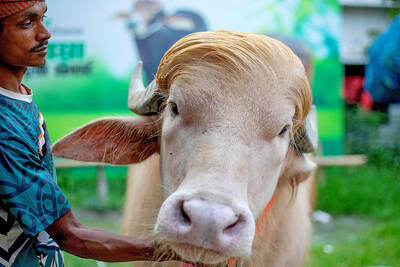
Crowds in Bangladesh are flocking to snap photographs with an unlikely social media star — an albino buffalo with flowing blond hair nicknamed “Donald Trump” that is due to be sacrificed within days. Owner Zia Uddin Mridha, 38, said his brother named the 700kg bull over its flowing helmet of hair resembling the signature look of the US president. “My younger brother picked this name because of the buffalo’s extraordinary hair,” he said at his farm in Narayanganj, just outside the capital, Dhaka. Mridha said that a constant stream of curious visitors — social media fans, onlookers and children — have come throughout

It began as a satirical online project. Now millions of young people in India are flocking to it as an outlet for their frustration. A parody political party called the Cockroach Janta Party, with the insect as its symbol, has exploded across India’s social media by turning absurdist humor into protest. Memes and short videos mocking corruption, joblessness and political dysfunction have flooded social media sites, where millions of users are embracing the cockroach — known for its ability to survive harsh conditions — as a tongue-in-cheek symbol of endurance. The online movement’s rise has been unusually rapid. The Cockroach Janta Party (CJP)
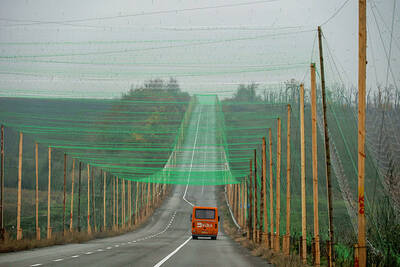
BIGGER ROLE: Beijing has said it maintains an impartial stance on the war in Ukraine, but by training Russian troops, China is far more involved than previously known China’s armed forces secretly trained about 200 Russian military personnel in China late last year, and some have since returned to fight in Ukraine, according to three European intelligence agencies and documents seen by Reuters. While China and Russia have held a number of joint military exercises since Moscow’s full-scale invasion of Ukraine in 2022, Beijing has repeatedly said that it is neutral in the conflict and presents itself as a peace mediator. The covert training sessions, which predominantly focused on the use of drones, were outlined in a dual-language Russian-Chinese agreement signed by senior Russian and Chinese officers in Beijing on
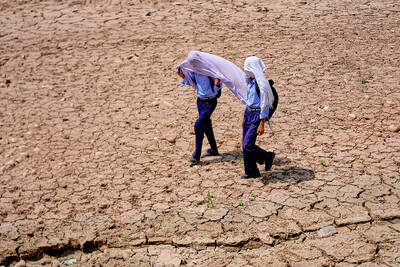
HOTTER: While Indians are accustomed to summer heat, climate change has caused northwestern India to warm faster than other parts of the country, an academic said Roads and markets have emptied during afternoons and some farmers have switched to nighttime work to avoid scorching temperatures as a heat wave grips large parts of India. The India Meteorological Department forecast maximum temperatures for yesterday of about 45°C in the capital, New Delhi, where authorities have opened temporary “cooling zones” to help people cope. The weather department warned that conditions would likely persist across several northern regions in the coming days, with temperatures staying well above seasonal averages. Authorities urged people to stay indoors during the hottest hours and take precautions against heat-related illnesses. India declares a heat wave whenever maximum temperatures


 RSS
RSS