


Russia and China said on Friday they saw eye-to-eye on all the world’s problems including the Syria conflict, as the Chinese foreign minister held talks in Moscow to prepare for a visit by Chinese Vice President Xi Jinping (習近平) later this year.
Chinese Foreign Minister Yang Jiechi (楊潔篪) confirmed after talks with his Russian counterpart, Sergei Lavrov, that Chinese Communist Party Secretary-General and Vice President Xi would visit Russia after he is confirmed as head of state next month to succeed President Hu Jintao (胡錦濤).
Yang did not directly confirm Chinese reports that Russia would be Xi’s first foreign destination after taking the office of president at a session of the National People’s Congress (NPC) next month, in what would be a hugely symbolic trip.
However, he made clear that Xi would be attending the Brazil, Russia, India, China and South Africa (BRICS) summit of the world’s top-five developing economies in Durban, South Africa, from March 26 to March 27 alongside Russian President Vladimir Putin.
Russia and China have stood shoulder-to-shoulder throughout the two-year conflict in Syria, with Beijing joining its fellow permanent UN Security Council member Moscow in vetoing resolutions that would have introduced sanctions against Syrian President Bashar al-Assad’s regime.
“Russia and China have united positions, and promote these united positions in negotiations, on the situation in the Middle East and North Africa, including the Syrian crisis, Afghanistan, the Iranian nuclear program and other crises,” Lavrov said at a news conference alongside Yang.
“On all these cases, we and our Chinese friends are led by one and the same principle — the necessity to observe international law, respect UN procedures and not allow interference from outside in domestic conflicts and all the more the use of force,” Lavrov added.
Lavrov said that Russia and China had a similarly united position condemning North Korea’s third nuclear test earlier this month as “unacceptable.”
However, he said that Moscow and Beijing also agreed that it was important that the test was not used as a pretext to start a new arms race in the region or allow external intervention.
Fully developing ties with its booming neighbor has become a major priority for Putin’s Kremlin at a time of difficult relations with the West and as state gas firm Gazprom and other Russian firms seek new markets for exports.
Despite their tight diplomatic alliance, Russia and China have still failed to finalize a potentially huge gas deal which could eventually see almost 70 billion cubic meters of Russian gas pumped to China annually for the next 30 years.
Gazprom and China National Petroleum Co signed a framework agreement in 2009, but differences remain over the pricing and no final agreement has yet been signed.
However, Yang, who held a closed-door meeting with Putin the day earlier, said that the two countries’ bilateral relations were of huge importance for the world as a whole.
“We believe together that Russia-China relations do not just have major importance for our countries, but have an influence on ensuring peace and development on the planet as a whole,” Yang said.

Crowds in Bangladesh are flocking to snap photographs with an unlikely social media star — an albino buffalo with flowing blond hair nicknamed “Donald Trump” that is due to be sacrificed within days. Owner Zia Uddin Mridha, 38, said his brother named the 700kg bull over its flowing helmet of hair resembling the signature look of the US president. “My younger brother picked this name because of the buffalo’s extraordinary hair,” he said at his farm in Narayanganj, just outside the capital, Dhaka. Mridha said that a constant stream of curious visitors — social media fans, onlookers and children — have come throughout

It began as a satirical online project. Now millions of young people in India are flocking to it as an outlet for their frustration. A parody political party called the Cockroach Janta Party, with the insect as its symbol, has exploded across India’s social media by turning absurdist humor into protest. Memes and short videos mocking corruption, joblessness and political dysfunction have flooded social media sites, where millions of users are embracing the cockroach — known for its ability to survive harsh conditions — as a tongue-in-cheek symbol of endurance. The online movement’s rise has been unusually rapid. The Cockroach Janta Party (CJP)

BIGGER ROLE: Beijing has said it maintains an impartial stance on the war in Ukraine, but by training Russian troops, China is far more involved than previously known China’s armed forces secretly trained about 200 Russian military personnel in China late last year, and some have since returned to fight in Ukraine, according to three European intelligence agencies and documents seen by Reuters. While China and Russia have held a number of joint military exercises since Moscow’s full-scale invasion of Ukraine in 2022, Beijing has repeatedly said that it is neutral in the conflict and presents itself as a peace mediator. The covert training sessions, which predominantly focused on the use of drones, were outlined in a dual-language Russian-Chinese agreement signed by senior Russian and Chinese officers in Beijing on
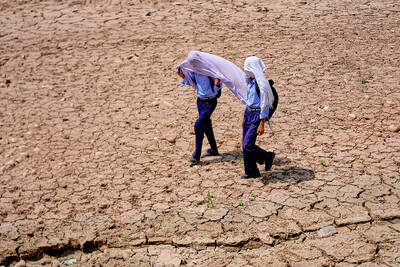
HOTTER: While Indians are accustomed to summer heat, climate change has caused northwestern India to warm faster than other parts of the country, an academic said Roads and markets have emptied during afternoons and some farmers have switched to nighttime work to avoid scorching temperatures as a heat wave grips large parts of India. The India Meteorological Department forecast maximum temperatures for yesterday of about 45°C in the capital, New Delhi, where authorities have opened temporary “cooling zones” to help people cope. The weather department warned that conditions would likely persist across several northern regions in the coming days, with temperatures staying well above seasonal averages. Authorities urged people to stay indoors during the hottest hours and take precautions against heat-related illnesses. India declares a heat wave whenever maximum temperatures


 RSS
RSS