


Egypt’s new president backed down on Saturday from his decision to remove the country’s top prosecutor, keeping him in his post and sidestepping a potential clash with the country’s powerful judiciary.
The two-day standoff between Egyptian President Mohamed Morsi and Prosecutor General Abdel-Meguid Mahmoud escalated with a backlash from a powerful group of judges who said Morsi’s move had infringed upon their authority.
The standoff, which both sides later described as a “misunderstanding,” exposed the enduring strength of an establishment packed with holdovers from the days of former Egyptian president Hosni Mubarak, and underlined Morsi’s limitations in challenging long-standing institutions.

Photo: Reuters
Some of those who had urged the dismissal of Mahmoud, in the post since Mubarak times, said Morsi’s move was clumsily handled and appeared as political score-settling between Islamists and former regime officials, rather than the sweeping reform so many are calling for in Egypt.
Though Morsi’s decision had considerable public support, it appeared similar to his move to restore the Islamist-dominated parliament to session despite a decree by the Supreme Constitutional Court, which dissolved it over election law violations. He backed down after an uproar over ignoring court rulings.
Morsi had ordered Mahmoud to step down on Thursday in an apparent bid to appease public anger over the acquittals of former regime officials a day earlier accused of orchestrating violence against protesters last year.
Egyptian law protects the prosecutor general from being fired by the president. To overcome the constraints, Morsi asked Mahmoud to become ambassador to the Vatican.
However, Mahmoud refused to be reappointed and quickly defied Morsi’s decision.
Backed by a powerful club of judges who said that the move was an infringement on the judiciary, he went to his office on Saturday in defiance, accompanied by a tight security escort and hundreds of supporters.
Hours later, Mahmoud and members of the country’s Supreme Judicial Council met with Morsi’s advisers.
“I remain in my post. We resolved the problem amicably,” Mahmoud said after the meeting. “We told him I wanted to stay and that there was a misunderstanding. He didn’t object.”
Egyptian Vice President Mahmoud Mekki said initially the president wanted to protect the prosecutor general from public pressure and protests, and then canceled the transfer to avoid “sedition.”
“Some politicians are trying to push the judiciary into the political battlefield,” Mekki said. “We were surprised by those voices raised to defend the independence of the judiciary. Now those accused of infringing on the judiciary’s independence are the ones who had long defended it.”
He said the decision was initially made to avoid popular anger following the Wednesday acquittal of Mubarak loyalists over their alleged role in a turning point of last year’s uprising, known as the “Battle of the Camel,” when camels ridden by Mubarak supporters charged into an opposition crowd.
After the meeting with Morsi, hundreds of judges came out to congratulate Mahmoud at his office.
The head of the powerful Judges Club, Ahmed el-Zind, who had rallied behind Mahmoud, said a “face saving” statement is to be issued from both sides.
“What we care about is that we assert that the judiciary is a red line which we will not allow anyone to cross,” he told attorneys and judges.
The move to remove the prosecutor general presented Morsi with a dilemma: If he moved too aggressively against Mahmoud, it would have fed into criticisms that he is exceeding the powers of his office. If he had moved too slowly, it would have fueled accusations that he is failing to address the goals of last year’s uprising that overthrew Mubarak.

Kouri Richins, a Utah mother who published a children’s book about grief after the death of her husband is to serve a life sentence for his murder without the possibility of parole, a judge ruled on Wednesday. Richins was convicted in March of aggravated murder for lacing a cocktail given to her husband, Eric Richins, with five times the lethal dose of fentanyl at their home near Park City in 2022. A jury also found her guilty of four other felonies, including insurance fraud, forgery and attempted murder for trying to poison her husband weeks earlier on Feb. 14, 2022, with a

‘PERSONAL MISTAKES’: Eileen Wang has agreed to plead guilty to the felony, which comes with a maximum sentence of 10 years in federal prison A southern California mayor has agreed to plead guilty to acting as an illegal agent for the Chinese government and has resigned from her city position, officials said on Monday. Eileen Wang (王愛琳), mayor of Arcadia, was charged last month with one count of acting in the US as an illegal agent of a foreign government. She was accused of doing the bidding of Chinese officials, such as sharing articles favorable to Beijing, without prior notification to the US government as required by law. The 58-year-old was elected in November 2022 to a five-person city council, from which the mayor is selected

DELA ROSA CASE: The whereabouts of the senator, who is wanted by the ICC, was unclear, while President Marcos faces a political test over the senate situation Philippine authorities yesterday were seeking confirmation of reports that a top politician wanted by the International Criminal Court (ICC) had fled, a day after gunfire rang out at the Philippine Senate where he had taken refuge fearing his arrest. Senator Ronald “Bato” dela Rosa, the former national police chief and top enforcer of former Philippine president Rodrigo Duterte’s “war on drugs,” has been under Senate protection and is wanted for crimes against humanity, the same charges Duterte is accused of. “Several sources confirmed that the senator, Senator Bato, is no longer in the Senate premises, but we are still getting confirmation,” Presidential
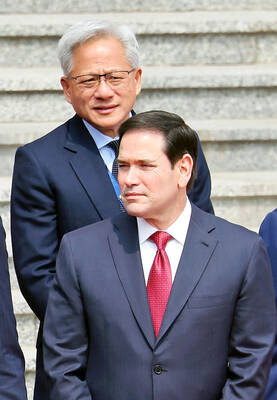
HELP DENIED? The US Department of State said that the Cuban leadership refuses to allow the US to provide aid to Cubans, ‘who are in desperate need of assistance’ US Secretary of State Marco Rubio on Wednesday said that Cuba’s leadership must change, as Washington renewed an offer of US$100 million in aid if the communist nation agrees to cooperate. Cuba has been suffering severe economic tumult led by an energy shortage that plunged 65 percent of the country into darkness on Tuesday. Cuba’s leaders have blamed US sanctions, but Rubio, a Cuban American and critic of the government established by Fidel Castro, said the system was to blame, including corruption by the military. “It’s a broken, nonfunctional economy, and it’s impossible to change it. I wish it were different,” he told


 RSS
RSS