


The cleanup after Hong Kong’s worst typhoon in 13 years is taking longer than usual as volunteers struggle to collect hundreds of millions of plastic pellets that washed onto beaches after the containers they were in fell off a ship.
Environmental groups are concerned the pellets will absorb toxins and pollutants and then be eaten by fish that may in turn be eaten by humans. They’re also worried rare marine species could be threatened by the pollutants as they make their way up the food chain.
Several hundred volunteers at one beach on Sunday used trowels, paintbrushes, dustpans and sieves to painstakingly pick up the translucent pellets, which coated the shore.
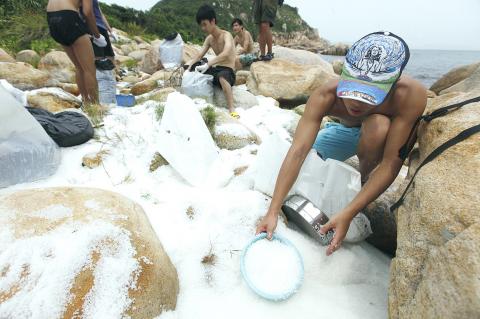
Photo: Reuters
“It’s a bit overwhelming. It seems like we can’t get rid of them even though there are hundreds of people here,” said Mathis Antony, one of the volunteers helping to clean up a beach on Lamma Island, off the western coast of Hong Kong Island. “It looks like it’s going to take a lot more to clean it up.”
The volunteers took on the daunting task of sweeping up the tiny pellets scattered across the grassy, boulder-strewn shoreline. They filled dozens of garbage bags, but there was still a lot left by the end of the day, piled up like snow between rocks.
Also known as nurdles, the pellets are the raw materials used by factories to make plastic products. Authorities say six containers filled with the pellets were lost from a ship in waters south of Hong Kong when it was caught in Typhoon Vicente last month.
The storm prompted authorities to raise the typhoon warning system to its highest level, indicating hurricane-force winds of 118km an hour or more, for the first time since 1999. The government said large amounts of pellets have been found at 10 beaches. At some beaches, numerous sacks filled with pellets and bearing the markings of the manufacturer, China Petroleum and Chemical Corp, have also washed ashore.
About half of the 150 tonnes of pellets that the containers were carrying have been collected so far, the government said, including 50 tonnes from sacks carrying the pellets found at sea and another 21 tonnes washed ashore.

It began as a satirical online project. Now millions of young people in India are flocking to it as an outlet for their frustration. A parody political party called the Cockroach Janta Party, with the insect as its symbol, has exploded across India’s social media by turning absurdist humor into protest. Memes and short videos mocking corruption, joblessness and political dysfunction have flooded social media sites, where millions of users are embracing the cockroach — known for its ability to survive harsh conditions — as a tongue-in-cheek symbol of endurance. The online movement’s rise has been unusually rapid. The Cockroach Janta Party (CJP)

SPEAKING OUT: After Siranudh Scott’s allegations surfaced, celebrities and public figures took to social media to share their own experiences of sexual misconduct and abuse A high-profile alleged sexual abuse case within a wealthy Thai beer brewing family has prompted a wave of painful accounts from survivors of unconnected abuse in the conservative nation. Siranudh Scott, a member of the billionaire Thai family that founded the ubiquitous Singha beer brand, posted an emotional video this month accusing his elder brother Sunit of repeatedly abusing him when he was a teenager. Sunit, who is in his 30s, later denied the allegations in a video posted online, but Singha parent Boonrawd dismissed him from his executive role with the company on Tuesday last week. “I felt I needed to speak

A Hong Kong astronaut is to join a Chinese space mission for the first time as part of a three-person crew launching today, as Beijing edges closer to its goal of landing people on the moon. The Tiangong space station — crewed by teams of three astronauts that are typically rotated every six months — is the crown jewel of China’s space program, boosted by billions in state investment in a bid to catch up with the US and Russia. The Shenzhou-23 mission is to blast off at 11:08pm from the Jiuquan Satellite Launch Center in northwestern China, carrying three astronauts to
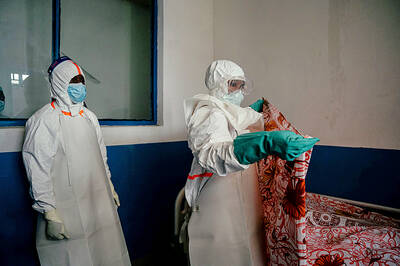
UPGRADED ALERT: The risk inside DR Congo is now considered ‘very high,’ while neighboring countries face a ‘high’ threat as the outbreak continues, the WHO said Ebola is spreading faster than responders can track it in eastern Congo, where health workers managed to follow up with barely one in five identified contacts in a single day. Authorities in the Democratic Republic of the Congo (DR Congo) reported 83 confirmed infections, 746 suspected cases and 1,603 identified contacts as of Thursday, but health workers were able to follow up on only 342 contacts that day — about 21 percent of the total under monitoring — data released by the DR Congo Ministry of Public Health on Friday showed. The figures suggest the response is falling behind the outbreak itself,


 RSS
RSS