


Deadly malaria that is resistant to drug treatment has spread rapidly from Cambodia to the border between Thailand and Myanmar, raising concerns of an uncontrollable epidemic, scientists said on Thursday.
A pair of studies published in the Lancet and the journal Science showed how the disease is moving fast into new territory and identified a region of the parasite’s genome that may be responsible for mutating in order to survive.
Malaria is a mosquito-borne disease commonly caused by a parasite, Plasmodium falciparum, that kills up to 1.2 million people a year, according to 2010 estimates by the Institute of Health Metrics and Evaluation at the University of Washington, Seattle.
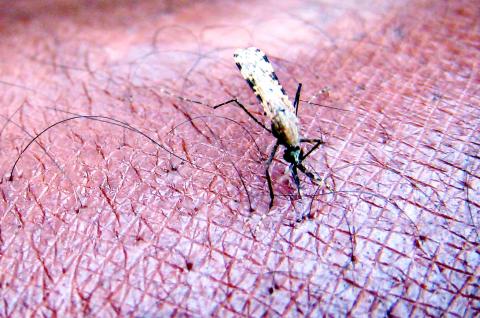
Photo: EPA
Malaria that was resistant to treatment with the current standard therapy, artemisinin, was confirmed in Cambodia in 2006 and has since spread 800km westward to the Thailand-Myanmar border, the researchers said.
By studying 3,202 patients along the northwestern border of Thailand near Myanmar from 2001 and 2010 and measuring the time it took them to clear malaria infections from their blood after treatment, scientists were able to show a steady increase in drug resistance.
The number of slow-clearing infections rose from 0.6 percent of cases treated in 2001 to 20 percent in 2010.
In western Cambodia, 42 percent of malaria cases were resistant between 2007 and 2010, indicating that the Thailand-Myanmar region was swiftly catching up to Cambodia’s rates.
“Genetically determined artemisinin resistance in P. falciparum emerged along the Thailand-Myanmar border at least eight years ago and has since increased substantially,” the Lancet study said.
“At this rate of increase, resistance will reach rates reported in western Cambodia in two to six years,” it said.
The research in the journal Science focused on what was making these parasites different, and found that a region on chromosome 13 of the parasite was strongly associated with slow clearance of infection.
They sequenced the genomes of 91 P. falciparum parasites from Cambodia and western Thailand and compared them with parasites from Laos, where resistance to the latest artemisinin-based drugs has not yet emerged.
They found seven genes that may be responsible for making the parasite resistant to drugs and which may explain up to 35 percent of the growing resistance in Southeast Asia.
“We have now seen the emergence of malaria resistant to our best drugs, and these resistant parasites are not confined to western Cambodia,” said the study’s leader, Francois Nosten, director of the Shoklo Malaria Research Unit that studies and treats malaria in the Thai-Myanmar region.
“This is very worrying indeed and suggests that we are in a race against time to control malaria in these regions before drug resistance worsens and develops and spreads further,” Nosten said.
The death toll from malaria has been declining in Africa — the part of the world worst hit by the disease — in recent years, largely due to the increased use of artemisinin drugs and the widening distribution of insecticide-treated bed nets.
However, if resistance spreads to artemisinin therapies — used alone or taken in combination with other anti-malarials — some experts are concerned that a resurgence of drug-resistant malaria could return to Africa. Researchers say a new anti-malaria drug is not expected to appear on the world market before the next decade is up.
The two studies were funded by the Wellcome Trust and the US National Institutes of Health, and included scientists from Mahidol University, Bangkok; the Centre for Tropical Medicine at Britain’s Oxford University; and the Texas Biomedical Research Institute in the US.

A US YouTuber who caused outrage for filming himself kissing a statue commemorating Korean wartime sex slaves has been sentenced to six months in prison, a court in Seoul said yesterday. Johnny Somali, 25, gained notoriety several years ago for recording himself doing a series of provocative stunts in South Korea and Japan, and streaming them on platforms such as YouTube and Twitch. South Korean authorities indicted Somali — whose real name is Ramsey Khalid Ismael — in 2024 on public order violations and obstruction of business, and banned him from leaving the country. “The court has sentenced him to six months in

Former Lima mayor Rafael Lopez Aliaga, a Peruvian presidential hopeful, gathered hundreds of supporters in Lima on Tuesday and gave authorities 24 hours to annul the first round of the country’s election over allegations of fraud. Lopez Aliaga is locked in a tight three-way race with two other candidates for second place in Sunday’s vote. The election runner-up wins a ticket to June’s presidential run-off against front-runner Keiko Fujimori. “I am giving them 24 hours to declare this electoral fraud null and void,” said Lopez Aliaga, surrounded by a crowd of several hundred supporters. “If it is not declared null and void tomorrow,

PAPAL RETORT: Pope Leo told reporters that he has ‘no fear, neither of the Trump administration nor speaking out loudly about the message of the Gospel’ US President Donald Trump has feuded with Pope Leo XIV over the Iran conflict — setting off an unholy row that could have serious political implications for the Republican leader back in the US. Trump has drawn barbs even from some allies over the attacks on the US-born pontiff, who has criticized the Trump administration over its immigration crackdown, the intervention in Venezuela and the Iran war. The president risks alienating the religious right in November’s crucial US midterm elections. So far the unprecedented clash between the leader of the most powerful military on Earth and the head of the world’s 1.4 billion

A 16-year-old boy has been charged with murder and aggravated sexual abuse in Florida in the death of his 18-year-old stepsister on a Carnival Cruise ship, the US Department of Justice said on Monday. Timothy Hudson was initially charged in February and subsequently indicted on March 10, but the breadth of the case was not known until a seal was lifted on Friday last week, weeks after US District Judge Beth Bloom in Miami said that he would be prosecuted as an adult at the request of the government. Anna Kepner had been traveling on the Carnival Horizon ship in November last


 RSS
RSS