


US authorities are building a steel and concrete barrier 90m out into the Pacific Ocean south of San Diego to curb dangerous attempts by illegal immigrants and smugglers to slip through the breakers to California.
The new maritime fence is being built at a cost of US$4.3 million at the point where the US-Mexico border plunges into the ocean between San Diego and the industrial powerhouse of Tijuana in northwest Mexico.
The new “surf fence” is a steel-and-concrete barrier up to 5.5m tall that replaces a rusted and uneven line of posts.
“It was falling apart, it was out of alignment, it looked like a bad set of teeth,” US Customs and Border Protection spokesman Ralph DeSio said.
“This is going to be much more aesthetically appealing to that area, but it also strengthens our abilities to prevent those dangerous smuggling attempts along that shoreline,” he said.
Federal authorities have in recent years added fencing and Border Patrol agents along the southwest US border with Mexico in a bid to stop illegal immigrant crossings and drug smuggling.
The US Congress also mandated building a further 1,040km of fencing along the 3,200km border.
Recent attempts to slip north through the surf and inshore waters to Imperial Beach, south of San Diego, have included two smugglers nabbed with marijuana piled onto a surfboard in 2009, and a pair of wetsuit-clad illegal immigrants arrested in February last year with self-propelled underwater dive scooters.
The upgrade comes at a time when smugglers are increasingly pushing further out to sea in open-topped panga fishing boats to run illegal immigrants and tonnes of marijuana up the coast as far as Los Angeles and Santa Barbara.
There have been 14 incidents there since October last year.
In a bid to make it more resilient to the pounding Pacific waves, the new barrier, due for completion next month, is coated with protectants inside and out and filled with concrete.
The effort under way to ratchet up security at the beach, which includes a stretch of fencing that runs more than 270m inland, is raising some eyebrows in Tijuana.
Policeman Cesar Ochoa is struck by the transformation to Parque Amistad, or Friendship Park, just back from the beach, where families separated by the border would chat informally through the bars of the fence beside a historic monument.
A double fence now walls off the area and prevents visitors from getting within a few meters of each other.
“The only thing that remains from that time are the cement tables where people used to meet. There were Border Patrol agents watching over them ... but they let people interact,” Ochoa said.
Local government employee Adriana Medina, 33, remembers families picnicking and playing ball and even partying in the park when she was growing up and is surprised by the upgrade that pushed “steel posts right into the sea.”
“It looks like a jail,” she said. “I think it’s an overreaction.”

When a hiker fell from a 55m waterfall in wild New Zealand bush, rescuers were forced to evacuate the badly hurt woman without her dog, which could not be found. After strangers raised thousands of dollars for a search, border collie Molly was flown to safety by a helicopter pilot who was determined to reunite the pet and the owner. A week earlier, an emergency rescue helicopter found the woman with bruises and lacerations after a fall at a rocky spot at the waterfall on the South Island’s West Coast. She was airlifted on March 24, but they were forced to
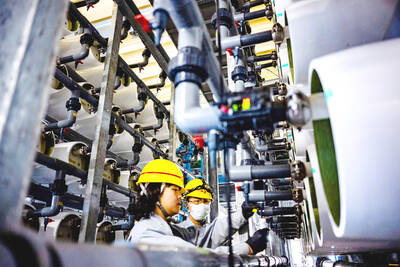
HIGH HOPES: The power source is expected to have a future, as it is not dependent on the weather or light, and could be useful for places with large desalination facilities A Japanese water plant is harnessing the natural process of osmosis to generate renewable energy that could one day become a common power source. The possibility of generating power from osmosis — when water molecules pass from a less salty solution to a more salty one — has long been known. However, actually generating energy from that has proved more complicated, in part due the difficulty of designing the membrane through which the molecules pass. Engineers in Fukuoka, Japan, and their private partners think they might have cracked it, and have opened what is only the world’s second osmotic power plant. It generates

Hundreds of Filipinos and tourists flocked to a sun-bleached field north of Manila yesterday, on Good Friday, to witness one of the country’s most blood-soaked displays of religious fervor, undeterred by rising fuel prices. Scores of bare-chested flagellants with covered faces walked barefoot through the dusty streets of Pampanga Province’s San Fernando as they flogged their backs with bamboo whips in the scorching heat. Agence France-Presse (AFP) journalists said they saw devotees deliberately puncturing their skin with glass shards attached to a small wooden paddle to ensure their bleeding during the ritual, a way to atone for sins and seek miracles from

Chinese dissident artist Gao Zhen (高兟), famous for making provocative satirical sculptures of former Chinese leader Mao Zedong (毛澤東), was tried on Monday over accusations of “defaming national heroes and martyrs,” his wife and a rights group said. Gao, 69, who was detained in 2024 during a visit from the US, faces a maximum three-year prison sentence, said his wife, Zhao Yaliang (趙雅良), and Shane Yi, a researcher at the Chinese Human Rights Defenders group which operates outside the nation. The closed-door, one-day trial took place at Sanhe City People’s Court in Hebei Province neighboring the capital, Beijing, and ended without a


 RSS
RSS